Friday, May 13, 2011

SILVER LEAVES


Illustrated is another chawan by Iga potter Banura Shiro. I have written about him in prior posts, so I will skip the biographical details. This tantalizing kuro-wan, black bowl, has Banura’s trademark black textural glaze over a redish clay body. After the chawan was glaze fired, it was rubbed with a gold (gilt) wash over the black which is barely noticeable accept in the right light. He then painted silver(ginji) leaves over the surface which accentuates the broad base and tapering form. As I look at this chawan, it reminds me of looking at the far off Fujiyama through sparse foliage. The concept and evocative form harken back to the ceramic pieces of the Rimpa masters and shows homage to Ogata Kenzan (1663-1743), the founder of this style.

Wednesday, May 11, 2011

THE TRADITION CONUNDRUM

“It is meaningless just to inherit tradition of [Japanese Pottery], unless you add to your own ideas….. but if you overdo yourself, you might ruin the traditions. The point is to make the best use of the old methods and ideas.”
Arakawa Toyozo

“Tradition does not mean the living are dead, but the dead are living.”
Gilbert K. Chesterton

Monday, May 9, 2011

TETSU-YU TEOKE


I must admit, I have always been fascinated, even in awe of the handled henko forms of Kawai Kanjiro (1890-1966). Their monolithic presence, despite their size, is undeniable and from my first encounter with them, I was in love. The handled press molded henko I am referring to were produced during the early 1960s and consist mainly of three styles; sancai (tri-color), gosu blue over thick hakeme and his rich temmoku with splashes of vivid green and orange-red overglaze. These forms are exceedingly evocative and though absolutely Kawai’s own creation, they harken back to the traditional teoke (water bucket) forms of Edo period Japan. The earlier teoke archetype is seen in clay, lacquer, wood and even occasionally metal. These forms ran the gamut from artist produced works to the everyday craftsman’s mingei.

Once I made my way to Cleveland, it was not uncommon to see Dick and Patty Schneider both making handled basket forms in varying sizes and styles. I was initially intrigued and like learning to assemble the pieces parts of teapots, I tried out the fundamentals of the handled basket form as well. Illustrated is a medium size teoke basket form from my last firing. It is glazed in my temmoku and tetsu-yu and though a bit difficult to see, the form is ever so slightly lobed and the glaze has run straight down the soft indented line. The runny nature of the glaze accentuates the vertical nature of the form and keeps the relatively undecorated form and handle from being dull. When I unloaded the kiln, I was pleasantly surprised by how the glaze “fermented” around the flat surface of the lip; it created an interesting pattern that I couldn’t have planned any better.


Friday, May 6, 2011

PIECES PARTS


It is an amazing process looking at pots. The eye takes in the whole image and the brain immediately reduces the image to its all of the pieces parts. From the foot to the lip or lid, the brain goes to work looking for errors, inconsistencies and faults. The brain races to the memory bank and compares the whole and its parts to stored away images of explary pieces and compares and contrasts the one to the other. What is truly amazing about this process is that given enough experience, this takes just seconds to process all this information.

I used to wonder if the same rules that would apply to a Greek urn, would also apply to the rough and assymetrical ware (chaki) of Japanese tea ceremony (chanoyu). I realized that once you establish a visual vocabulary of those pots, the same type of processing the form and surface takes place. It would seem to be all about image recovery within your memory where your brain applies principles of the “golden mean”, geometry and established archetypes on each and every pot. The dialogue between pot and viewer is sacrosanct and as the poet John Keats extolled in his poem, ODE TO A GRECIAN URN (1819);


“Beauty is truth, truth beauty, that is all Ye know on earth, and all ye need know.”

“Aesthetically a pot may be analyzed for its abstract content or as a humanistic expression; subjectively or objectively; for its relationship of pure form; or its manner or handwriting and suggestion of source of emotional content.” This quote from THE POTTER’S CHALLENGE by Bernard Leach is the premise for why people bond with pottery or objects in general. It is the dialogue sparked by the potter who has done his/her best to capture their “humanistic expression” which carries on a dialogue with the viewer. The “emotional content” of the pot is the trigger that connects potter/pot to the viewer and begins the journey and study of the object, its components and its source.


The illustration is from THE POTTER’S CHALLENGE by Bernard Leach.

Wednesday, May 4, 2011

SOME POTS...................


I have recently started converting some older 35mm slides to digital images and talk about a stroll down memory lane. I have made a lot of pots, I am not bragging just stating a fact. In fact, looking through all the slides I am jolted back to various places I have worked, themes I was working through and styles and varying ideas, many of which have continued to this day. There is majolica, slipware, abstract resist, still life, Persian influenced pots and many others. I am somewhat surprised at the number of directions that have worked out and even more that hit a brick wall, think “twister-ware”. I started the “twister-ware” while my wife was out of town and when she got back it was, “what were you thinking?”. Needless to say, the “twister-ware” has remained a bench mark for a bad idea.


Illustrated is a set of altered pitcher and mugs glazed in a rich Persian blue glaze over black and white slip. This set was made for a show about ritual and was entitled; Gathering. Having made all these pots, sometimes my mind wanders to wondering where they are now? Have they found a purpose, are they being used? It is funny that some pots or sets of pots, stand out in your mind and every once and a while you wonder if they still have something to say to the owners……

Monday, May 2, 2011

DOWN SIZING


I have a friend who has been collecting mostly Japanese art since the 70s. Recently, he moved from a fairly large and spaceous home to a much smaller one. This reduction in wall space and storage space has led him to seriously down size his collection and that includes lots of pots. Over the years, he had collected mostly modern Japanese pottery, with a concentration on Hagi and he has had me sell a number of the pieces on my Trocadero website. In fact, most of the Hagi-yaki sold on my site have been from his collection.


He recently decided to part with several more Hagi chawan by a diverse group of potters; Yamanae Seigan, Mashita Tadashi, Tanomura Shogetsu II and Kaneta Sanzaemon VII. I have put these pieces up on my website and invite you to take a look at your leisure;
http://www.trocadero.com/albedo3studio/catalog.html


As collectors, we never really own things. Rather we are caretakers and conservators of these objects, insuring they are passed along in the condition we acquire them, or in restored condition. All objects move about in time and this down sizing collector is setting these in motion to find a new resting spot with new collectors who will care for them, appreciate them and have their own dialogue with them.

Friday, April 29, 2011

NEBULOUS


Like most people through the mid-west and east coast, it has been dreary, rainy and very windy here with lots of localized flooding as well. This makes it a bit difficult to have a positive outlook and upbeat mood. When I am feeling that way, I turn to my drug of choice, pottery. Looking at the right pots can’t easily change my mood and perspective.


Illustrated is an ethereal Shino chawan by Toki Juyo Mukei Bunkazai, Sakai Kobu (1937- ). His Shino works are different than most and very easy to pick out of a crowd. This softly altered bowl has wonderful shades of iron, nezumi blue and hints of white somewhat reminiscent of an old science fiction paperback cover; a nebula springs to mind and certainly transports me to a different place. Where would we be with out such ceramic gems?


“The Cosmos is also within us. We are made of star stuff. We are a way for the Cosmos to know itself.”
Carl Sagan (1934-1996)


(From a private collection)

Wednesday, April 27, 2011

GIRI

Illustrated is a richly ash glazed covered jar by William Henry Klock. This stamped east meets west jar was made shortly after Bill worked in South Korea and visited and studied the Onggi potters. As I have mentioned before, Bill was a Leach student and this pot surely shows the cross cultural combination of English, American and Asian influences.


On a trip to upstate NY to work with Bill back in the mid-90’s, I bought a group of his pots to bring back to Cleveland as gifts for two very kind patrons who helped me start my studio up. Though I would have loved to keep this jar, I gave each a choice of what pot they would like and one picked this jar and the other pot to go was a wonderful teapot in the same style. Oh well, there is no doubt that I miss this pot, but at the same time, the patronage I received in Cleveland was instrumental to my becoming a full time potter. There was no way I could not give the best pots for such support. The pot lives on somewhere out in the real world and in my senses that recall this wonderful pot.

Monday, April 25, 2011

THE RESULTS ARE IN


I fired off the glaze kiln last Thursday and finally got it cool enough to unload by late Friday. Overall the firing was pretty good, though it was pretty hot at the top of the kiln and some pieces ran a little, at least not off the pot, except one larger covered jar. As my wife remarks, I need more glaze diversity in the kiln as this one was mostly temmoku and partridge feather iron with a few medieval green and haiyu pieces mixed in. I get in the groove of working with a new glaze combo and tend to forsake other possibilities.


The larger pieces and all of the serving bowls came out rather well, excepting the one runner. There was another very seriously close call on a larger covered jar as the glaze ran all the way to the foot and just crested the angle where the foot touches the shelf, but there it stayed.


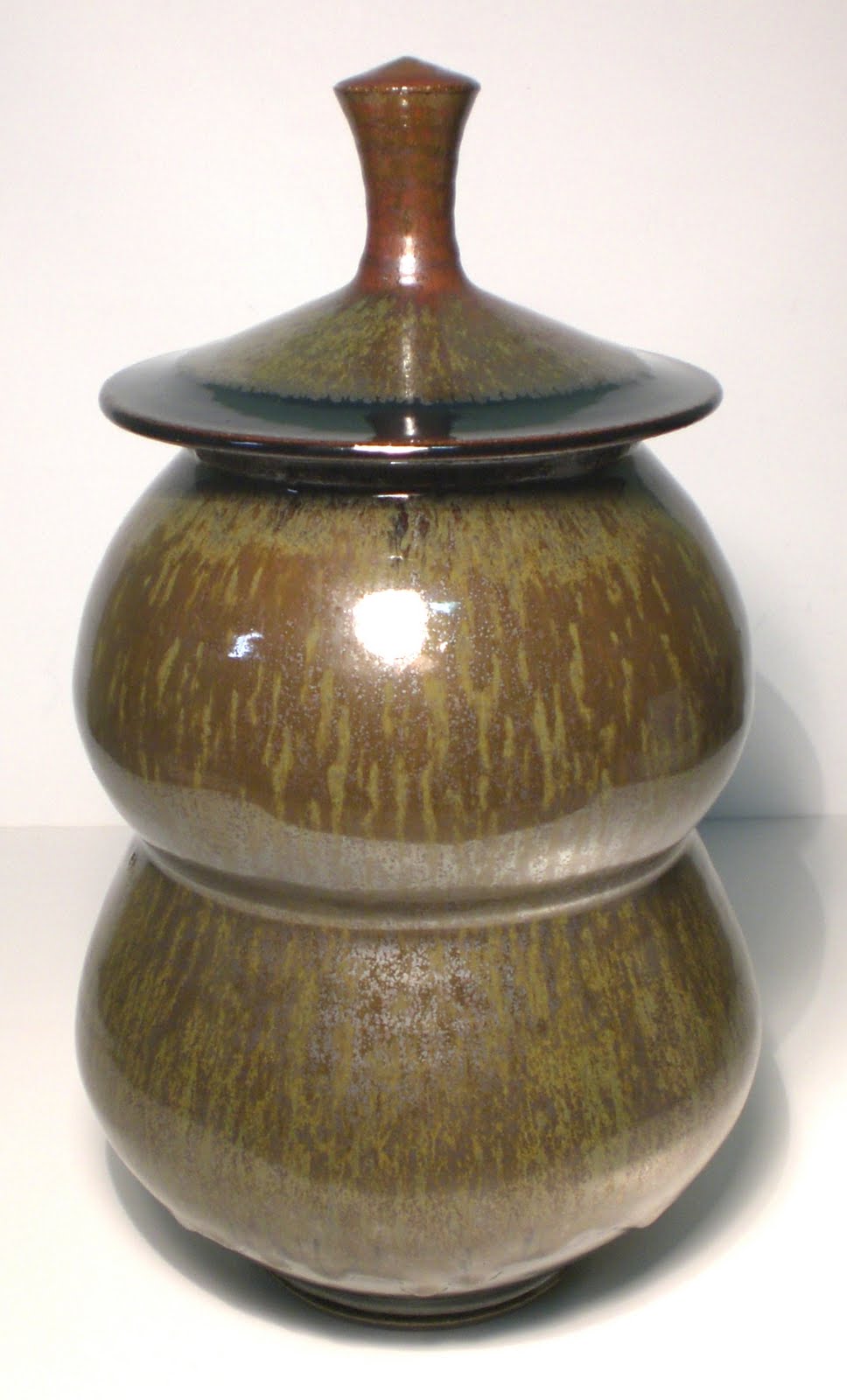
Illustrated is wespeglas covered jar about 14” with long cascading trails of the partridge feather glaze over my temmoku. The close-up illustration is a group of three “lip-bowls” in the same glaze combination with pulled lips and stamped decoration around the bowls.


Friday, April 22, 2011

IPTV; TAKAUCHI SHUGO VIDEO SHORT

Here is a short video preview of a longer special on Mashiko veteran potter; Takauchi Shugo (b. 1937). This short and the full length special were done by the NHK television network in Japan and was part of a series on prominent potters. Much of Takauchi’s work is Oribe in nature, though he does a myriad of “Mino” styles including Shino and haiyu glazed wares.


Illustrated is a close-up of a very fine Oribe pot by Takauchi Shugo. His use of Oribe and iron as well as sqraffito is part of what makes him a modern Mashiko master.
(Illustration used with the permission of a private collector.)