I
can think of very few potters that are able to create a simple, functional
vessel, in this case a tokkuri and make it such a pleasure to use as does Kakurezaki
Ryuichi. Visually engaging, this Bizen tokkuri checks off the list of all the
bells in whistles from wonderful form, great surface, exceptional texture,
masterfully functional and just a real treat to put through its paces though it
can do so much more than pour. Created by throwing a basic form, the pot is
brought to life by paddling, pushing, cutting and even cajoling the clay to do the bidding that the manipulator wishes, what
appears is a tokkuri distinct, idiosyncratic to this potter, unlike no other
and set apart even from its relations. Kakurezaki is of course a master at
moving clay, creating and fine tuning evocative form and choosing both great
clay and wood for his firings; this piece has benefited from all of his skills
from imagination to firing and though a simple tokkuri, it is evidently so much
more.
You can see more of this little gem over on my Trocadero marketplace;
https://www.trocadero.com/stores/albedo3studio/catalog/
I
decided to try my hand at making a few faceted & banded tokkuri and this is
what I came up with. It is only about seven inches or so tall and should make a proper size by
the time it is finished fired and my thought process is through some degree of
measured persistence I may get a better feel for this process at any scale or form. I am
most likely to glaze this in Oribe to allow all the lines and sharp angles show
through the surface and collect on whatever points it can. I made the central
ring of the bottle a bit depressed to aid in the handling and use of the vessel
and it will remain to see how that decision pans out. I think all the lines and
angles should like quite nice under the Oribe and will try to remember to post
a finished photo when the pot is finished.
"No rock so hard but
that a little wave may beat admission in a thousand years." Alfred, Lord
Tennyson

In
studying the classics, in this case Ki-Seto, one of the essential 20th century
potters of that idiom that needs to be singled out is of course Kagami Shukai
(1941-2009) whose pots were deeply rooted in the styles archetypes with a sense
of his modern touch. The illustrated Ki-Seto mizusashi has that classic
sensibility appearing like a molded pot of the Edo period yet was thrown and
altered to this unique shape. The lozenge form of this pot goes back to various
traditions and styles of the Edo period which ties this piece firmly between
antiquity and modern times cloaked in Kagami's well known Ki-Seto glaze with
detailed areas highlighted where marks were made in the soft clay. The whole
package is made complete with a wonderful cryptomeria cypress lid with attached
wood handle, the overall feel with this lid roots it even more firmly in days
gone by. I think it is impossible to think about modern Ki-Seto without
bringing Kagami Shukai in to the conversation where he is associated with the likes
of Arakawa Toyozo, Kato Kozo, Hori Ichiro, Hara Kenji and Hayashi Kyosuke,
there may be others to add to this list but there is no denying this is certainly
good company to keep.

A while back I had a rather
nice Oribe mizusashi in hand that a collector was parting with and I managed to
take quite a few photos of the piece which I will eventually turn in to a
slideshow video. The mizusashi is by Higashida Shigemasa and the interior
perspective photo illustrated here captures the wondrous and almost eerie
iridescence that was created through all of the glaze pooling at the bottom of
the pot and the copper trapped at the surface.
As you look around the interior of the pot there are so many varying
effects, like a light show that are to be seen depending on the angle and light
source from the mentioned iridescence to thick blankets of speckled copper-blue
pools with crystals manifesting on the surface. It is a shame that there are so
many pots we are both familiar with and only getting acquainted with and their
mysteries are hidden under lids and lurking on the unseen sides of photographs.
I hope this adds a small dimension to this mizusashi by Higashida and the ever
expanding possibilities of, in this case Oribe pottery.

Illustrated is a teabowl
that came out of a recent firing along with a few other bowls in this series.
Though I realize it is certainly a misnomer, I have been referring to this type
as Kuro-Oribe style, black Oribe as depending on the use of the overglaze I can
make it go from what you see here to a very dark, blackish surface. Name aside, this is a fun and somewhat
unpredictable surface to work with areas of droozy, running glaze and sparkling
iron specks that catch the light adding a new twist on the existing Oribe that
I am working with. Despite the addition of the overglaze and the formation of
small cell like attributes across the surface the sharp edges of the facets
still poke through showing a glimpse of the clay color in the midst of the
green and black of the bowl. As a last observation, this new combination runs
to build up a super rich surface on all of the horizontal lines and projections
from lip to the base of the bowl creating an interesting segmentation of the
pot. I realize there is still a lot more to try with this glaze combination but
so far so good.

Though
I would be hard pressed to date this positively old school rustic wood fired mallet
vase, if pushed I would guess it was likely made in the mid-1970s. Made by
Takauchi Shugo, just prior to this date he had changed his life and put suit
and tie on a rack and traded them in for more practical pottery making cloths;
jeans, apron, denim shirt, the new uniform of a craftsman. Quite a number of
Shugo's early work are strictly wood fired, haikaburi style or glazed and wood
fired with a wonderful range of surfaces that speak less about Mashiko where he
ended up than about an inner vision bursting at the seams. It would be hard to
confuse this mallet vase for Mashiko-yaki
having a more Bizen, Echizen or even Tokoname appearance based on a more
traditional and rigid form seen by many of the earlier potters but not quite
like the forms of Arakawa and Tsukigata for instance. That being said, the
surface compliments the form rather nicely making for a rich appearance on a
rugged and honest pot. Though I greatly appreciate and even covet Takeuchi
Shugo's broad interpretation of Oribe ware I find his early wood and salt fired
pots quite enthralling and worth all the attention they can absorb.
There is an old quote by Alexander Pope that has always intrigued me, it goes;
"An honest man's the noblest work of God", if this is reasonable or
true, is an honest pot the noblest work of a potter?
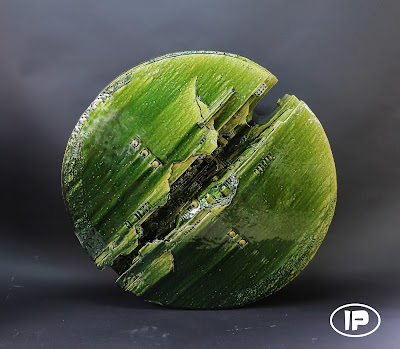
In
a recent email exchange with the potter Kowari Tetsuya he passed along a group
of photos which included two pieces that were singled out for special
recognition, 2018 was a good year. Illustrated is a large Oribe object that is
a cross between a deconstructivist icon and modern art rendered out of very
traditional technique, clay and glaze with a healthy dose of a particular
imagination. Receiving a "special prize" at the Japan Fine Arts
Exhibition (2018) this wondrous object truly shows what extremes and potential
lay within the Oribe idiom and tradition. Having a unique resemblance to some
science fiction back drop this piece has taken a simple circular object and
stood it on its head, adding dimension, power and motion to such a simple element
of geometry. Beyond the eloquence of the form and evocative texture the
skillful use of the bold, lush Oribe glaze brings a palpable sense of kinetic energy
through its implied motion, animating the piece where the glaze has run
seemingly defying gravity as it is displayed. This innovative contemporary disk
form is further enhanced with variations in the depths of the glaze from light
to dark adding even more dimension to this stellar example of Oribe in the 21st
century.
"You can understand nothing about art, particularly
modern art, if you do not understand that imagination is a value in
itself." Milan Kundera
(Photo
courtesy of the artist, Kowari Tetsuya)
I
keep working on the various greens that I work with from the multiple Oribe
formulas to the old standard medieval green to see what more I can wring out of
the copper glazes. The small yunomi pictured is part of a set of six that I
made in which I soaked the glaze at high temperature for just a bit and then
let it cool as slowly as I could. The results were better than expected and
have that lush, verdant quality that only green glazes seem to possess, a depth
and richness that cloaks a pot in a comforting warmth and attractive invitation. The deeply
impressed decoration has filled up with extra glaze making fro a really dark
green appearance and the impressions also help in the function of the yunomi
making for a sure grip. I am pleased with this glaze, it is simple to make,
simple to use and simple to appreciate when it is fired, what more can you ask
from a surface?

Illustrated
is a classic 1980s Oni-Shino vase by Tsukigata Nahiko; the photo is from an ad
for an exhibition in a Japanese ceramics magazine. This vase clearly shows the thick, viscous
Shino having been pulled apart and crawled during the firing and creating exposed
chasms of iron which also shows through the whiteness of the surface about the
pot as well. The upper portion of neck and shoulder show areas where natural
wood ash has built up and in some places is now dripping down the surface
making the whole pot a bit more complication through the intense firing
process. The addition of lugs to the form while not exactly unique are not seen
that often as a rule and add a dimension that the pot would seem to have
needed. This particular form is one of many that Tsukigata relied on over the
years having a rather casual and easy to use ambience for tea ceremony, ikebana
or for just every day use though the powerful surface would require just the
right accompaniment in a floral companion. I should also mention that though I
have not handled the vase in the advert, I have handled a number of the
Oni-Shino where the glaze was just super thick and unctuous having a gem like
appearance, perhaps a bit like opal without the chatoyant flashes but quite
provocative and beautiful on its own, I suspect even a hashi rest would be
quite wondrous. Add the fierce iron and natural ash and you end up with a
landscape like melting ice off a spires face to which a picture of a picture just cannot do
it justice.
Quite
some time back I wrote a blog post entitled; YURIKO! with a detail shot of a
large tsubo by Yoshida Takashi. I was recently asked if I had any overall shots
of the pot and if so, could I please send a picture of the pot. I do indeed have
an overall, quite a few in fact and choose this picture to give a sense of the
piece with its smallish foot, broad shoulder and mouth and wonderful mentori
faceting around the pot which in no way interferes with the vivid underglaze
decoration. Though I mentioned the pot was large, I believe it was well over a
foot tall and wider yet but the exact dimensions escape me at the moment, the
images were easier to find than the notes. This jar today is at home with a
large, hakuji style fluted tsubo, larger yet by Takanaka Ko making for a rather
stark and impressive display.


.JPG)