Monday, March 7, 2022

STARTING WITH THE BONES II


Quick update, illustrated is one of a group of teabowls I made trying to get to the simplest form that was practical and had movement and eye interest. The clay I used was a new stoneware I am mixing up with sand mixed in of varying size. Once thrown the forms were slightly altered by minimal faceting or scraping the surfaces to expose the clay and sand with the intention of using my Oribe, Kuro-Oribe or this iron yellow (saffron) glaze over a thin Hagi style white glaze (haku-yu). As you can see in the picture gravity has once again done a good deal of the heavy lifting in decoration this teabowl with the addition of the faceted areas adding a diagonal movement to the surface. Having opened up the clay surface prior to glazing the surface now is uneven and punctuated with areas of pits and highpoints from the protruding sand and grit making for a very textural appearance and feeling in hand. I think that with this group, there are several more to fire in an upcoming firing, I have gotten pretty close to basically starting at the beginning with the advantage of having some amount of experience and technology to add to these elemental forms.         

As a postscript, like most of the glazes I have been working with, each light source creates its own version of the surface and ultimately the bowl.

Friday, March 4, 2022

F+WJH=SG

Funky with a dash of "what just happened" describes this earthy Iga vase using my particular vernacular which is about as timeless as they come. I love pots that display this degree of casualness and there certainly is no lack of bravado or even a hint of symmetry but what else would one expect from Suzuki Goro who has made a career out of doing what just comes naturally along a path that is definitely less traveled. Made out of a coarse Shigaraki (?) clay, the pot was thrown quickly, loosely and with little concern for the weight of the finished object, once thrown the piece had lugs attached to either side of the neck while the piece was still quite wet culminating in an object that has a rather natural quality to it. This pot just exudes function, stability and a liveliness that seem to come along with Goro's pots as expected as the surprise toy in a box of Cracker Jacks. 

Though not necessarily known for his haikaburi (Shigaraki) style pots, I have seen quite a few and it is obvious that this sturdy vase was fired in a great spot in the kiln producing a rather wonderful surface painted by ash and flame. Of particular note is where the ash built up on the right side of the vase, the ash has pooled on the depressed shoulder and then the clay eroded just a bit unleashing the small but noticeable waterfall of molten glass now forever frozen in mid-stream. In the end where ever you fall on the like or dislike wood fired pots it would be difficult to just walk past this vase without giving it a more than thorough once over and thinking it is maybe betwixt and between then and now.

Wednesday, March 2, 2022

DIVERSITY

I think that it is easy to admit how much diversity of surface and firing there is in any given tradition though I am most specifically talking about the six ancient kilns (Rokkoyo). There are a multitude of variables from type of clay,  time of year, wood sources, weather and firing practices among others that have a direct outcome on the surface that can make classifying a particular piece with a specific tradition a bit trying. I think to a certain degree that is the case with this particular chawan that could, I believe pass for Shigaraki, Echizen, Bizen or Iga though based on the potter who made the piece and what the box says it is clear this piece is Iga and made by Kojima Kenji in the 1990s.    As is obvious in the picture, the form is a typical form used by Kojima Kenji and the surface shows off a rather good firing and skillful use of the kiln but the surface has characteristics that are not always top of mind being a bit drier, more opaque and dense green ash deposits and the rear of the bowl having a distinctly not necessarily Iga appearance. My thought process is that this chawan was in a spot that was initially rather hot during the firing and then cooled somewhat slowly allowing a more crystalline structure to develop leading to this particular surface that both is Iga and not "classically" Iga at the same time. I think it is also safe to say that the diversity within these specific traditions is what has kept them so contemporary and alive over the centuries and has allowed them to continue on in to the 21st century.

Monday, February 28, 2022

TEA JAR

This Ao+ glazed tea jar was part of a group that I made a while back trying to get a feel for how several glazes and visual textures worked especially focusing in on applied medallions around some teabowls, an incense container and this small but useful tea jar for loose tea leaves or just about anything else you may want to use it for. At just about six inches tall, it is easy to deal with, doesn't take up much space and the lid fits rather well and the medallions add a lot of actual and visual texture to the little pot. I was originally going to mount a medallion on the top of the cap lid but thought that was overkill and instead went for a raised area tooled in to the top to seemingly insinuate an additional device like those around the pot. Nothing really complicated here, just a fun usable pot that got me thinking about techniques I haven't used for a long time; it is funny how easy it is to move on from something when there was never any reason to do so other that running toward something new.

Friday, February 25, 2022

MASTER'S SHADOW

Rustic and unpretentious are how I would choose to describe this functional Oni-Iga mizusashi by Ayukai Kogetsu lurking somewhat in the shadows, perhaps a metaphor. Created using the glazes and tutelage of her teacher, Tsukigata Nahiko it is apparent that though this relies heavily on her master's vision there are subtle difference in the surface and most obviously in the form of the mizusashi. Thrown out of a slightly sandy clay and carefully manipulated the addition of some throwing and potter's marks add a sense of motion to the form which is then completed with an array of color and textures from the interaction with the various glazes and the firing process to create this landscape of past and present. In this tea utensil I see elements for classic old Tamba and Seto ware vessels that gives this pot a sense of antiquity which is one of my favorite characteristics in a pot, using the old to make the new. Like many potters who work in their master's shadow Ayukai Kogetsu has navigated that fine line using some of what she learned under Tsukigata Nahiko to move forward and add a dimension or two to what it means to be Oni-Iga moving in to the future.       

"A teacher affects eternity; he can never tell where his influence stops."  Henry Brooks Adams

Wednesday, February 23, 2022

DIFFERENT PATH

I find a real attraction and appeal to modern pots that straddle the various time zones of past and present and show a reliance and homage to the classical archetypes from varying traditions and styles. In this classic mizusashi there are key indicators and elements of both the old and new within the tradition of Tamba pottery. Though perhaps not a household name outside of Japan, Ichino Toyoji of the sprawling Tamba Ichino clan made this straightforward and honest mizusashi with that blend of regional classicism and his personal flair of what is modern Tamba. The form of this mizusashi is somewhat simple but with the addition of gestural lugs and potter's marks around the surface, the form becomes much less stiff and form with an the atmosphere of a casual object that still embraces all of the functional obligations of the tea ceremony. Fired in a nobori-gama wood kiln the surface has received just the right amount of flashing and ash to bring the pot to life without hiding or obscuring the marks and details that animate and articulate the form while creating a focal point on the face of the pot that is hard to ignore.    

Beyond the basic honesty of the clay, there are other features of note on this simple pot from the exacting fit of the lid, the wetness that embraces much of the form and the iridescent flashing on the base of the pot where the piece was set on wadding and fired. I may sound like a broken record but this is yet another example of a classic and simple pot that gives back to the viewer through various obvious and subtle details as well as the totality of the pot itself, I wonder what different path the tea ceremony would have taken if not for simple pots exactly like this mizusashi filled with purpose, sincerity and tradition.    

I am reminded of this quote by John Lyly; "The true measure of life is not length, but honesty" and I think as it pertains to pottery, it just may be that it is the honesty that makes for the long life of any given pot. 

Monday, February 21, 2022

JUST ONE OR TWO MORE

I am not exactly sure how it looks to you but there is just enough clay left under this faceted teabowl to throw just one more bowl. I thought I was at the end when I threw and faceted this stoneware teabowl but soon realized there was enough for another go around on a slightly more conservative bowl minus any faceting. I enjoy making bowls this way using what is left over from a mound of clay that was originally intended for a group of more or less the same pots, in this case the same group of lids, about 10" across that I had mentioned in a previous post now tooled, bisque, glazed and fired. This particular teabowl was thrown on the thick side and then faceted to create a sharp, visually defining band around the bottom third of the bowl which is both an aesthetic and design decision as the glaze pools around these raised areas. I have also gotten the foot to approximately where it needed to be but will fine tune it to have a bit more taper and flair when it gets to that stage. Once cut off the mound, I coned up the remaining clay and immediately threw a simple, mostly straight sided bowl that I plan on using for testing down the road, it may not have looked like it but there was plenty of clay to go around.

Friday, February 18, 2022

KO-CHAWAN(?)

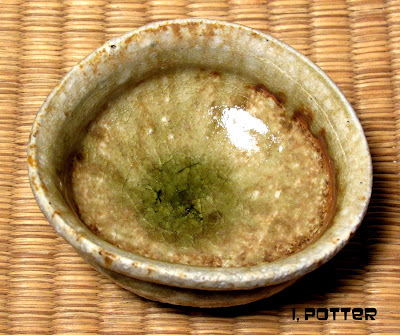
I really love guinomi that though lacking the size have all the characteristics of being a chawan and this glistening Iga guinomi fits that to a tee. Set on a carefully crafted kodai, the posture and undulation of this form reminds me of a wide array of chawan from Iga to Oribe as the anatomy of the bowl is in motion, animated while bathed in a rich coat of ash both inside and out. The interior landscape is like a diminutive valley complete with a deep pool of sea green where the ash collected and melted creating a focal point for the eye each and every time the guinomi is poised to be drunk from. This miniature chawan is alive with all of the best attributes of its larger cousin and shouldn't be faulted for its scale.     

Made by Umehara Isamu, this Iga guinomi was fired in a wood kiln which the potter also turns his hand to other traditional Mino pottery including Iga, Shino, Oribe and Mino-Iga as well. Umehara is just another potter who though embarked on a normal day job career turned his attention to pottery and moved from Osaka to Utouzaka in Gifu Prefecture and by 1987 was completely immersed in Shino, Oribe and Iga pottery. Beyond his pottery skill, Umehara is also a well accomplished designer and builder of kilns, one of which was built for the late Kato Tokuro. Specializing in chadogu, this guinomi is perhaps not the best example of his work but having seen just shy of a couple of dozen of his pots, I can say that what I have encountered has all show the same dedication and attention to details that tends to make a pot both conversant and memorable and what more can you expect from any pot, especially one that fits in your (well my) closed hand?

Wednesday, February 16, 2022

A BOTTLE OR TWO

I ended up having to throw a couple of taller cylindrical covered jars the other day and realizing how they will take up space I decided to throw a couple of 14" tall vases or bottles as you decide to define them. Each was thrown out of 3.5lbs of clay and will have a shallow tooled in foot when they are completed. The base of the form is terminated with a pronounced flair that creates a sturdy base and also acts to slow down glaze flow as heat and gravity take over. I should mention that this piece was thrown in one piece, it sort of happened organically and where I would normally throw the neck separately I used a throwing stick and my sponge on a stick to help facilitate the task at hand. At this point I am likely to glaze one of the bottles in the Kuro-oribe style with a heavier concentration of iron up around the top quarter of the form which should then run quite dramatically while the other will be decorated in temmoku and iron to accentuate the simple features of the piece. As you can see in the photo I have added depressed lines around the mouth and shoulder of the pot together with a combed band to hopefully create more movement in the pot as well as to fill with the Oribe glaze and create dark, dramatic lines on the surface. Making a bottle or two for the firing wasn't a lot of extra work and coupled with the two covered jars will fill one half shelf in the kiln allowing the rest of the space to be used to the fullest which I rarely fail to do.

Monday, February 14, 2022

KURUMI-ZU

Though not quite what I would call an actual Raqqa or Persian glaze, this turquoise glaze reminds me of ancient Egyptian faience in its color and surface but this pot is not only modern but Japanese as well. This mizuzashi which is described as "Persian blue" was made by Koyama Kihei who after graduating from Kyoto City University of Arts went on to study with two Ningen Kokuho; Tomimoto Kenkichi and Kondo Yuzo. In 1956 he rejoined his alma matter as a professor where he remained until his retirement in 1996 while exhibiting all along the way with a specialty in this blue glaze as well as black and white porcelain, mishima work, yuriko underglaze red and many other techniques. This particular mizusashi is decorated around the form with the castanea crenata, the Japanese chestnut (kurumi-zu) in black slip under the glaze which together with the copper in the glaze creates a more blue than black appearance to the overall design. As I mentioned the chestnut design is a black slip which has had sgraffito accents added to the decoration to flush out the chestnuts that are articulating the form which is completed with a custom made black lacquer lid. 

Though it may be difficult to tell from only this image, Koyama Kihei specialized in ceramics for the tea ceremony and was the recipient of a number of awards and accolades during his tenure as professor where he divided his time making pottery, teaching and writing for the Silk Road Research Society (not 100% sure of the translation) regarding Mid-Eastern art and pottery. Though I may not agree 100% with the box description, this pot does have the feel of being influenced by pots along the Silk Road and the addition of the Japanese chestnut anchors the piece as a thoroughly Japanese pot, a rather intriguing mizusashi to assemble a tea ceremony around.