Friday, August 18, 2023

OLD TWO VIEW

Illustrated is a rather old two-view picture that has been on the hard-drive for quite some time, perhaps a decade or so and at one time belonged to a migratory collector who lived in the Mid-West before finding his true place in the world on the Left Coast these days. As you can see this is a wonderful "golden" Oni-Shino kinuta hanaire by Tsukigata Nahiko and despite its bold nature, posture and animated form it is filled with nuances and subtleties that make it abundantly clear this is no ordinary mallet vase. As for the form, the base was made round and then ever so slightly squared which is much more apparent in person and the shoulder area depressed just a bit where the stocky neck was affixed to stand upright while the form itself appears a bit off center and looking a bit like the Tower of Pisa. The pot was dipped, several times, the first coat being thin and the top coat quite a bit thicker making for this heavily textured and luxuriously fat surface. Once glazed the pot was fired and the neck and some of the body has a crusty ash addition to help narrate the visual landscape of the pot while the rest of the piece is covered in a thin coat of natural ash where it has created eroded rivers as it melted and cascades down the form adding to the vertical impression of the kinuta. Having handled this pot I can attest to the fact that it is infinitely better in person being both bold and subtle at the same time and having a landscape that moves as the pot does and is best described as a quintessential, classic vase by the master of the style, Tsukigata Nahiko. 

(Photos courtesy of a Mid-West, Left-Coast collector)

Wednesday, August 16, 2023

ALL IN

A short while back I put up a blog post on a rather unique approach in terms of form and concept to making a mizusashi by Mino potter Kato Yoji. Having the opportunity to handle and live with the wood fired haiyu mizusashi when the opportunity arose to handle a haikaburi style chawan, I was all in and the photo is the result of that encounter. Appearing to be made by hand, not thrown, the form was created using slabs of clay to create the form and while that is apparent looking at the exterior of the chawan the interior has been worked, scraped and smoothed and perfect for its intended use and the semi-fragile nature of the tea whisk. Once the bowl form was finished a carefully applied coil was attached to complete the weel conceived and perfectly functional foot, thus completing the form. 

Though I am not 100% sure when, a layer of black to brown slip was applied to the clay prior to it being loaded in to the wood kiln which has further enhanced the ash that has built up and landed on much of this bowl. As you can see the finished piece is quite rugged in appearance and the face none the worse for the ferocious process it was subjected to where shell scars and built up ash paint and abstract portrait depicting a landscape that echoes a sense of survival where a surface and form work hand in hand to create not only a unique chawan but also an object that demands one's attention in use or simple appreciation. What I can say after this additional encounter with Kato Yoji's work is that if two encounters has been more than enjoyable, certainly three would be even better.

Monday, August 14, 2023

TWO BIRDS, ONE STONE


It wasn't that long ago that this teabowl was a flat, cracked mess, akin to Humpty Dumpty but I took the time, repaired it and used a new thick, sandy slip on the piece despite the fact that it hadn't been thoroughly vetted. In a firing a couple of weeks back I sent through the first test using this sandy slip with an Oribe glaze which worked fine so I decided to kill two birds with one stone and tried out a slightly larger piece with an amber glaze I haven't used in quite some time. Illustrated is the teabowl , once flat and now fired with a rather hefty visual and actual texture where glaze has built up here and there created rich, deep valleys of dark amber glaze with a surface punctuated by fine white sand and small stones across the surface. I am glad I didn't just throw this bowl in the slake bucket when it hit the floor asit has provided a fair amount of information, the big question now is how best to use either slip or glaze?

Friday, August 11, 2023

IN THE PRESENT

Bringing to bare the teaching and aesthetic decision making processes of his teacher, Jeff Shapiro and his father Isezaki Jun, Isezaki Koichiro has infused a modern, international sensibility to his Bizen work that blends tradition, modernity and sculpture into much of his work. This Bizen chawan was made by Koichiro over a decade ago and is still vibrantly and in the present where he has used his vertical lines, shinogi devices to articulate and decorate his work which carved kuriniku style out of a ball of clay. Using a solid block of clay which is rolled and manipulated into the general size and form he is considering, the exterior decoration of carved, cut decoration is made and then the material is allowed to season as it were by drying a bit. Once at the right consistency, the interior is meticulously carved out and smoothed to utilitarian perfection and then the foot is cut ridding the chawan of the last vestiges of weight and superfluous clay.  

In this case the chawan sits, tall and proudly on a pedestal style foot which is sturdy and balances the form from top to bottom with just the right amount of lift to please the eye. Once fired this chawan has a rich, wet surface of flashed ash with borders of running ash and a velvety bottom interior adding features serendipitously as the maker and fire strike a bargain during the fire to let happenstance and experience mingle. Perhaps my main take-away from having seen and handled this chawan is the near flawless pursuit of both the Bizen tradition and the contemporary time in which he Isezaki Koichiro works.

Wednesday, August 9, 2023

EVERYDAY USE

I started on an extended terra cotta cycle a week ago Monday and was not quite pleased with my output due to several time consuming interruptions. Ultimately I went down and threw a small group of pieces on Sunday using about an hour which included two small covered serving bowls and then on Monday made another group of four along with other pots. Illustrated is one of the six small covered serving bowls currently completed with another half dozen or so to be made, at 2.5lbs of clay (plus lid), these are the smaller cousins of the four and six pound versions and the bulk of these are either for carved black slip or black and white slip trailing. Once glazed in a clear glaze, the general purpose of these pots is that they are easy to use, easy to clean, easy to hold and lift the lid with the broad knob. Basic utility intended for everyday use was the goal and hopefully along the way the slightly folky appearance, old style charm and black and white decoration finds its way into just about any style of apartment or home.

Monday, August 7, 2023

DASHING FIGURE


Since I don't practice chanoyu and have not used this chawan for any practical use, I can't really speak to the functional efficacy of the piece but I do think it cuts quite a dashing figure none the less. This modern take on an Oribe chawan was made by Ishii Takahiro who studied with Kakurezaki Ryuichi where I suspect his sense of modernity and cutting edge ideas was fostered and developed during his apprenticeship. This chawan was first thrown and then manipulated into this nearly rectangular form when it was faceted to create a rather angular appearance with sharp edges and lines to define its internal and external space. I should note that as a byproduct of manipulating and "cutting" the clay it present s a rather appealing shadow line created by the small amount of lift of the kodai which acts almost like a pedestal to the geometric inspired form. 

The chawan was then seemingly casually glazed leaving micro-textured areas of the clay exposed before being fired on three shell wads to effect glaze movement that would alter the sense of movement and depth during the firing. The glaze ran to the side which during the firing was the floor of the pot, creating thick, deep green pools of Oribe glass and can be seen running toward the shell scars on the face of the bowl. The combination of the sharp lines, unusual form, glaze movement and the firing scars all combine to create a rather intriguing take on modern Oribe and just what is possible with some creative thinking outside of the box and four centuries of tradition to pick and choose from. It would seem that with many traditions and pursuits the possibilities are endless and honestly, isn't green just wonderful?

Friday, August 4, 2023

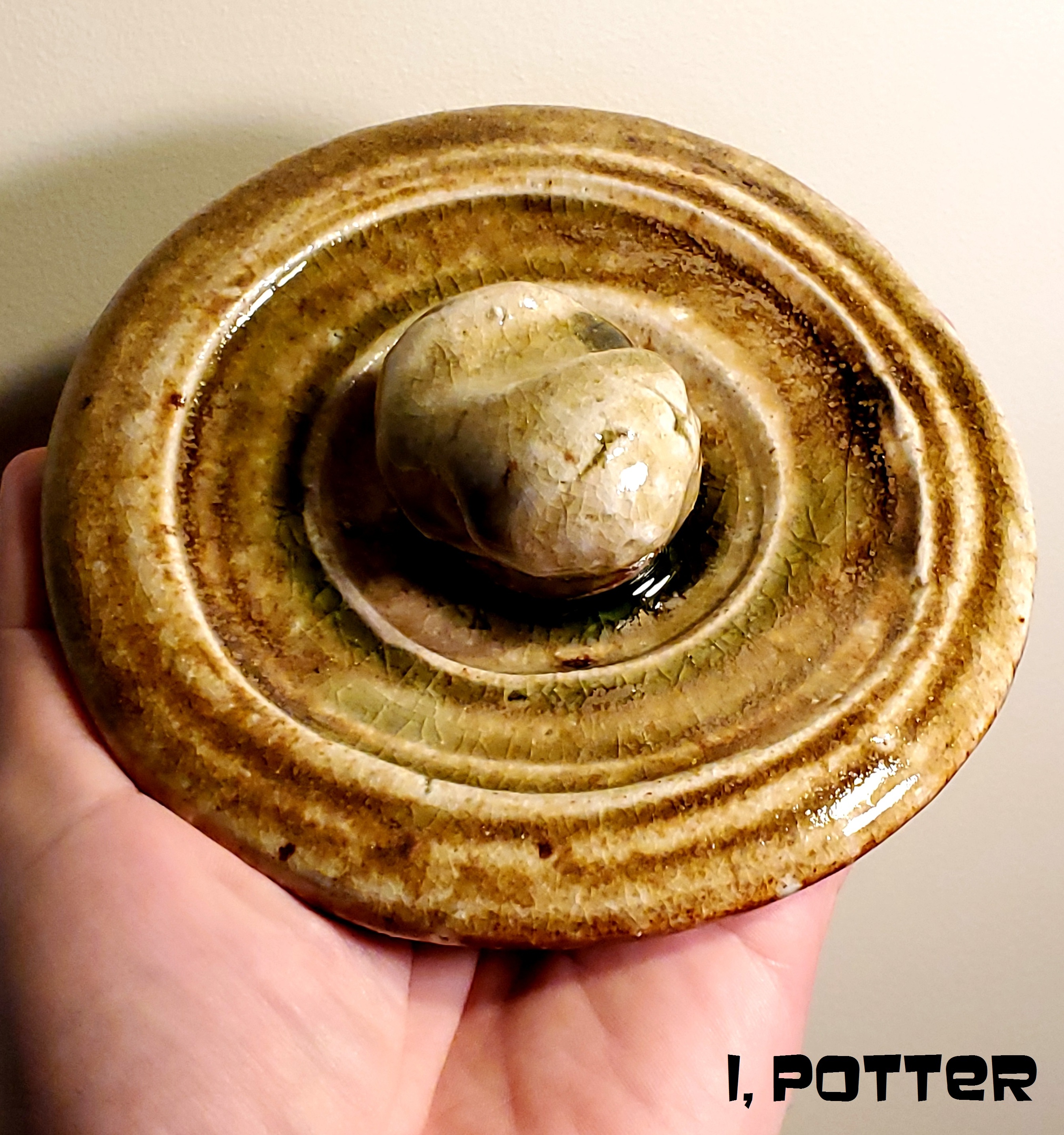
JUST A LID (Or the Fine Art of lid making)

It is likely no secret that I really enjoy pots with lids, big and small, glazed and wood fired, they all find a way to draw me in. Perhaps the main attraction is the sense of mystery and all the implied volume of the forms where each reveal is a bit like a new discovery and seeing a thing for the very first time with some being subtle and others being quite dramatic. In this realm the mizusashi as a form and essential element of the tea ceremony "reigns supreme"* for me and though I understand the function and purpose, exploring the interior must be a lot like what spelunkers experience with a new cave. There can be a vastness to the interior or tight, constricted volume, each one having something very different to offer, each something very new and with some, an interior that never disappoints of grows old in the lifting of the lid.       

To this end, there is the lid which I would guess is easy enough to overlook but like the body of the pot, the lid has as much to offer and in the right circumstance either whispers or screams to the viewer, lift me and explore my contents. To that end of looking at lids, I choose this Iga lid from a mizusashi by Kojima Kenji which is large, robust and quite sturdy preforming its function admirably while presenting itself as a self-contained object, an adjunct to the overall pot though in this case as essential as the body. Over the years I have seen a good number of mizusashi by Kojima Kenji in person and quite a few in catalogues and I have noticed that in more modern times no matter how disperate in form there is one overwhelmingly consistent feature and that is of the lid. A bit like circular valleys around the lid, the lids are defined by a number of distinct rings which in turn serve to collect and pool ash with the central knob looking a bit like a large, pinched adzuki bean which is up to the task at hand.      

Despite this arrived at formulaic approach to lid making, I have not yet encountered a Kojima Kenji mizusashi where the body and lid did not visually go hand in hand as each one is tweeked just enough to "fit" the actual and aesthetic needs of the piece. There is a casual and spontaneous feel to the lid as you can see in the photo where the firing has softened the marks and rings created by the potter and the knob almost has the feeling of a stone in a garden, made wet by the mist or rain who's placement was meant as much for use as contemplation. Though to some it is just a lid, each one is individual in its throwing and perhaps formulaic in its birth but sometimes if it works and works well, don't mess with it and leave things well enough alone from pot to pot. 

(*Yet another IRON CHEF JAPAN reference.)

Wednesday, August 2, 2023

MOMENTARY ACHEIVEMENT

Illustrated is a comb textured teabowl that I made a while back finally fired and ready for its close up. The teabowl was thrown out of stoneware and had white slip brushed over the surface and then the highpoints removed to expose the clay again. The pot was glazed in a soda blue and has been sitting around while I went through two terra cotta cycles before getting back to a kiln load of stoneware, white stoneware and porcelain. I wasn't quite sure exactly how this would play out but what did surprise me is the where the combing is at its widest, the glaze color is what I normally expect from the glaze and where the channels are smaller and narrower, the color came out much richer and deeper. I should mention that the glaze is not thicker top to bottom though it does run a slight amount and perhaps this is accounting for the different from the top lobe to the bottom one. So here is the good news that I take away from this bowl; the glaze didn't run off the pot, the glaze worked well within the channels and didn't crawl or pinhole and honestly I like the difference in color value from the top and bottom and lastly given how some other recent tests have gone, I have absolutely nothing to complain about with this teabowl, the glaze and the surface overall. I'll take that as the momentary achievement that it is!

Monday, July 31, 2023

REDO

Today was one of those rather busy days, the table is filled with ware-boards filled with terra cotta bowls and covered serving pieces, I spent hours on the phone trying to sort out an existing problem and I had to make up black and white slips and 6000gr of my new, old amber glaze. In other words, time went by fast so I went to my photo file and picked out this sun drenched Echizen chawan by Nishiura Takeshi. I know this is one of those redo posts and photos but it could be a lot worse than this chawan showing off some of its bells and whistles in the sunlight.

Friday, July 28, 2023

MODERNIST ART POTTERY

Despite having a somewhat decent memory I can't say I remember all the details of how I ended up with this mysterious vase other than it was described as "modernist art pottery" and in the end no one bid against me on the rather ubiquitous auction site. I have to admit I was drawn to the simplicity and utility of the form, the dry, modernist surface and decoration and the sensibility it presented which reminded me of the Arts & Crafts movement ushered in by Ruskin and Morris. The pot arrived be it vase or large lager glass and I wasn't disappointed by any of the attributes that drew me in to begin with and the decoration worked well around the form creating an rather animated landscape. 

Once in hand I was able to read the seal which was actually in English, MOMO in capital letters and after a brief internet seach I happened upon the website of Momoda Hikaru who lives and works in Asaka, Saitama. Momoda's website shows a wide array of pottery, mostly using less traditional surfaces and very little actual glaze excepting as liners for the interiors of pots. Having a rather busy record of exhibitions, Momoda also won the prestigous Shoji Hamada Prize at the 7th Annual Mashiko Ceramics Exhibition. Though without a box and a somewhat mysterious origins, this pot has been sitting up on a bookshelf where I get to look at it nearly everyday and not a day passes when I don't think to myself, that would surely hold a fair measure of a good bourbon beer! If interested, here is the Insta-page of Momoda Hikaru;