Tuesday, September 7, 2010

THROWN SLABS


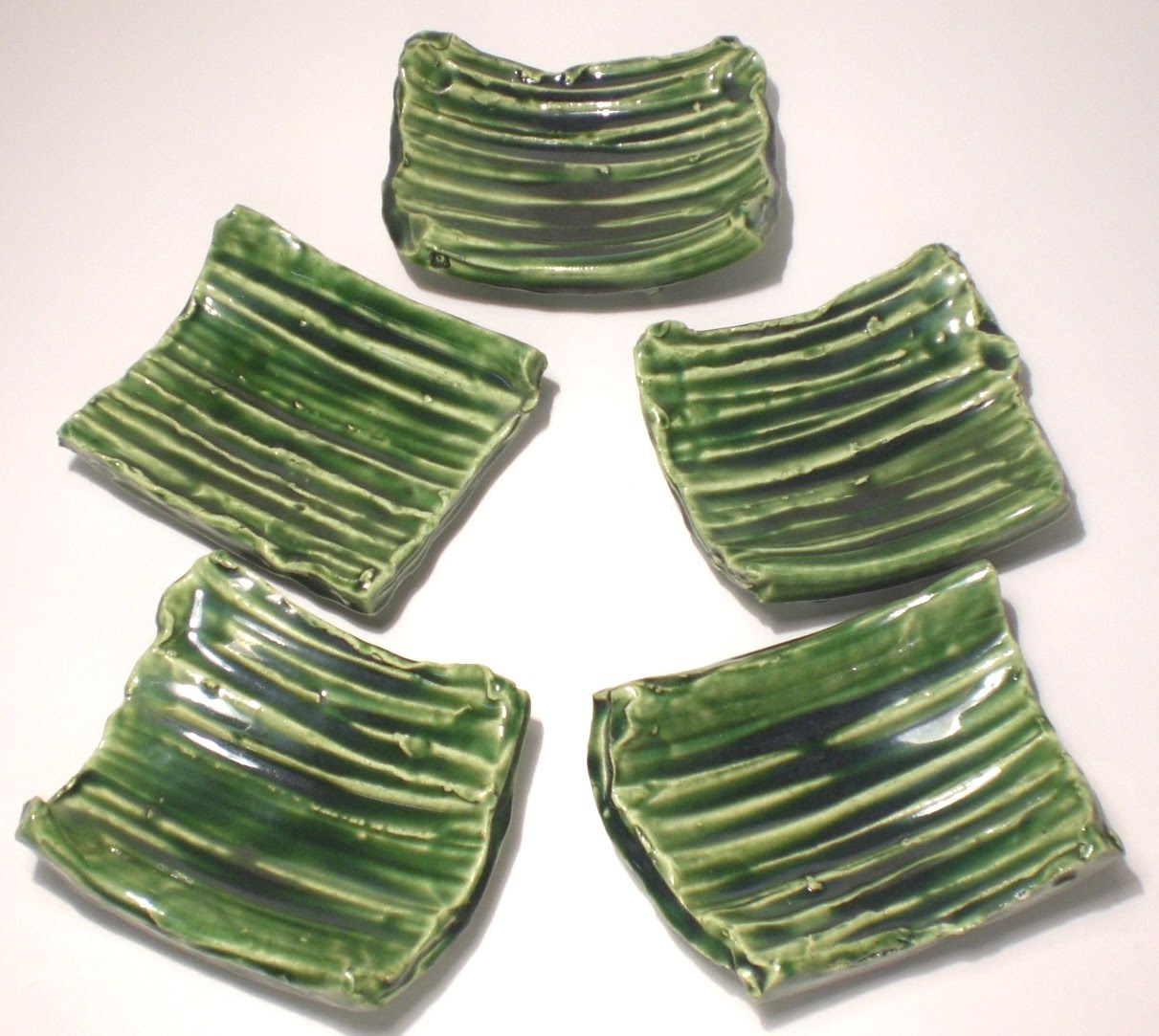
While in Japan I was fortunate to see a demo by Koie Ryoji. In the demo he threw a bottomless rough cylinder and when it firmed up just a bit, he cut it off the wheel, cut through on side and stretched it out to make a long, flatish “slab” plate. It was a very interesting use of the wheel.

I have used the same technique on and off for some time and have also at times taken it just a bit further. Once I have thrown the cylinder, without any tools and leaving rough throwing marks, I wait for the clay to firm up and then cut it into five or six equal pieces. I then occasionally add feet and have a set of matched plates. The throwing marks and some added distress to the surface makes for very tactile and user friendly pieces. I use my Oribe glaze quite a bit with this technique, but also works well with ash or amber glazes.

Friday, September 3, 2010

SIMPLICITY


“My Pots are not about risk taking. They are about serenity-clarity-simplicity. Some people climb mountains, I like to walk through meadows of wildflowers.”

Excerpt from the artist statement of David Shaner (1934-2002), a generous teacher, pioneer and potter.

A simple wood fired teabowl by David Shaner, circa 1995.

Wednesday, September 1, 2010

BOWLS, BOWLS & MORE BOWLS


As I am working in a new cycle, I have decided to limit the number of bowls I make for the next firing to see how I can manage the kiln space without those ubiquitous forms. I have already thrown a group of 12” U bowls and that is where I draw the line, well maybe a teabowl or two and who knows what else could come up, maybe a last minute order (one can hope). I guess the cards will fall as they may.

The reason for this restriction on bowls is that it has occurred to me what a large percentage bowls are of my total output. Though I make a lot of covered jars, lidded serving pieces, plates, teapots, bottles and vases, bowls seem to be the ever present form that helps plan and fill each kiln, fill orders, fill commission orders and are special ordered. I make a wide variety of bowls as teabowls, soup bowls, catch all bowls, pasta bowls, wall bowls, salad bowls and every other bowl you can think of including popcorn bowls. They are not all round, some are lobed, squared, faceted, pierced and so on, but they are still bowls.

After the countless thousands of bowls I have made, you would think I would be tired of making such forms, but honestly no. Like any other form, the bowl makes for a rich surface and space to work with. In reality, were would we be without bowls? They have served man well for thousands of years and the bowl is certainly far better off being of any form of handmade pottery than out of some vacuum injected plastic or other lifeless material. I am glad I make bowls and maybe will make a few more to fill the nooks and crannies of my next firing……………..

(One set of four temmoku and medieval green soup bowls from the last firing)
Monday, August 30, 2010

THIS FIRING


I cracked the kiln early on Saturday morning, but it took until 4pm to actually unload the kiln. I had a few problems with crawling on two of the carved porcelain bowls, the glaze just dried to slowly, leading to the eventual crawling. Everything else came out fine and the cap jars exceeded my expectations. It is always nice when that happens.

It is not my intension to regal any reader with the daily minutia and travails of each of my work cycles, I just wanted to give a glimpse as to how I work. I do not plan to make this a regular thing. A new week now and a new cycle of work, the life of a potter.

(Illustrated, a cap jar and wall bowl from this firing, together with a close up of the bowl. The bowl is about 15” in diameter for scale.)

Friday, August 27, 2010

FIRED

I finished up glazing on Thursday; got the pots all cleaned off and spent quite a while loading the kiln. It took some real fancy moves, but I ended up getting everything except one of the wall bowls loaded into the kiln. It is packed without any room to spare.

Though the kiln is off now, I can’t help but think about what has happened to all those glazed pots. Because of how I glaze, glazing right up to the foot ring, running is always a real threat. Overall, very little runs and my shelves are in relatively good shape given the years of use they have seen. In every firing though, there are always some close calls with drips poised to come off the pot, suspended on the very bottoms. There is always glaze runs, glaze rolls and near drips, but that is the fun of using clay and ash glazes.


A “runner” from a previous firing.

Wednesday, August 25, 2010

ITS GLAZE DAY (1)


I got the bisque unloaded and everything cleaned off early this morning. Everything made it and from there, got the jars/lids waxed and what ever else needed waxing, waxed as well. Glazes are all mixed, overglazes all ready and I was off and running.

I glazed the wall bowls first as I need to pour the glaze into a wide container, they are about 17” across and the glaze buckets are a bit narrow. I have the porcelain bowls in the bisque kiln on low, heating them up a bit. I throw my porcelain on the thin side and unless you heat the bowls up so the glaze dries fast, you run into a myriad of problems. I get the wall bowls, the porcelain carved bowls, some bottles, a group of large cap jars, soup bowls and some teabowls all glazed in their primary glaze and need them to dry before putting a second or third glaze on them. The clear glazed bowls are cleaned and put aside, at least those are completed.

Tomorrow is another day of glaze fun. I need to get secondary glazes on 80% of the pots. Once dry, some get third glazes, but most get cleaned off and set aside, ready to load in the kiln, which I hope to do tomorrow evening at the latest. Though it seems unbelievable, I am actually still on track to fire on Friday, though I won’t count my pots before they are fired.

(Picture is of one of 4 tables I use when glazing)

Monday, August 23, 2010

THIS & THAT

As Fred Schneider may say, “it’s a dreary downtown day”, overcast, occasionally raining and a hard day to get motivated. Everything is thrown now and sanded and I just finished loading the kiln for a bisque. My original estimate of there being 20% too much for a glaze firing was way off especially considering I kept throwing. I now have at least enough for a kiln and a half and together with some large pitchers I’ll throw next week, well on to a quick turn around bisque/glaze firing. I’ll glaze this Weds. And Thursday, load and hopefully glaze fire on Friday. Makes for a busy week.
-----------------------------------------------------------------

One of the interesting things about the internet is the number of individuals I have met over the last decade because of pottery, mine and Japanese pots. I am constantly carrying on conversations that can last weeks with individuals half way around the world or in differing time zones of the US. A conversation I have been having was about the nature of simplicity in pottery. There would seem to be an exceedingly fine line between an exciting kohiki chawan and a dull bowl. Most styles of pottery can be exciting and complex in their simplicity, but the truth is the simpler the pot, the greater the potter must be to articulate simple form and surface to engage the viewer.


Illustrated is a Shino chawan by master Japanese potter Okabe Mineo. At first glance it may almost seem innocuous in its appearance, but as you begin to study the form and the posture of the bowl, the undulation of the lip, the simple and abstract iron brush work under the glaze and the casually placed finger print in the glaze, you realize, this is no simple chawan. I have seen a number of Okabe Mineo pieces, and what is ever apparent, is that he has mastered the complex art of simplicity.

Friday, August 20, 2010

THE POT

Over a number of years I have had the privilege of teaching at a variety of locations as well as giving workshops. One of my maxims of pottery sanity is to never get too attached to any single pot. Work in a series and if one bites the dust, there are others to work with. I have always found this to be sound and profitable advice.

Well, despite my own best advice and my “zen like” approach to clay, there is periodically a pot, the pot, that I am far more invested in than is healthy. It can be a teabowl, covered jar or what have you, it just speaks a bit louder than others in the series. Such was just the case with a bottle vase I was decorating. In using wax to help define the design, it just didn’t come out the way I wanted it to and it just ruined the pot to my eye.

So what to do, for a day and a half I obsessed on the pot and the decoration that ruined it. Should I fire it, should I scrap it, it is just greenware after all. No, not I, I pick door #3. In what can only be described as a herculean effort to salvage the situation and the pot, I scraped, sanded, reslipped, rewaxed and redecorated what would only take 15 minutes to throw and tool all over again. An hour invested in a pot that on a good day will fetch $40. I have saved the pot and what is life without the occasional quixotic pursuit?

Wednesday, August 18, 2010

THE GRAVITY OF THE SITUATION


Quite a few years back, a very good friend of mine was packing up a really good chawan he had recently sold. He had it set on strips of bubble wrap and as he reached for one, the bowl tumbled to the ground and shattered. The loss of any great pot is a tragedy in my eyes and a financial loss to the dealer as well.

Recently, I was moving things around on a storage shelf and out of the corner of my eye I caught a falling shadow. A teabowl, I had made, fell and broke against the cement floor. I had been saving the bowl for a show and my action had an equal reaction. What sprung to mind was a wry “psuedo-haiku” I had sent to my friend Dan those few years back, as a means of consoling him;

“A Fine chawan,
What is Zen?
100 Pieces”

For years I have been trying to add an abundance of hydrogen molecules to my glazes to make them lighter than air, but to no avail. It is probably the distraction of my work to turn lead into gold that has impeded my progress. Considering gravity is a law we must all contend with, doesn’t humor makes it just a bit easier to live with?

Monday, August 16, 2010

WORKING


“When you are doing your work, you and your work are two different things. But when you become the work itself, and do the work, or in other words, when the work is itself doing the work, true work becomes possible.”

From THE UNKNOWN CRAFTSMAN by Soetsu Yanagi