Wednesday, September 15, 2010

C + Ss = EV


I have often though how wonderful it would be if there were formulas like in physics and mathematics, though less complex than Fermat’s, to appreciate and measure emotional occurrences in our lives. For instance, we own a simple 20th century Oribe candlestick, it doesn’t hold much monetary value, but the emotional impact is immeasurable. Think of a great Monet painting, a well used pottery bowl or a daughter’s finger painting, the value of these objects is beyond conventional value.

In a recent email exchange, a customer expressed the notion that; “the form is the function”. While I can partially relate to that concept, I believe that the function of an object can be purely the emotional value; the function of the object is beauty. I think that though many objects are certainly made to be used, their use does not strictly define their function. An object’s presence and appreciation can enrich a viewer, add to their environment and give back inspiration just by being. A chawan does not necessarily have to be used in chanoyu to be appreciated and enjoyed on a different level than through its use. Think of a great Faberge egg, is it a bookend, paperweight, doorstop? Its entire reason for being is in its appreciation and beauty.

I am in complete agreement with Yanagi’s statement; beauty born of use, but believe the use of an object can be the simple impact it has on one’s daily life.

(Illustrated a Kuro-Iga chawan by Kojima Kenji and an Iga chaire by Furutani Michio (1946-2000), both from a private collection)

Monday, September 13, 2010

MONDAY BLUES


Recently I have been playing with the combination of my version of a toruko-ao glaze over my neriage. At first, there were a few stumbling blocks but those seem to have been solved. This glaze has taken a complete metamorphosis since I originally got the recipe from Colin Pearson back in the mid-90s. I embarked on the task of morphing the glaze into a vellum style Persian blue glaze (toruko-ao) that was very influenced by the work of Kato Kenji

This glaze started out as a semi-opaque copper blue glaze which ran like the dickens and was splotchy and uneven despite a careful application. Over the years it has been altered so much, that the current recipe does not even resemble the original in content or percentages. The current version, TA-Variation-56s, can be used thin or thick without running and now works well over various underglaze slips as well as the cobalt rich black neriage porcelain I use.

Aside from the luminous quality of the glaze, the richness of the blue has a timeless and ancient quality to it. It seemed only fitting that I used it over the black & white neriage pots I have been making which are influenced by suminagashi style paper marbling. The real appeal of these pots though, is the cool and inviting softness of the vellum glaze texture. It has a feel unlike any other glaze texture I know and is truly enjoyable in the hand. It would seem to be the perfect Monday blues……………

(Illustrated are four teabowls and a close-up of a bowl, unloaded from a kiln this morning)

Friday, September 10, 2010

SIMPLE FORM

I have been interested in chawan and more specifically Shigaraki and Iga chawan for a long while. Though there is a myriad of shapes, it is the tsutsu-gata, cylindrical form that I am very fond of. The concept of the cylinder would seem somewhat defined and finite, but there are a number of Japanese potters who make the simple form so articulated and animated and distinctly their own in a nearly infinite variety of subtle interpretations.

This anonymous Iga chawan has a wonderfully glassy surface which at some point in the past, covered the makers mark and now the identity of the potter is lost. The robust form was fired on its side on clamshells and has compressed a bit to alter the tapering cylinder. The shallow glass coating is all running to the clamshell marks left, fossilized from the firing. The play of the horizontal glass running opposed to the verticality of the form is frozen in a moment when the chawan was pulled from the hot kiln, hikidashi style to cool and freeze the surface forever.

The second chawan is an older Shigaraki piece by pottery maestro Tsujimura Shiro. The surface is the opposite of the previous chawan, showing minimal natural ash deposits, rather favoring the rich hi-iro fire color that accentuates the wonderful posture and form of the bowl. The “wonky” lip just adds to the motion of the form and beckons the viewer to look within the chawan. What will you discover?

Wednesday, September 8, 2010

HANDLES


I finally got around to throwing the last pieces for my next firing, a group of large pitchers. The inevitable part of throwing pitchers is that you have to put handles on them. After waiting forever for them to firm up, I pulled a group of handles, with two extras and set about putting the handles on the pots. I pull the handles first, though sometimes I pull the handles off smaller pitchers. In this case, I pull the handles first, attach it and finish pulling it on the pot.

The whole process of then fusing over the handles is just a pain. I probably would be less particular if I didn’t have to meet up to a standard I have set. For pitchers, especially, I measure my work against Bill Klock, Warren MacKenzie and several of the British pitcher makers. I think by doing this, it keeps my work honest and gives me the push to make each pot better than the last and distinctly my own thing.

My original intention was to throw larger pitchers, but a last minute addition to the firing, a group of 5” tall serving bowls, has altered my original plan for 17” tall pitchers and reduced them to just under 15” wet. Doesn’t sound like much, but in the end, it will help me load another full, cramped and well planned out firing. Just two more handles to put on…………..

Tuesday, September 7, 2010

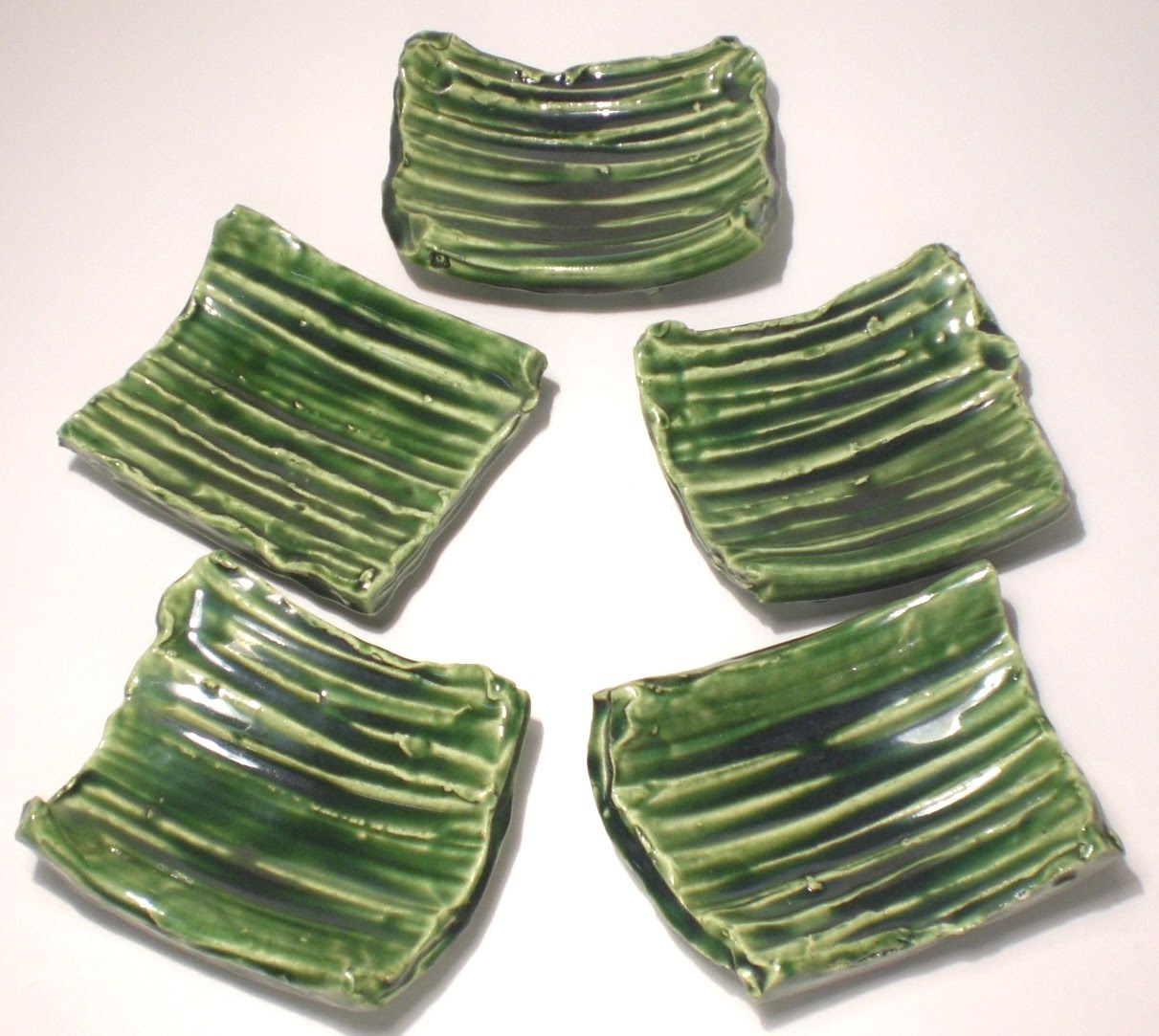
THROWN SLABS


While in Japan I was fortunate to see a demo by Koie Ryoji. In the demo he threw a bottomless rough cylinder and when it firmed up just a bit, he cut it off the wheel, cut through on side and stretched it out to make a long, flatish “slab” plate. It was a very interesting use of the wheel.

I have used the same technique on and off for some time and have also at times taken it just a bit further. Once I have thrown the cylinder, without any tools and leaving rough throwing marks, I wait for the clay to firm up and then cut it into five or six equal pieces. I then occasionally add feet and have a set of matched plates. The throwing marks and some added distress to the surface makes for very tactile and user friendly pieces. I use my Oribe glaze quite a bit with this technique, but also works well with ash or amber glazes.

Friday, September 3, 2010

SIMPLICITY


“My Pots are not about risk taking. They are about serenity-clarity-simplicity. Some people climb mountains, I like to walk through meadows of wildflowers.”

Excerpt from the artist statement of David Shaner (1934-2002), a generous teacher, pioneer and potter.

A simple wood fired teabowl by David Shaner, circa 1995.

Wednesday, September 1, 2010

BOWLS, BOWLS & MORE BOWLS


As I am working in a new cycle, I have decided to limit the number of bowls I make for the next firing to see how I can manage the kiln space without those ubiquitous forms. I have already thrown a group of 12” U bowls and that is where I draw the line, well maybe a teabowl or two and who knows what else could come up, maybe a last minute order (one can hope). I guess the cards will fall as they may.

The reason for this restriction on bowls is that it has occurred to me what a large percentage bowls are of my total output. Though I make a lot of covered jars, lidded serving pieces, plates, teapots, bottles and vases, bowls seem to be the ever present form that helps plan and fill each kiln, fill orders, fill commission orders and are special ordered. I make a wide variety of bowls as teabowls, soup bowls, catch all bowls, pasta bowls, wall bowls, salad bowls and every other bowl you can think of including popcorn bowls. They are not all round, some are lobed, squared, faceted, pierced and so on, but they are still bowls.

After the countless thousands of bowls I have made, you would think I would be tired of making such forms, but honestly no. Like any other form, the bowl makes for a rich surface and space to work with. In reality, were would we be without bowls? They have served man well for thousands of years and the bowl is certainly far better off being of any form of handmade pottery than out of some vacuum injected plastic or other lifeless material. I am glad I make bowls and maybe will make a few more to fill the nooks and crannies of my next firing……………..

(One set of four temmoku and medieval green soup bowls from the last firing)

Monday, August 30, 2010

THIS FIRING


I cracked the kiln early on Saturday morning, but it took until 4pm to actually unload the kiln. I had a few problems with crawling on two of the carved porcelain bowls, the glaze just dried to slowly, leading to the eventual crawling. Everything else came out fine and the cap jars exceeded my expectations. It is always nice when that happens.

It is not my intension to regal any reader with the daily minutia and travails of each of my work cycles, I just wanted to give a glimpse as to how I work. I do not plan to make this a regular thing. A new week now and a new cycle of work, the life of a potter.

(Illustrated, a cap jar and wall bowl from this firing, together with a close up of the bowl. The bowl is about 15” in diameter for scale.)

Friday, August 27, 2010

FIRED

I finished up glazing on Thursday; got the pots all cleaned off and spent quite a while loading the kiln. It took some real fancy moves, but I ended up getting everything except one of the wall bowls loaded into the kiln. It is packed without any room to spare.

Though the kiln is off now, I can’t help but think about what has happened to all those glazed pots. Because of how I glaze, glazing right up to the foot ring, running is always a real threat. Overall, very little runs and my shelves are in relatively good shape given the years of use they have seen. In every firing though, there are always some close calls with drips poised to come off the pot, suspended on the very bottoms. There is always glaze runs, glaze rolls and near drips, but that is the fun of using clay and ash glazes.


A “runner” from a previous firing.

Wednesday, August 25, 2010

ITS GLAZE DAY (1)


I got the bisque unloaded and everything cleaned off early this morning. Everything made it and from there, got the jars/lids waxed and what ever else needed waxing, waxed as well. Glazes are all mixed, overglazes all ready and I was off and running.

I glazed the wall bowls first as I need to pour the glaze into a wide container, they are about 17” across and the glaze buckets are a bit narrow. I have the porcelain bowls in the bisque kiln on low, heating them up a bit. I throw my porcelain on the thin side and unless you heat the bowls up so the glaze dries fast, you run into a myriad of problems. I get the wall bowls, the porcelain carved bowls, some bottles, a group of large cap jars, soup bowls and some teabowls all glazed in their primary glaze and need them to dry before putting a second or third glaze on them. The clear glazed bowls are cleaned and put aside, at least those are completed.

Tomorrow is another day of glaze fun. I need to get secondary glazes on 80% of the pots. Once dry, some get third glazes, but most get cleaned off and set aside, ready to load in the kiln, which I hope to do tomorrow evening at the latest. Though it seems unbelievable, I am actually still on track to fire on Friday, though I won’t count my pots before they are fired.

(Picture is of one of 4 tables I use when glazing)