Illustrated is a set of altered pitcher and mugs glazed in a rich Persian blue glaze over black and white slip. This set was made for a show about ritual and was entitled; Gathering. Having made all these pots, sometimes my mind wanders to wondering where they are now? Have they found a purpose, are they being used? It is funny that some pots or sets of pots, stand out in your mind and every once and a while you wonder if they still have something to say to the owners……
Wednesday, May 4, 2011
SOME POTS...................
Monday, May 2, 2011
DOWN SIZING
He recently decided to part with several more Hagi chawan by a diverse group of potters; Yamanae Seigan, Mashita Tadashi, Tanomura Shogetsu II and Kaneta Sanzaemon VII. I have put these pieces up on my website and invite you to take a look at your leisure;
http://www.trocadero.com/albedo3studio/catalog.html
As collectors, we never really own things. Rather we are caretakers and conservators of these objects, insuring they are passed along in the condition we acquire them, or in restored condition. All objects move about in time and this down sizing collector is setting these in motion to find a new resting spot with new collectors who will care for them, appreciate them and have their own dialogue with them.
Friday, April 29, 2011
NEBULOUS
Illustrated is an ethereal Shino chawan by Toki Juyo Mukei Bunkazai, Sakai Kobu (1937- ). His Shino works are different than most and very easy to pick out of a crowd. This softly altered bowl has wonderful shades of iron, nezumi blue and hints of white somewhat reminiscent of an old science fiction paperback cover; a nebula springs to mind and certainly transports me to a different place. Where would we be with out such ceramic gems?
“The Cosmos is also within us. We are made of star stuff. We are a way for the Cosmos to know itself.”
Carl Sagan (1934-1996)
(From a private collection)
Wednesday, April 27, 2011
GIRI
On a trip to upstate NY to work with Bill back in the mid-90’s, I bought a group of his pots to bring back to Cleveland as gifts for two very kind patrons who helped me start my studio up. Though I would have loved to keep this jar, I gave each a choice of what pot they would like and one picked this jar and the other pot to go was a wonderful teapot in the same style. Oh well, there is no doubt that I miss this pot, but at the same time, the patronage I received in Cleveland was instrumental to my becoming a full time potter. There was no way I could not give the best pots for such support. The pot lives on somewhere out in the real world and in my senses that recall this wonderful pot.
Monday, April 25, 2011
THE RESULTS ARE IN
I fired off the glaze kiln last Thursday and finally got it cool enough to unload by late Friday. Overall the firing was pretty good, though it was pretty hot at the top of the kiln and some pieces ran a little, at least not off the pot, except one larger covered jar. As my wife remarks, I need more glaze diversity in the kiln as this one was mostly temmoku and partridge feather iron with a few medieval green and haiyu pieces mixed in. I get in the groove of working with a new glaze combo and tend to forsake other possibilities.
The larger pieces and all of the serving bowls came out rather well, excepting the one runner. There was another very seriously close call on a larger covered jar as the glaze ran all the way to the foot and just crested the angle where the foot touches the shelf, but there it stayed.
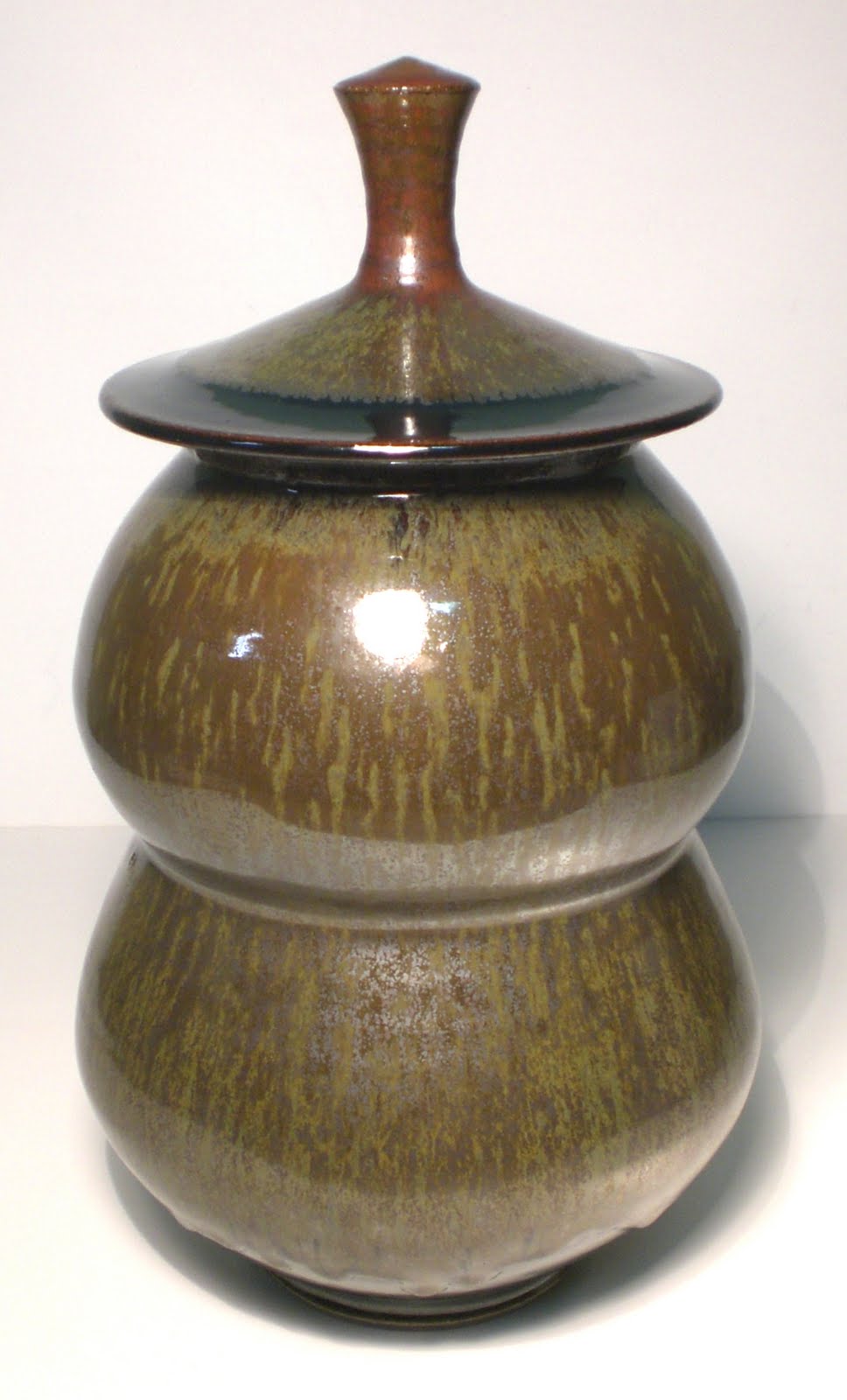
Illustrated is wespeglas covered jar about 14” with long cascading trails of the partridge feather glaze over my temmoku. The close-up illustration is a group of three “lip-bowls” in the same glaze combination with pulled lips and stamped decoration around the bowls.
Friday, April 22, 2011
IPTV; TAKAUCHI SHUGO VIDEO SHORT
(Illustration used with the permission of a private collector.)
Wednesday, April 20, 2011
PART & PARCEL
Despite the task at hand and the loud music in the background, it is hard to focus on glazing and kiln loading. As I work, my mind drifts to the number of Japanese potters, especially in and around Mashiko, that have lost not only their gas and wood kilns, but their homes as well. Though I know how resilient potters are and can be, I can not help but think about the loss and all of the energy (and expense) that will have to go into rebuilding their kilns, studios and places for family and students. I am humbled by their ability to cope and write about their ordeals in what seems like a stubborn cavalier outlook. I suspect they are just counting down to when they well be potting again in the very near future.
I am just always struck that despite the fact I have done this numerous times before, each glazing is just anything but routine. That is the real surprise. At this point of my potting life, you would think this would just happen exactly like every cycle before, but that never happens. Quite possibly this is a really good thing. Keeps me on my toes and ready to adapt to varying forms, numbers of pots and how they will all fit into the kiln, not to mention where they should fit in the kiln. Like most kilns, the top is maybe 20 degrees hotter than the bottom and this does have its impact on the glazes.
The kiln is now all loaded and ready to go. I will fire it off tomorrow and by early evening it will be in the hands of the “kiln gods”. I can only hope that I have played my part to the best of my ability and let the unseen variables do their best to make for another good firing…………….
“Nothing is really work unless you would rather be doing something else.” James Matthew Barrie (1860-1937)
Monday, April 18, 2011
WOULD YOU LIKE TO SEE MY ETCHINGS?
Over time, I settled on simple wax as the resist and a solution of the cheapest vinegar I could find mixed with water (4 parts water to 1 part vinegar). This combo has proven to be the best for my uses together with a stout sponge and the right touch not to break the greenware. Illustrated is a before and after picture of an etched porcelain teabowl. The etched design is of the kanji “JU” which represents long life or longevity. I refer to it as O-Ju, the Big Life, and it is bordered by a net design. The teabowl is glazed in my temmoku and haiyu glazes, which despite softening the visual of the design, the etched surface is very tactile and as a recent client commented, “it allows you to feel the JU”.
Friday, April 15, 2011
JUKO-SHINO
Like Tsukigata, Murata’s pathway started early on in pottery. He sought out potters he could study with that would help him answer his questions about clay and the Mino tradition in particular. Early on he worked with Kato Kobei V whose heritage connected the old style Shino and Mino tradition with the burgeoning revival of the Momoyama aesthetic. From there he went on the study with 20th century legend, Kato Tokuro. From Tokuro, he would have learned the essentials of technology, firing and the many facets of Mino pottery; Shino, Oribe, Seto-Guro, Ki-Seto, to name a few. After leaving the workshop of Kato Tokuro, he finished his education with the tutelage of Kato Hajime. Whatever questions about aesthetics and technology that may have remained, he would have found answers with Kato Hajime. Hajime, designated Ningen Kokuho, was a master of form and surface. He mastered whatever he set after and was as adept in Persian blue with underglaze gold all the way to Bizen ware. I can not imagine three greater teachers to prepare one for the real world of making pottery for a living.
So, he left the realm of study and set up a pottery and built his kiln. His pathway, like Tsukigata, leads him to explore the nature of Shino and its relationship with iron, among other things. In time, using a liberal blend of iron and Shino glazes, coupled with the natural ash deposits of his wood firing, he arrived at his Juko-Shino. The Juko-Shino wares he made are classified as kiln change Shino (Gama-Yohen Shino) and in many cases; the surfaces are heavily coated with ash, in a tamadare style cascade.
Where Tsukigata and Murata differ is in the nature of their pieces and the depth of the surface. Murata’s works tend to be more on the conservative side and along the lines of proven archetypes. His surfaces also have a bit less depth than Tsukigata, partially, I believe, because Tsukigata took on glazing and firing with every ounce of his being. Murata’s glazing and subsequent firings fall on the more conservative side and possibly end up more intimate and less aggressively masculine in appearance. Throughout his career, Murata exhibited widely and was published in a wide variety of books on tea utensils and/or chawan specifically.
Illustrated is a large Juko-Shino (Gama-Yohen Shino) chawan by Murata Juko. This chawan is a wonderfully rounded piece with a thick, translucent feldspar Shino glaze coving the exterior with vivid areas of iron glaze accenting the surface. The exterior also has areas of a thin layer of natural ash glaze coating the Shino like a thin coat of glass. The interior has a thicker layer of iron with iridescence where the glaze has pooled at the bottom. All in all, it makes for a rich visual surface that coats the well conceived form and steps away from our usual concept of Shino. Potters like Murata Juko, Tsukigata Nahiko, Kumano Kuroemon and others, push our concept of Shino into a whole new realm, this chawan is no exception.
Wednesday, April 13, 2011
BOTA-MOCHI
As most of you know, wood firing doesn’t allow for many mistakes of line or form. The pot either is or isn’t a wood fired pot. I think back to my first wood firing, anything was fair game for going into the kiln. The results were the beginning of my education with many of the pots looking horrible and should have never been wood fired, rather fired with glaze. Over the years as potter and collector, I have studied what makes a good wood fired pot using the Western and Eastern potters as examples from Kirk Mangus and Jeff Shapiro all the way to Kakurezaki Ryuichi to Kaneshige Toyo, Ningen Kokuho.
Illustrated is a classic, sturdy and simple form that stands the test for wood firing. This simple cylindrical Bizen vase was made by Yoshimoto Tadashi (b. 1944) who studied with legendary potter, Kaneshige Toyo. This vase exhibits a variety of ash effects from goma and sangiri to the vivid bota-mochi areas of bright orange bare to the clay body. This vase has it all and reminds me of one of those computer generated visions of some galactic far away nebula “burned” on to the clay surface. From my perspective, this pot was made to be wood fired…..