Illustrated is a chawan made in the mid-1980s by Funaki Kenji, thrown out of a coarse, iron rich clay that was then covered in a white slip. The slip has been very simply combed, a style his father Michitada was also well known for and then the pot was glazed to create lighter areas around the form to show off the decoration. This style of ameyu glaze is another mainstream feature of the signature Fujina-yaki style that Bernard Leach first lauded as classic pottery folk craft , mingei in practice. This chawan is finished off with a simple foot that aids in collecting the glaze and allows the potter to get a firm grip when dipping the piece in glaze as well and the interior of the foot is well excised of clay leaving no fancy or superfluous flourishes as one would expect from this style of pottery. At the end of the day this chawan stands the test of the mingei moniker and though simple and unpretentious it is hard to ignore the "beauty born of use" concept baked in this quiet and capable bowl.
Wednesday, March 9, 2022
FUJINA-YAKI
Monday, March 7, 2022
STARTING WITH THE BONES II
Quick update, illustrated is one of a group of teabowls I made trying to get to the simplest form that was practical and had movement and eye interest. The clay I used was a new stoneware I am mixing up with sand mixed in of varying size. Once thrown the forms were slightly altered by minimal faceting or scraping the surfaces to expose the clay and sand with the intention of using my Oribe, Kuro-Oribe or this iron yellow (saffron) glaze over a thin Hagi style white glaze (haku-yu). As you can see in the picture gravity has once again done a good deal of the heavy lifting in decoration this teabowl with the addition of the faceted areas adding a diagonal movement to the surface. Having opened up the clay surface prior to glazing the surface now is uneven and punctuated with areas of pits and highpoints from the protruding sand and grit making for a very textural appearance and feeling in hand. I think that with this group, there are several more to fire in an upcoming firing, I have gotten pretty close to basically starting at the beginning with the advantage of having some amount of experience and technology to add to these elemental forms.
As a postscript, like most of the glazes I have been working with, each light source creates its own version of the surface and ultimately the bowl.
Friday, March 4, 2022
F+WJH=SG
Though not necessarily known for his haikaburi (Shigaraki) style pots, I have seen quite a few and it is obvious that this sturdy vase was fired in a great spot in the kiln producing a rather wonderful surface painted by ash and flame. Of particular note is where the ash built up on the right side of the vase, the ash has pooled on the depressed shoulder and then the clay eroded just a bit unleashing the small but noticeable waterfall of molten glass now forever frozen in mid-stream. In the end where ever you fall on the like or dislike wood fired pots it would be difficult to just walk past this vase without giving it a more than thorough once over and thinking it is maybe betwixt and between then and now.
Wednesday, March 2, 2022
DIVERSITY
Monday, February 28, 2022
TEA JAR
Friday, February 25, 2022
MASTER'S SHADOW
"A teacher affects eternity; he can never tell where his influence stops." Henry Brooks Adams
Wednesday, February 23, 2022
DIFFERENT PATH
I find a real attraction and appeal to modern pots that straddle the various time zones of past and present and show a reliance and homage to the classical archetypes from varying traditions and styles. In this classic mizusashi there are key indicators and elements of both the old and new within the tradition of Tamba pottery. Though perhaps not a household name outside of Japan, Ichino Toyoharu of the sprawling Tamba Ichino clan made this straightforward and honest mizusashi with that blend of regional classicism and his personal flair of what is modern Tamba. The form of this mizusashi is somewhat simple but with the addition of gestural lugs and potter's marks around the surface, the form becomes much less stiff and form with an the atmosphere of a casual object that still embraces all of the functional obligations of the tea ceremony. Fired in a nobori-gama wood kiln the surface has received just the right amount of flashing and ash to bring the pot to life without hiding or obscuring the marks and details that animate and articulate the form while creating a focal point on the face of the pot that is hard to ignore.
Beyond the basic honesty of the clay, there are other features of note on this simple pot from the exacting fit of the lid, the wetness that embraces much of the form and the iridescent flashing on the base of the pot where the piece was set on wadding and fired. I may sound like a broken record but this is yet another example of a classic and simple pot that gives back to the viewer through various obvious and subtle details as well as the totality of the pot itself, I wonder what different path the tea ceremony would have taken if not for simple pots exactly like this mizusashi filled with purpose, sincerity and tradition.
I am reminded of this quote by John Lyly; "The true measure of life is not length, but honesty" and I think as it pertains to pottery, it just may be that it is the honesty that makes for the long life of any given pot.
Monday, February 21, 2022
JUST ONE OR TWO MORE
Friday, February 18, 2022
KO-CHAWAN(?)
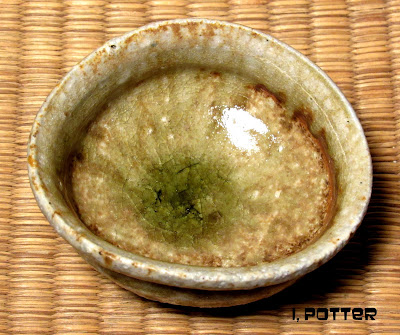
I really love guinomi that though lacking the size have all the characteristics of being a chawan and this glistening Iga guinomi fits that to a tee. Set on a carefully crafted kodai, the posture and undulation of this form reminds me of a wide array of chawan from Iga to Oribe as the anatomy of the bowl is in motion, animated while bathed in a rich coat of ash both inside and out. The interior landscape is like a diminutive valley complete with a deep pool of sea green where the ash collected and melted creating a focal point for the eye each and every time the guinomi is poised to be drunk from. This miniature chawan is alive with all of the best attributes of its larger cousin and shouldn't be faulted for its scale.
Made by Umehara Isamu, this Iga guinomi was fired in a wood kiln which the potter also turns his hand to other traditional Mino pottery including Iga, Shino, Oribe and Mino-Iga as well. Umehara is just another potter who though embarked on a normal day job career turned his attention to pottery and moved from Osaka to Utouzaka in Gifu Prefecture and by 1987 was completely immersed in Shino, Oribe and Iga pottery. Beyond his pottery skill, Umehara is also a well accomplished designer and builder of kilns, one of which was built for the late Kato Tokuro. Specializing in chadogu, this guinomi is perhaps not the best example of his work but having seen just shy of a couple of dozen of his pots, I can say that what I have encountered has all show the same dedication and attention to details that tends to make a pot both conversant and memorable and what more can you expect from any pot, especially one that fits in your (well my) closed hand?