Friday, January 6, 2023

"IT'S ALIVE"

I must admit, when I first saw this piece and this glorious surface all I could think of was how alive it was, how it just moved and shimmered from every angle, possibly as good as it gets. Just a few simple elements, a wood fired kiln and some heat and like in the old version of Fritz Lang's FRANKENSTEIN, "It's alive". It may sound hyperbolic but of all the Oni-Shino pots by Tsukigata Nahiko I have never seen a surface quite like this, fractured green glass over layers of Shino make for a surface filled with movement and raw, almost palpable emotion despite the pot fitting in just one hand.   Illustrated is just one detail shot of a very classic but extraordinary Oni-Shino chaire made by Tsukigata Nahiko presumably in the mid to late 1980s. Looking a bit like a diminutive tsubo, this chaire has layers of iron and feldspar Shino which have taken a thick coating of ash over the surface that has cracked and crazed creating a vivid and shimming fractured surface that is animated and just a bit intoxicating in its natural presence. As I mentioned I have seen quite a few Tsukigata pots in person and in pictures and this surface, at least this part is what happens when just everything goes right, the surface was applied to perfection, the place in the kiln and the subsequent encounter with heat all go just as smooth as silk. I think this is what every potter hopes for and is rarely rewarded with as I see it this may well be  the definition of ceramic kismet!

Wednesday, January 4, 2023

IMPASTO JAR


 A few firings back I made several covered jars in the style of this illustrated one. They vary a bit in overall dimensions, taller or wider proportions but they were all decorated in a coating of impasto style slip and either Oribe, Kuro-Oribe or saffron yellow glaze surface. This particular covered jar is Oribe over an impasto slip with just a hint of iron over the surface and to complete the jar, all of these had two lids made for each to provide an option for the new owner. Though the lids are almost identical it is the knobs that differ, one is the St. Louis Arch style and the other the time-machine Gumby style which originates from an idea from the old TIME TUNNEL TV show of the 1960s, have to take your inspiration from where ever it springs. These jars are not too large, fit just about anywhere from countertop to book shelf and are built for use even if that use is sitting on a shelf and collecting a bit of dust now and again.

Monday, January 2, 2023

ASAHI USAGI
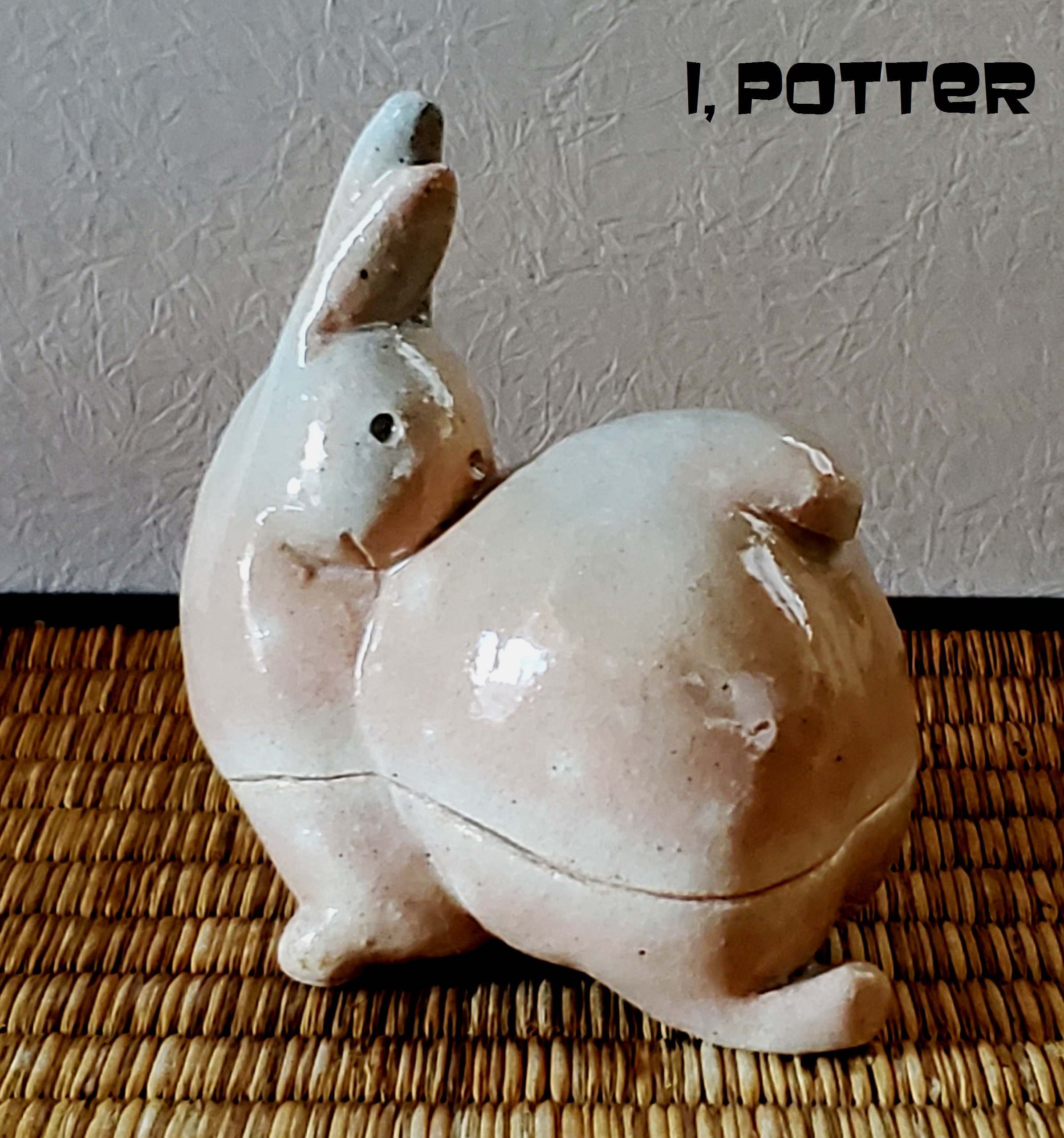

I know I have written about Matsubayashi Hosai XIV in the past and recently I found a simple Asahi-yaki Usagi kogo. Though in a signed box by Hosai XIV, it is more than likely studio ware but never the less a nice reminder of an interesting encounter. Found on the ubiquitous auction website a few months back, I thought this would make a nice Christmas gift for my wife as well as help usher in the New Year, the year of the rabbit. Though pale in appearance, there is some very attractive blushing to pink as well as very subtle gohon spots here and there all indicative of Asahi pottery and of the Matsubayashi family. Though this little rabbit is a simple eto-omiyage it has a pleasant demeanor and has just the right amount of playfulness to make for a perfect little kogo and a nice little gift and as I am reminded now and again, it surely beats a lump of coal.

https://albedo3studio.blogspot.com/2018/06/a-wrong-turn-made-right.html


Friday, December 30, 2022

AN ALCHEMIST'S FORMULA

The other day I ended up using a Shigaraki chawan hidden in shadows and highlighted by sunlight for a Season's greeting photo and thought best to show the piece in a more formal portrait. This haikaburi style Shigaraki chawan was made by Kohyama Yasuhisa when back when in Showa 48 (1973) and is illustrated in an exhibition catalogue from that year and in person or illustration has that timeless appearance. Though a rather early chawan by Kohyama, overall he has maintained a rather recognizable style from form, lip and kodai and because of that this the classic fore-runner of chawan made decades later. As for the surface created by one of the earliest anagama in The Valley since the 18th century, there are three distinct panels from crusty, dark ash to thin glass to rich fire color punctuated by small ishihaze, stones and feldspar popping out here and there. Added all together, the features like an alchemist's formula come together to create a bowl that sits rather nicely in the hand or on display and offers all of the tidbits that contemporary Shigaraki pottery is well known for. 


Wednesday, December 28, 2022

GOING BACK TO MOVE FORWARD

Every now and again I find myself going back to move forward, not exactly to the drawing board but rather to a way and style of working that I have moved away from. In this case, though I am constantly working in terra cotta which is about 80% of my out-put, I decided to do some black and white combed slip pieces in an Oribe and an amber glazed surface using stoneware. For the firing this covered jar came out of I made about a dozen or so covered jars, all black and white slip, some trailed, others brushed and combed in sized from about 12" to 15" in height. 

This particular jar was slipped and combed and has two lids, the interior lid and the exterior one that fits over the neck of the pot. I was, am pleased with how they came out and really like the pattern created by the comb showing up as a rich, darker color through the transparent Oribe glaze. In many respects a see a lot of my old mentor Bill Klock in these pots together with the wide array of historic pottery made in this style with a hint of a Japanese flair through the use of an Oribe style glaze. These were rather enjoyable to make, I like the honesty and directness of such pots and I hope that I circle back to making a few more pieces including larger jars and plates/bowls in the near future as now that my wife has snagged one of these jars she informed me she needs a "good size" plate for the wall and to use on the right occasions.

Monday, December 26, 2022

ONE HIT WONDER

I have to admit when thinking about the Iga and Seiji potter, Kishimoto Kennin, Ki-Seto is about the last thing that springs to mind but that is exactly what we are looking at proving he is no one hit wonder where it comes to surfaces. This is neither my pot nor my photo, this chawan belongs to a fellow collector and is an earlier piece by Kishimoto showing off a classic form and somewhat unique glaze surface that along with all of his other surfaces, he has managed to make this Ki-Seto particular to his studio. Beyond the form, the slightly meandering lip, protruding rib, centrally located and the fast spatula work breath the right amount of movement and life into this chawan making it somewhat enjoyable in the viewing and presumably even more so in the using.

Friday, December 23, 2022

GRAND PURPOSE

Looking a bit like a battlefield of both competing and complimentary textures and hues of color, this Oribe chawan is evidence of modernity in a tradition that has proliferated chadogu for nearly five centuries. This Oribe chawan was made by Tsukamoto Haruhiko and is the embodiment of a new spirit within the Mino tradition where the old and new collide to create new surfaces, forms, styles and firing techniques to add to a long standing tradition. Though many of the features may appear traditional from form and playful exterior, the way in which textures, slips and throwing and tooling are employed, there is a distinct freshness to much of Tsukamoto's work, there is both animation and abstraction worked into the clay which springboards off the playful intent of the earliest Oribe ware. I think what I normally bring away from after a Tsukamoto Haruhiko encounter is a sense of being visually and texturally amused and though they are designed and made for use and ceremony both, harnassing both exuberence and solemnity in a three dimensional form is likely their grandest purpose.

Wednesday, December 21, 2022

1.5÷15=ftb

At the end of the day in which I got less done than I had hoped, I had a few minutes to spare and just about 1.5lbs of clay so I decided to see what I could get done, start to finish in 15 minutes. To be honest, I kind of cheated in that given a recent encounter, i decided to make something that I have made in the past though not for some time or in recent memory. As you can see in the picture, I ended up making a fluted teabowl (ftb) that now tooled and fluted is quite a bit lighter than it started. The original inspiration for these bowls (and jars) that I made came from a 16th medieval suit of armour* most associated with Maximilian I or II, known as Maximiliansharnisch or Riefelharnisch where the armour is heavily fluted to create a stronger more defensive surface against weapons of the 16th century. 

My intent was to create an organic form which was curvy and imitated the upper torso portion of the armour (cuirass) which also serves as a great way to handle the pot once completed. Before this bowl goes to bisque I will gently sand and round down the ridges to remove the sharper protrusions and then decide how to graze it, maybe Oribe would be a good choice! All in all, using my handy stopwatch, now encrusted in clay, from wedging to tooling the bowl took 13 minutes and 22 seconds, shy of the 15 minutes I allot myself but this being a somewhat practiced form and technique the time should have come in even shorter. As I have mentioned before, anything worth doing is worth doing even faster the next time.      

The second photo shows the finished fired maxarm teabowl that I had made as a mad dash project. As may seem totally uncharacteristic of me, I opted for my Oribe glaze with a fine addition of iron over the surface. At the termination of each channel the glaze has collected creating a dark, rich pool that has an eerie effect under the most intense light source.  

(*I should mention that since my suit of Maximilian armour is at the dry cleaners a simple web search will give you the necessary comparative illustration that you may be intrigued by or you could follow the attached link. ) 

https://en.wikipedia.org/wiki/Maximilian_armour


Monday, December 19, 2022

NIGHT & DAY

When I look at this large bottle, I just marvel at the atmosphere that it gives off, somber, brooding and purposeful straddling the realms of utility and appreciation, all attributes that make for a powerful and direct pot. Though I knew the maker immediately, you can see some elements of Karatsu-yaki in this bottle though if you know the potter, Sakata Deika XIII (1915-2010) it is quite clear that this is but one facet of how this potter sees and interprets Hagi in modern times. Full of volume and graceful bearing this stoneware form is the perfect setting for a surface that runs with hues of creamy off-white, lavenders and pinks all punctuated by effects created by the clay surface to dark, almost ominous overtones on the rear that paints a dynamic landscape moving from the light into darkness, like night and day.       

Born in 1915, Sakata Deika assumed the mantle as head of the Fugawa-gama (Yamaguchi Pref.) where he settled in and pioneered research into the recreation of the classic Ido style chawan of his ancestry. Having a career that expands over such a long time, Deika XIII left works in a wide array of styles, surfaces and forms among which this bottle and surface seem to be prevelant right through the 1990s though this piece dates to the late 1970s. Aside from Sakata Deika's classic Ido chawan, it is clear that he was dedicated to the Hagi tradition in which he spent a lifetime combining the old with the new with a clear eye on expanding the tradition, moving forward and bringing along hints of a modern aesthetic along for the ride.

Friday, December 16, 2022

FULLNESS

Glazed and wood fired, what really draws me to this Tamba tokkuri is the fullness of the piece, the captured volume that creates a taunt form, ready to burst or perhaps just be used spilling all of its contents. Made to be used, the surface of this tokkuri is a delightful collage of creamy, running glaze over an ash glaze with areas of iron while punctuated with stone and feldspar emerging from the clay to add further accents the pot. At its core this is a simple tokkuri, skillfully thrown with a purposeful base and mouth capping the structure, centuries in the designing though clearly of a more modern age this is a pot full of movement an in the moment. In all respects Nishibata Tadashi has taken what would seem to be an everyday pot and stretched its use, definition and aesthetics into an amalgamation of old and new, simple and complex and most assuredly the familiar into the distinctive vision of a potter building on the Tamba tradition who creating uncommon works along the way.