Monday, July 12, 2010

PATIENCE


I am in the midst of a terra cotta cycle right now which entails throwing, tooling, bisquing and glazing. A standard cycle usually lasts about 3 weeks. I am also in the midst of making up some glaze tests for some of the terra cotta pieces. In the past, I would have taken a glaze I had used previously and just made up 6000gr. of glaze in a in for a penny in for a pound style impetuousness. I have learned my lesson. In other words, “fool me once, shame on you, fool me twice, shame on me!”.

To illustrate my early folly, back in the very early 90’s, I happened on a copper red glaze formula. In the next firing, I put several pods in the kiln at varying places. The pods came out incredible, the best copper red I had seen, let alone ever made up. I was sold and made up 10,000 grams of glaze and fired a whole Alpine gas kiln full of porcelain. As I open the kiln, I learned a hard won lesson, never put all of your eggs in one basket. I had nearly a hundred pieces of what everyone was jokingly calling liver ware. The best learned lessons are ones that you have to go through.

I have moved some many times now that I am constantly surprised at the variables that will alter a glaze. In our first big move from Cleveland to NH, as soon as my studio was up and running, I set about throwing terra cotta and making up a few glazes for cone 04. None worked. The variables are many, but one of the main culprits was the use of well water. In my moves I have found how water high in iron, calcium, copper, etc. can alter the slips and glazes and change them beyond recognition.

Now days, I am a bit slower to leap before I look. Staying in the Northeast, I can at least control my clay and glaze materials, but the water source is a big variable. We live now, where we use well water that is both iron and calcium rich. I am trying to alter the glaze accordingly and will test before I go and glaze a kiln load of pots in glazes that I haven’t used since we moved here to Little Falls.

I know this just sounds like common sense, but there is nothing common about it. Some lessons have to be learned the hard way and I am determined not to repeat mistakes that I have made before. More pods, more glaze tests, more test bowls, each a valuable step in proofing glazes that have worked in the past and will hopefully work tomorrow.

Friday, July 9, 2010

THE UBIQUITOUS CHAWAN


I first encountered a chawan when I was in my mid-teens, I was more interested in swords, so it basically went unnoticed until my wife and I went to the BMFA and saw the LIVING TREASURES OF JAPAN exhibit. It was there that we were confronted with chawan unlike any we had seen before. The works of Arakawa Toyozo, Ishiguro Munemaro, Miwa Kyuwa and Nakazato Muan were prominently displayed. Shortly after that the KIKUCHI COLLECTION, JAPANESE CERAMICS TODAY made it to Washington. It was a shock to the system. Though I had no cultural relationship to the chawan or chanoyu, the teabowl itself had captivated my imagination.

I just couldn’t define the impact those two exhibits had on my psyche. I was mesmerized by the seeming simplicity and infinite variety of the chawan. I began an earnest study of the history, form, styles and nuances of the teabowl. I handled every chawan I could and those that were copies of the teabowl made by western potters. In essence the teabowl form had somehow run over my entire being and I began to realize how little I knew.

As collector and potter, I focused on the different sugata (form), kodai (foot), mikomi (tea pool) of any chawan I could handle or look at. Realizing I was not trained in the art of chanoyu, my direction was based on the many interpretations of the form. I wasn’t trapped in the absolutism of traditional convention and was able to, as most western potters are, to make a pot based on the teabowl archetypes.

As I began making pots, I focused on the teabowl as a form to pursue and interpret as I saw it in my mind. Over the years I have worked from cone 04 to cone 14, in stoneware, porcelain, earthenware and terra cotta from electric, gas, wood, salt, soda and raku and along the way, I am always trying to work out different forms, surfaces and designs with the idiom of the teabowl and doubt I have even scratched the surface. It is a fascinating form the shows beyond all other forms the complexity of simplicity.
( The chawan illustrated is a conventional Hagi chawan made by Tanomura Shogetsu, used with permission from a collection.)

Wednesday, July 7, 2010

TERRA COTTA


Working in terra cotta is so much different than throwing stoneware. It is somewhat more akin to porcelain, but even porcelain seems to have more body than terra cotta. The terra cotta I use, I have been using since the very early 90’s. The formula is based on the terra cotta that Dick Schneider used as CSU. I have my clay body made up for me and though it has its quirks and is tempermental to throw, it works well for me. Once thrown, it tools nicely, can be dried quickly and doesn’t warp unless overly abused. I use the terra cotta for my colorful underglazed pots, slipware, tebori ware and majolica and fire it anywhere from cone 04 to 01.

I spent yesterday afternoon prepping to deal with the terra cotta. I had to mix up various slips and underglazes and will be trying out a series of transparent glazes that I have not used for 5 years. Seems the testing is never done here.

Monday, July 5, 2010

KILN UPDATE

The elements arrived on Friday and I started prep to replace the elements that afternoon. I removed all the pins I could find and separated the kiln rings. On Saturday, I removed the electrical boxes and sniped the crimped connectors and removed the elements and replaced them with new ones.

By 4PM I had the new elements installed and started a cone 06 test fire. The kiln fired even and faster than it has been. Just a little bit of swearing and momentary lapses in sanity and the kiln is like new.

Out of my recent glaze fire, I got an adjusted test glaze out. I have been working on a Ki-Seto style ash glaze with copper accents over and under the glaze. This recent test which is a combo of wood and husk ash has come out somewhat close to what I was after. I am after a wetter, more glistening style of Ki-Seto and not the rougher aburagi style glaze like Hori Ichiro. It needs some work and some fine tuning, but ever journey begins with the first step.

Friday, July 2, 2010

OKABE’S PERSPECTIVE


“Fundamentally, no form or shape exists. The fact that the material itself has a reason for existence is the starting point of my work.”

“Clay acquires meaning only in its relationship to fire and glaze.”

“The connection between the materials-clay, shape and glaze- and the factor called the human being brings about the concreteness of ceramics.”
Okabe Mineo (1919-90)

Okabe Mineo was the son of the legendary Kato Tokuro. Much has been written about Okabe, so I will not extol the history and achievements of his life. Let is suffice to say, he was a master of each style he embraced. His Ko-Seto, Oribe, Shino, Ash glazed and celadon works are among the finest of the 20th century. His use of Oribe was homeric in nature, second to none and in my opinion unparalleled in the 20th century.

(The chawan illustrated is an early Ko-Seto ash glazed piece by Okabe Mineo, circa 1950. This piece is used with the kind permission of a private collection.)

Wednesday, June 30, 2010

CONTINUING KILN WOES

I recently had to do some ad hoc kiln repair on my electric bique kiln. I have an Olympic kiln and it has been a true work horse and very problem free. The first problem was solved by replacing my tube assembly for the kiln setter and new switches.

Once repaired, I loaded the bique and off it went. Seemingly no problems, though a bit slower than previously. Now as I am firing another bisque and am having a near impossible time making the last 50 degrees of cone 06, I have no choice but to admit it is time to replace the elements.

The elements in the kiln are just about 5 years old and on average I fire the kiln twice a week, so do the math. I have ordered new elements and when they arrive, the fun begins. Though I have replaced elements several times before, it is always such a long period of time between doing so, that the lead up to the process is always wrought with a bit of anxiety. There is little you can do wrong to replace the elements, but I am just dreading the process not to mention the down time and loss of a day to do so. As usual, I’d rather be throwing!

Monday, June 28, 2010

MARKS


Shoji Hamada was arguably one of the best mark makers in pottery of the last century. His repeated use of the sugarcane motif was casual, engaging and very prominently articulated his pottery. There are a number of good mark makers today; Tom Coleman, Michael Simon and Ron Meyers spring to mind.

Like many potters, though I understand the importance of the mark (and line) on clay and as a decoration, it takes years to develop a vocabulary of marks that work well and are responded to. Good marks add value to a pot and help establish it’s form and gesture.

I use a variety of marks, some from cartoons, historical examples and some just happened on for my pottery. I try to match the right marks with the right surfaces and pots and am always looking to improve with the help of critical analysis of collectors, potters and critics. As Soetsu Yanagi points out; “unless a thing attracts the mind it is not a thing; unless the mind gives life to a thing it is not as yet complete”. Good marks engage the mind, completing a process started by the potter and help bring the pot to fruition.

Friday, June 25, 2010

NEW BIZEN


Whenever I think about Bizen pottery today, I invariably think of the Isezaki family. Isezaki Yozan(1902-61) was the father of Isezaki Jun, Ningen Kokuho of Bizen pottery and his brother Isezaki Mitsuru, Prefectural Living National Treasure of Okayama and Jun’s son is one of the quintessential faces of modern Bizen pottery; Isezaki Koichiro (伊勢﨑 晃一朗 ).

Isezaki Koichiro (b. 1974) has had a rich learning experience having studied with his father (Jun) as well as, being in proximity to his uncle (Mitsuru) and his father’s apprentice Kakurezaki Ryuichi. Koichiro also went to the US and studied with noted wood fire potter Jeff Shapiro. This blend of eastern and western traditions is evident in his pottery and firing technique which is helping add a new definition to modern Bizen pottery.

Much of his work is similar in style to the pictured chawan. His chawan in particular, have been stripped to the bare essentials of form and are nearly minimalist in execution. His work is not only visually engaging, but is seductive in the hand, soft in it’s lines, evocative and enticing. To finish the bowl, the wood firing has left rivulets of ash cascading down the teabowl further accentuating the height and curve of the piece. The foot is also deceptively simple in it’s finish and the roving lip calls you into the interior. Overall this chawan is a minimalist tour de force.

Tuesday, June 22, 2010

FREE TO TEST


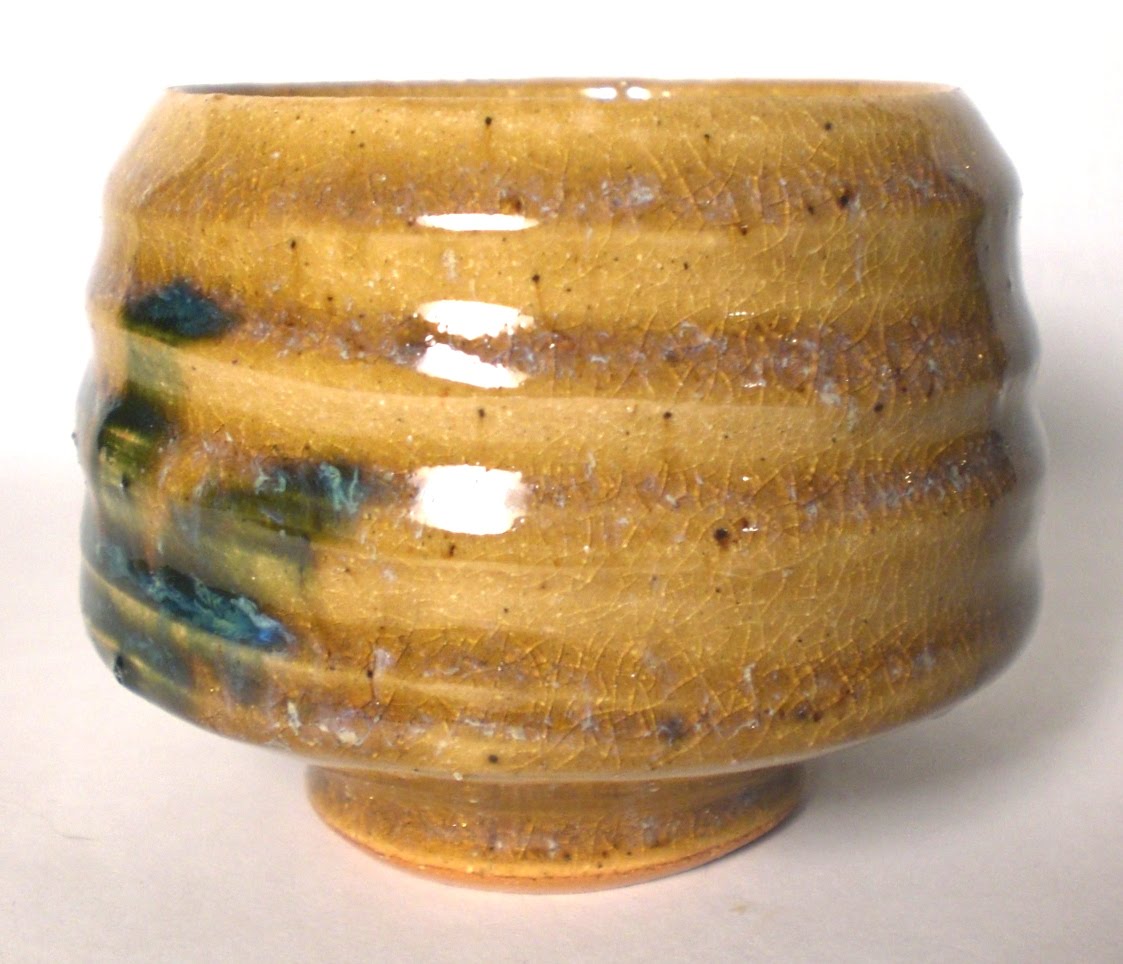
I have been making pots long enough now that I have inherited misc. supplies from various sources. While at Cleveland State the university co-op went under and they gave away a large amount of chemicals and clay. I got quite a bit of colorants, stains and glaze materials that I could use and squirrel away. After leaving CSU, I was lucky enough to get materials from various sources, potters retiring, leaving clay, etc. and I was able to put together a constant pool of usable materials and things I knew were no longer mined and a bit out of the ordinary. I still take every opportunity to get ‘free” stuff whenever the chance presents itself.

Back while at CSU, I used copper sulfate and cobalt sulfate on porcelain with some interesting results. Having recently inherited a small amount of cobalt sulfate I thought to try it out with my ash glaze and see what would happen. I mixed the cobalt sulfate with gerstley borate at 1:1 and mixed it up watercolor thin. I painted a small band around the lip of a teabowl and fired it along with the rest of my pots.

The results surprised me a bit. It ran with long tendrils down the bowl, nearly four inches. Considering the less that ¼” band I painted on the lip, I will need to keep in mind the potency of cobalt in general and the running qualities of the cobalt sulfate/gerstley borate mix. It does make for a rather fluid surface and definitely accentuates the vertical nature of the bowl.

Friday, June 18, 2010

A BOOK GLAZE

When I first decided to go and interview the local pottery professor in Plattsburgh, NY (Bill Klock) I stopped at the local used book store and bought the two pottery books they had; FINDING ONE’S WAY IN CLAY (1972) by Paulus Berensohn and MAKING POTTERY WITHOUT A WHEEL (1965) by F. Carlton Ball and Janice Lovoos. Though neither gave me any insight into wheel throwing, both we very illuminating as to the scope and possibilities of clay.

The other day, I was tooling around Amazon.com and stumbled on the MAKING POTTERY WITHOUT A WHEEL book and have to admit, I was somewhat surprised at one of the reviews of the book. It pointed out that the glaze section of the book was severely outdated. Not to sound argumentative, but how can any glazes, that work, be outdated.

I have been using several formulas, mostly that I have altered a bit, from this book for 20 years. What worked when the book came out in 1965, works today. In fact, one of the nicest blue-green celadons I have ever used came from this source and I continue to use it now and again some 45 years after it was published. Here is the formula exactly as it is in the book;

Choy Blue Celadon Cone10 (weight in grams)
Feldspar 1226
Whiting 150
Flint 496
Kaolin 96
Barium Carbonate 400
Red Iron Oxide 50

I have also illustrated the glaze on two teabowls I have made. The first one shows the glaze right out of the book. The pale yellow-green version was just tweaked a bit. Though most of my glazes started out as book glazes, most have been so altered that they bare little resemblance to the original formulas, but this Choy Blue Celadon is great, as is and I love this glaze and think it is absolutely timeless, many thanks to Ball and Lovoos!