Friday, September 20, 2013

SIDE-EFFECTS

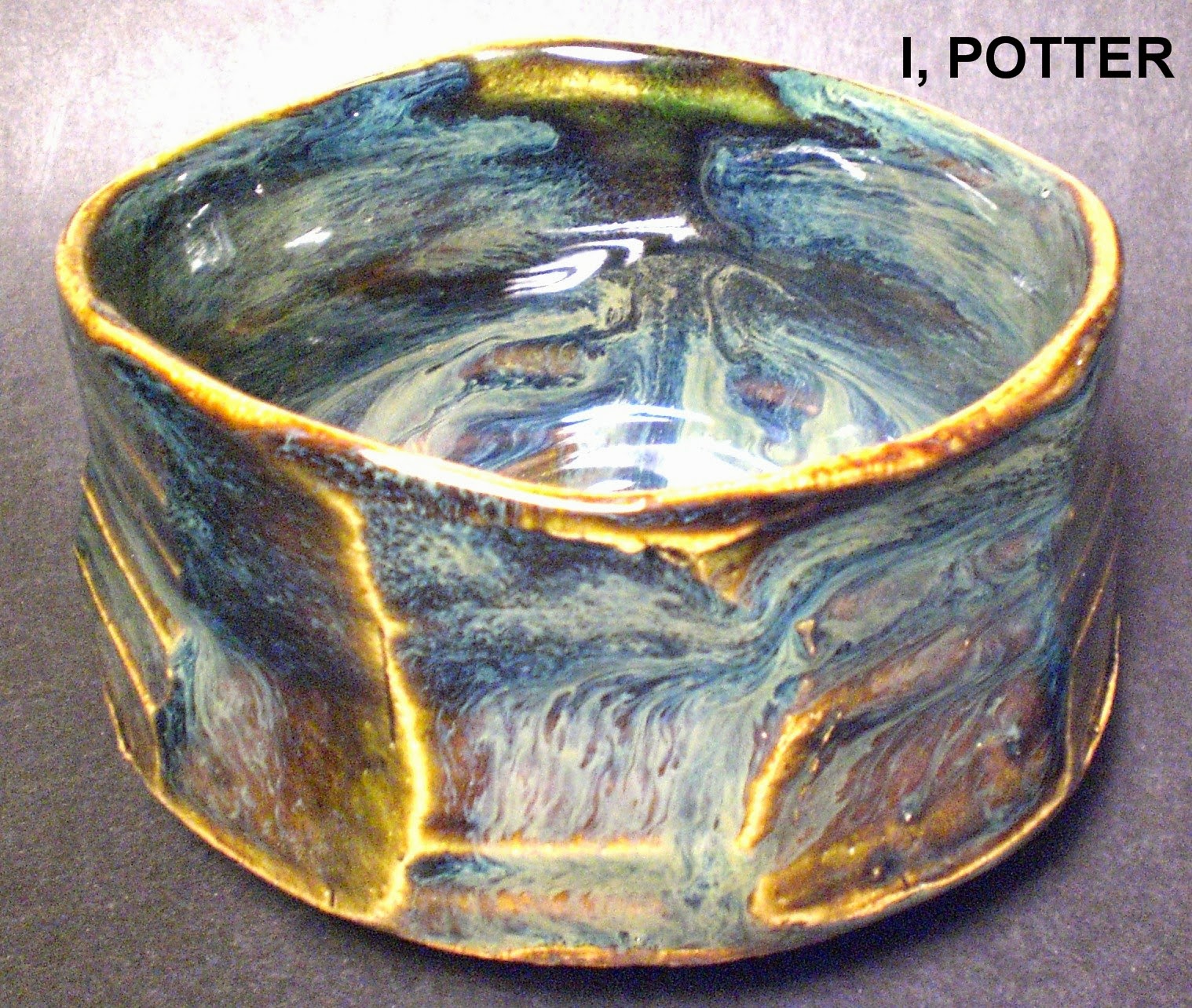
I threw a few stoneware teabowls recently that were faceted while still on the wheel, each then had a hand cut foot to try to compliment the form. Illustrated is one of the finished bowls that was first glazed in my Oribe glaze and then overglazed in the same glaze altered by adding iron and ash to it. The bowls were then fired on wads on their sides, in this case, you are looking at the front of the teabowl which was the top creating interesting side-effects. The base overglaze ran extensively toward the bottom, the opposite side as can be seen from the front and the interior creating a rather nice flow of effects which seem to defy gravity without an explanation added. These side-fired teabowls were a neat experience and obviously the outcome was in question and certainly unpredictable making them all the more interesting and worth making more.
"Experience is a hard teacher because she gives the tests first, the answers afterward." Vernon Sanders Law (b. 1930)

Wednesday, September 18, 2013

JUN-YAO 1996-2013

My longtime companion and studio assistant passed away today. He has been sick for a few short months now and the inevitability was ever apparent. He was ours and to us, was the greatest cat ever and will be sorely missed as I survey his favorite spots and am reminded of his incessant need for attention as well as tuna and very rare roast beef. He was my cat and the best I can hope is that he would have said; "thanks for everything, I had a wonderful time". He was our truly great cat that enriched our lives while here but I am reminded; "one can not cheat time". Rest in peace.
"Good-night, sweet prince; And flights of angels sing thee to thy rest."

Monday, September 16, 2013

FIRST SALE

A few months back, I was contacted by an old friend from my Cleveland days. He was curious if I would like to show my pottery at a new gallery in Ohio which was being developed by his wife. The idea came about as a retail space next to their framing gallery became available so they decided to expand their current business and create a print and craft gallery. Run by Lori Drugan, the gallery draws from a rich collection of mostly 20th century prints and a core group of ceramics people which includes Tom Radka's raku pottery as well as my own. The gallery is spacious and well thought out with unfettered displays and plenty of breathing room to contemplate the works displayed.
On Friday, I missed a call from Cris Drugan as I was busy trimming pots, he called to let me know the gallery was finally open and the first sales in the new gallery were two of my pots. I was of course very pleased to hear that, especially considering it has been a number of years since I have been represented in that area. For anyone in the general Akron, Ohio area, the gallery is located in Fairlawn, Ohio and is run by Lori (and Cris) Drugan;
Gallery of Framing
131 Ghent Road
Fairlawn, Ohio 44333
(303)835-3046

Friday, September 13, 2013

DO YOU HAVE ONE IN BLUE?


This is not meant to sound like a complaint, far from it, the simple fact that people want to buy stuff you make is wonderful. At issue is that many times, invariably so, when someone asks about your pottery, what you have on hand is rarely exactly what they want and isn't this a great excuse for me to throw some more pots! There are a number of reasons for that; the pot is too big, not big enough, it is too tall, not tall enough, it is too blue or in this case not blue enough. After I posted one of the slipped amber ash teabowls I got a query asking; "do you have one in blue?". This has happened countless times, especially since the advent of the internet and most times I tell them, well no, I don't have one currently, but if you would like to order one, I can most likely get it into the very next firing. This response works about 80% of the time, though for some the immediacy or the need for a immediate gift precludes the order process. Luckily enough, in the last firing there were three amber ash slipped bowls as well as three blue Ao+ pieces. I offered the customer a choice between two of the same style, one was picked and off it went by carrier pick-up from the USPS. I may have said this one too many times, but, all's well that ends well.


Wednesday, September 11, 2013

IMPORTANCE

In relation to pottery, there are two distinct ways one can understand importance. The first is the most literal, the importance of a pot in relationship or context to the field of pottery; as in an important Ming jar. The other type of importance is the importance or influence a pot may have on an individual or in this case a potter. The best case scenario is when the two intersect at the same place at the same pot. Illustrated is a pot that qualifies for both, being an exceptionally fine example of the style and a monumental influence on me as a potter. I first encountered this Kawai Kanjiro chawan back in 1992 while living in Cleveland. I was immediately struck by the deceptively simple form of the bowl with the ever so undulating lip and broad and earthy foot. The manner in which it was so casually decorated with what seem to be off handed splashes speaks of the innate sensibilities of the potter and his confidence in his decades of "doing".  In every sense of the word, this is an important pot.

This particular image has been a guiding light for my work, first through dozens of photographs of the piece, later multiple jpegs and now even video (mpeg) footage of the pot. Through all of these images, I can study the varying nuances of posture, form, foot, glaze and decoration grasping the essentials of what became second nature to Kawai, who would have been in his 60's when this pot was made. I am sure that Kawai had little thought to the importance of this pot or the influence its shadow would cast, but that does not alter the fact that his works have found their place of importance in history and have influenced more potters, both knowingly and unknowingly, than could be counted.

"Every thought which genius and piety throw into the world alters the world." Ralph Waldo Emerson

(Used with the kind permission of Mr/Mrs Private Collector)

Monday, September 9, 2013

ONI-SHINO TAMADARE

Illustrated is a fine Oni-Shino vase by Tsukigata Nahiko. This form is one Tsukigata used quite frequently with sizes ranging from about 8" up to as much as 16". On this particular piece, there is a wonderful interplay of the iron and the white Shino glaze with a rich and vibrant green ash running down the face of the pot indicating its position in the firing. Tsukigata fired his pottery in an anagama much like his master, Arakawa Toyozo; the main difference being the intensity to which it was fired and the determined encouragement of ash build up that would then melt and run along the surfaces of his pots in tamadare fashion. If you look at this vase, you can see where the bulk of the ash built up on the upper third of the pot and then when the temperature was just right in the kiln, it began to cascade down the surface adding to the varying effects of the iron and Shino. Though I can imagine the pot without the contribution of the ash, it is not only the glazing, but the ferocity of the process that make Tsukigata's work truly unique and stand alone among the wide array of pottery now called (erroneously) Oni-Shino.
"Though old the thought and oft exprest; 'Tis his at last that says it best."  James Russell Lowell (1819-1891)

Friday, September 6, 2013

THICK AS A BRICK

Illustrated is another pot from the last firing, glazed in an amber ash over temmoku combo. I have been working on getting slip thicker and at some places, the slip exceeds 0.25" by quite a bit. This cog inspired bowl was first slipped and then the texture created using an old credit card. If you look at the base of the bowl, you can see where the slip channeled running ash and created an unexpected secondary texture of a thick, rippled glaze roll. I am continuing to work on this technique, getting the slip thicker and thicker but in the back of my mind I know at some point, it will all go too far. Ultimately the slip will flake off in the bisque or shiver off after the glaze, I am just compelled to find out what that point is. I wonder if it is the technique or the potter that is thick as a brick?

Wednesday, September 4, 2013

FOOTSTEPS

At first glance, this Iga chawan has the classically medieval  style of the late Furutani Michio, but upon closer examination, there are subtle differences. The form a bit different, a bit tighter in  the way the pot is thrown and the kodai is created, telling his own story. This chawan was made by Furutani Kazuya, son of Furutani Michio and quite the apt pupil. Relying on forms forged by his father and exceptional firing skills, this teabowl follows in the footsteps of his father's body of work, but it is quite clear, Kazuya has his own voice and chapter to write within the traditions of both Iga and Shigaraki pottery. In this case the idiom, "the apple doesn't fall far from the tree" has rarely been more apropos.

Monday, September 2, 2013

BLUE MONDAY XIII

Salt fired in the last chamber of his nobori-gama this rice-bowl inspired chawan is a lovely example of the work of Shimaoka Tatsuzo (1919-2007). Taking a number of cues from his master, Hamada Shoji, this simple, yet elegant salt fired bowl has his patented Jomon-zogan technique using rich cobalt contrasted against the pale green salted surface. The generous form and crisp cut foot are complimented by the band of cobalt which seems to hold the pot together like a taut belt while the angle of the inlay yields perpetual motion. The bowl pays homage to not only the work of Hamada but the countless number of folk potters who proceeded and inspired them both.

Friday, August 30, 2013

ANTI-Q

A friend sent me this picture recently and at first glance it looked like an antique Seto pot, turn of the century or a bit older, until I really looked at it. Though I doubt I would have guessed who made it, the brushwork was very familiar.  What is obviously based on old Momoyama style suibokuga, the decoration is an abstracted landscape which speaks of far off places and a very tranquil and calming atmosphere which the form echoes. I marvel at the abbreviated and direct decoration, it speaks of nearly an infinite variety of landscapes and places we all know and love. In its own way,  it is any place we can imagine, painting a grand illusion in its brevity. What ends up being a rather powerful and evocative brush stroke is an excuse to get lost in a myriad of possibilities.
In truth this is not Seto-yaki, rather it is Iga pottery, not the Iga that normally comes to mind, but rather the place it was created and the potter, Banura Shiro, is every bit the Iga potter. Working in styles influenced by much older pottery and the Rimpa tradition, Banura created work that relies on common designs, motifs and decoration, but used in a potent and original manner while making them best fit three dimensional forms, a skill he excelled at. First dipped in a coat of white slip, the iron brushwork is applied, over which an ash based translucent amber glaze is used and the results are quite wonderful. It ends up being a rather earthy pot which exudes charm and at the end of the day, this is one of the most antique modern pots I have seen in some time and this but another skill of Banura Shiro.
"The closest way into the universe is through a forest wilderness." John Muir