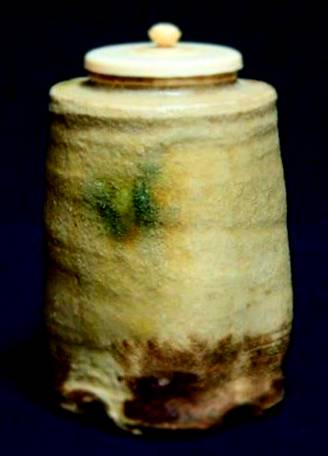
Making wonderful use of the marriage of shape and surface this chawan was carefully manipulated to create a more dramatic effect and just the right amount of movement that brings a pot to life. I find this chawan pleasing to the eye and hand with a soft, blushed color that in some respects reminds me of a winter trying to hang on while the spring is in a hurry to take over. It is hard not to enjoy the narratives that Tsukigata paints on the surface of his pots substituting clay, glaze and fire for oils and canvas, either way, it paints a rich portrait that brings more depth of meaning to such a simple teabowl.
Showing posts with label momoyama. Show all posts
Wednesday, October 28, 2020
DNA
The
box that accompanies this chawan is simply marked, SHINO CHAWAN which in truth
is a faithful description that leaves out some of the details that one can
clearly see with just a simple glance. Thrown out of a fine clay this bowl has
that classic Shino sense to it, part Momoyama and part modern in its DNA but it
is also clearly recognizable as a chawan by Tsukigata Nahiko. Though I see
those influences, including a dash of Arakawa Toyozo in the shape, posture and
lip, I also clearly see that this is a near textbook "plain" Shino
chawan by Tsukigata.
Labels:
Arakawa Toyozo,
chawan,
momoyama,
shino,
tsukigata nahiko
Wednesday, October 7, 2020
F.C.E.
I'll
be perfectly honest and say that I really don't know a lot about the potter who
made this sweet Ki-Seto guinomi but when I first saw it, the reaction was
visceral. Made by Iwatsuki Takemitsu (b.1949) this guinomi is part of a body of
work mostly influenced by Momoyama pottery with a specialty in Ki-seto where he
has spent 30 years experimenting with the right combination of clay, ash and
firing techniques to try to reproduce a surface that he has set in his mind's
eye. As for this guinomi it has that wonderful quality of at first appearing
like a miniature chawan, the great posture and form are complimented by the
sparse use of Ki-Seto glaze over incised decoration with copper accents. Even
in this static photo, the pot is in motion with the variety of alterations to
the thrown form aiding in this production from undulating lip, pinched and
altered body and the accentuated lines around the waist and at the base create
this perpetual motion. Though this guinomi is not made by one of the great
Ki-Seto masters if Iwatsuki was after
capturing the character, playfulness and spirit of the Momoyama antecedents, he
has done a pretty good job, definitely a first class effort.
Labels:
Arakawa Toyozo,
chawan,
guinomi,
hori ichiro,
kagami shukai,
kato kozo,
ki-seto,
momoyama
Friday, June 21, 2019
GLASSY GEM
Illustrated
is a classic and rather wonderful chaire by Raku and Iga potter, Konishi Heinai.
As with many of these photos, this is
not a photo I took or a pot that I handled but I certainly thought it worth
sharing as a stellar example of Konishi's work which at first glance almost
appears like it was dipped in a glass tank and coated in a beautiful coating of
rich bidoro. The form is strong and medieval in appearance with a simple, even
subtle design rendered around the pot which is further accentuated by the all
natural ash that has covered this chaire. I have seen and handled a number of
pots by Konishi Heinai over the years and can say without hesitation this may
rank as the finest and my favorite chaire by him that I have seen; the surface
is electric and shimmery like a coveted glassy gem which in all likelihood
would be hard to play second fiddle to the chawan in use during the tea
ceremony. Though this could be considered ever so slightly old school, I
believe that pots like this will keep traditions like Iga on the straight and
narrow and serve as an archetype into the future in the same way medieval pots
served this function for potters like Konishi Heinai in the recent century past.
Friday, May 31, 2019
BRIEF ENCOUNTER
I
had an extremely brief encounter with a rather nice pot by Takauchi Shugo yesterday
at which time I took a lot of photos of it and then posted it up on Trocadero
all as a favor to a friend. The pot in question is the illustrated Oribe te-oke,
perhaps the quintessential form associated with Takauchi Shugo in which the the clay was roughly thrown leaving a variety of marks around the piece at which time he
then hacked away vertical channels disrupting the surface and adding a sense of
dramatic tension and even a hint of aggression to the piece. The top of the
form was also quickly cut and a handle was skillfully added to the form
which adds a striking visual presence to the pot and then it was glazed and
fired in his trademark, rich Oribe glaze which has accentuated every mark made.
The encounter of about two hour was brief as it went about as quickly as it
arrived; it arrived, it was re-packed, it was shipped. I enjoyed this brief
encounter but would have been just as happy have more time to spend with it but
hopefully the 100+ photos and possible slideshow video down the road will be
reminder enough of the time spent well.
Labels:
mashiko,
momoyama,
oribe,
suzuki goro,
takauchi shugo
Friday, March 2, 2018
TANPAN
Arguably one of the finest Ki-Seto potters of the
20th century, Kagami Shukai (1941-2009) created this little gem of a chaire in
his thoughful and classical style. This simple form with natural throwing marks
and taunt shoulder is covered in Kagami's unique Ki-Seto glaze with tanpan
(tanban, tampan), copper splashes on the on the face and back and a slight amount of koge, scorching around
the bottom third of the piece making this an ideal and crucial part of the tea
ceremony. Though seemingly simple in its creation, this chaire is the pinnacle of
the art and the result of years of practice and in depth research not only
honing his craft but also understanding the historical glaze and forms he
pursued; in fact his research into Mino pottery extended to archeological digs
and kiln and shard excavations to further his knowledge of the history, clay,
glazes and manufacture of Shino, Oribe, Seto-Guro and Ki-Seto in the region.
There is little else I can actually say about this wonderful little pot other
than stating the obvious, big things do come in small packages and in this
case it also packs a tremendous punch on nearly every level.
Labels:
chaire,
chanoyu,
kagami shukai,
ki-seto,
momoyama
Friday, September 29, 2017
FRAME JOB
I am sure that I am not alone in my love of a rather
ubiquitous auction site that from time to time yields little treasures or more
aptly put, object which collectors value more than the seller or fellow
collectors. The illustrated little kogo is one such prize, a simple Ki-Seto
kogo by Toyoba Seiya that is about as timeless and classic in form and function
as they come reminding me of a wet, moss covered stepping stone leading one to
a tea house or a small shrine well off the beaten path. Toyoba studied with
Arakawa Toyozo which is rather apparent looking at this kogo with a glaze that
is wet in appearance and has a depth that still allows the clay to speak which
is highlighted by the dark, rich crinkled texture that frames the top of the
piece. Having learned well from his master, Toyoba tends to create pots that
are in no way fussy or contrived, most have a certain simplicity to the lines
and concept of the form with glazes that compliment the pots to near
perfection. Perhaps the one characteristic of this kogo that I enjoy beyond the
form and feudal surface is the casual way both clay and glaze was handled with
a single fingerprint to both punctuate the overall presentation of the piece
but to also act as an ad-hoc marker to instruct the viewer/user how and where
the halves line up. Does it get any more extemporaneous than this?
Labels:
Arakawa Toyozo,
ki-seto,
mino-yaki,
momoyama,
toyoba seiya
Wednesday, March 29, 2017
CUT SHORT
Though there are several major categories
for defining Ki-Seto glazes, I like to think of them in to only two distinct, broad styles; dry
and wet surfaces. The illustrated tsubo falls in to the drier surface category
which cloaks the clay and gives way to a myriad of variations in the color and
texture all of which paint the identity of the maker in to and on to the pot.
This particular Ki-Seto tsubo was made by Ningen Kokuho potter, Kato Kozo and
shows the influences of Mino's Momoyama heritage not to mention that of his
master, Arakawa Toyozo. Thrown with a definite attention to the wheels rhythm,
this pot was paddled a bit flat on opposing side which he used as his canvas, embellished with a quick and fluid grass decoration on either side and
then glazed in his distinctive glaze. The rich color and texture highlight this
tsubo from mouth all the way to the transitional area above the foot with ash
"pebbles" bubbling up around the mouth where the glaze was a bit
thicker and the surface percolated to create these fine gems. As gravity took
over, some areas of the glaze ran, creating glassy ash runs making their
way to the cut foot ring and adding a bit more drama to the canvas. I like this
type of pot and Ki-Seto surface that sets the mind to thinking about the
past, present and future of a tradition and makes it even more difficult to
walk away from a conversation cut short with so much left to talk about.
Labels:
Arakawa Toyozo,
hori ichiro,
kato kozo,
ki-seto,
momoyama,
tsubo
Friday, March 17, 2017
HSPD
Not being of Irish descent or at least
not that I know of, I am not 100% sure how close this chawan comes to the
emerald green of Ireland, but it will have to do for today. This rich Oribe chawan
is by Yamada Kazu and has a variety of colors and tones throughout the glaze
including a rather copper rich, hazy moon-pool to finish off the inside of the
mikomi and areas of such intense green they only come to life under direct
light appearing like mysterious emeralds punctuated about the surface. I
handled and photographed this chawan some time ago but I remember that it felt
cool and comfortable in the hand and changed appearances as the light played
across the pot. The overall feel to the piece was somewhat contemporary but it
is from a time long since past that Yamada sought his influences and infused
his modern bowl with a sense of now and then. I am a huge fan of Oribe when the
clay can be seen through the transparent or translucent surface and where each
and every mark add to the narrative that is the Oribe tradition.
And for St. Patrick's day, one of The
Pogues finest;
Labels:
momoyama,
oribe,
saint patrick,
the pogues,
yamada kazu
Friday, December 9, 2016
ANOTHER MALLET VASE
I
was searching around on the web and came across this picture of a nice Shino
mallet vase by Mizuno Takuzo, my original search didn't pan out despite
searching for some time so in some ways this vase is a consolation prize of
sorts. The form is certainly deliberate in nature with the type of inward taper
moving toward the shoulder with the neck flaring out as it goes up giving the
mallet just the right sense of proportions and geometry that appeals to me.
Though there doesn't appear to be any iron slip applied, the Shino surface has
blushed to pinks and orange flashes from top to bottom and coupled with the
excellent texture makes for a rather visually engaging pot. I would be remiss
if I didn't mention the shallow depression that moves from the shoulder to the
neck which is highlighted by a spiraling texture that goes around the pot and
is dusted with just a hint of wood ash especially in the depressions. I think
if I was pressed I could come up with a reasonable explanation of what it is
about the mallet form that interests me, but the short cut to the answer is simple,
it appeals to me at a visceral level, I respond to the borrowed purpose and
weathered aesthetic that is imparted on pots just exactly like this piece by
Mizuno Takuzo. There is little more that I can ask or expect from a pot.
Friday, August 5, 2016
SIMPLY RADISHING
Now I know a bad pun can be
considered a sign of a short attention span (or worse) though Alfred Hitchcock
considered them "the highest form of literature" but since we were
talking about radishes, I just couldn't help myself and let the jeering
commence. I found this illustration on the internet quite some time ago and
though I am not a huge fan of radishes as food, I found that this ink painting
by Kitaoji Rosanjin captured the essence and even spirit of the ubiquitous root
vegetable. If you look at it from Rosanjin's point of view as artist, arbiter
and gourmand, the scroll painting makes perfect sense as natural as sparse
lines and color can be. If you had asked me a hand full of years ago what I
thought about the humble radish I doubt I would have much to say but after
encountering Momoyama pottery, Kato Tokuro and Rosanjin all linked by this
little veggie, I dare say there is certainly more here than meets the eye.
Labels:
kakejiku,
Kato Tokuro,
kitaoji rosanji,
momoyama
Monday, August 1, 2016
RAPHANUS SATIVUS II
Over the years I have seen a
number of wonderful Ki-Seto pots with various decoration of which the simple
incised and accented radish design has always sparked my imagination.
Considering I don't have a decent dry style Ki-Seto glaze I decided to make due
and blend the design with the Oribe tradition to create moderate using pieces
including this large sake cup. While still wet the mouth of the cup was lobed
to compliment the natural theme of the piece and then the Momoyama influenced
design was incised into the bottom of the cup. I used my rich lepidolite based
Oribe glaze for the piece and I think that for the first and only of the
production run, the results are not to bad. At nearly five inches across it
will certainly make most aficionados pleased with the volume within and the design
cloaked in the clarity of their favorite sake.
Labels:
choko,
guinomi,
Kato Tokuro,
ki-seto,
lepidolite,
momoyama,
oribe,
sakezuki,
suzuki goro
Monday, June 6, 2016
A CERTAIN CLASSICISM
At first
glance it is easy to see what appears to be a classic modern Shino bowl form in
this illustration but the surface is neither typical of the pot or potter being
fired Shigaraki style. Thrown and fired by Mino traditional veteran, Wakao
Toshisada, this particular bowl form is highly typical of the potter who on occasion
creates a number of pots that are distinctly outside his normal range including
Karatsu, hakeme, kohiki, Shigaraki and over-glaze enamel pieces this chawan was
thrown out of a durable Shigaraki clay and has a nice, rich coat of ash with
areas punctuated by melting feldspar and fiery hi-iro patches making for a
lovely wood fired pot that pays homage to traditions of the past, both
Shigaraki and Mino. I have seen a wide array of pots by Wakao Toshisada and am
always left satisfied by his ability to create thoughtful and classic works
infused with his distinctive touch whether they be his trademark Rimpa style
pieces or his more classic works in Shino, Seto-Guro and Oribe. Though not within
the traditional boundaries of Mino, you can get hints of that classicism in
this chawan through the posture, character and form that only a well seasoned
and practiced potter could get away with.
"It is
an unscrupulous intellect that does not pay to antiquity its due
reverence." Desiderius Erasmus
(1466-1536)
Labels:
mino,
momoyama,
shigaraki,
shino,
wakao toshisada
Wednesday, January 27, 2016
DATABASE
As a potter, I am constantly
reminded that ceramic history in the US is rather short compared to a country
like Greece, the Mid-East, China or Japan. Though I have not had to go it alone
in my studies, I am the first and most likely last of my family to make pots so
much of what I have learned and experienced will end with me except what I
share along the way. In Japan, things are much different having multiple
generations to rely on, a vast tradition and pool of knowledge, a pottery
database and experience to draw from, such was the case for the late Kato Yasukage
XIV. As a potter, Yasukage was able to draw on a knowledge base that dates back
to 1596 which certainly helps with the pitfalls of a steep learning curve where
some but certainly not all the possible mistakes can be avoided. As I look at
this rich Aka-Shino chawan by Kato Yasukage I can see the subtle influences of
Kato Kageaki and Kagekiyo from his family lineage along with other Momoyama and
modern attributes with possibly just a slight hint of Kitaoji Rosanjin thrown in
for good measure. The rich red surface is decorated with a medieval fence
design that stand out as bold white animating the piece and making a bold
statement infusing the old with the new, a family tradition with the
individuality of a modern potter. I cannot help but be impressed by a pot the straddles
the past and present as skillfully as this classically conceived chawan without
being entirely dependent on that tradition.
"Tradition is a guide and
not a jailer." W. Somerset Maugham
Labels:
Arakawa Toyozo,
gifu prefecture,
kagekiyo,
kato kageaki,
mino,
momoyama,
rosanjin
Friday, August 21, 2015
JUST PLUCKED
I
remember back when I first read the book, PLAYFULNESS IN JAPANESE ART by Nobuo
Tsuji, he discussed the purposefully altered, distressed and distorted vessels
used for tea ceremony as "warped and comical". At the time I took
this at face value and thought of all of the art of Japan that was playful,
much with undercurrents of tremendous insight to reflect a counterpoint to the
violent and chaotic times that a great number of these masterpieces were created.
The simplicity and whimsy ran opposite to the age and nature of the times and
the tea ceremony served as a brief
respite from the "real world"; reflection and clarity could be
enhanced by the audacity and humor hidden in the art of the time. Among the
real playful plastic arts of the time was the various works of Oribe-yaki where
many of the design and forms seem nonsensical but upon a deeper examination
there is quite a bit more to be seen and enjoyed in these spirited and
whimsical creations.
Like
a fat, ripe fruit just plucked from a branch, this small Oribe chaire clearly
displays what Oribe is all about. Part of a complete tea set which includes
chawan, mizusashi, chaire, kogo and futaoki, this modern Oribe chaire is by Ishii
Takehiro, an apprentice of the Bizen master Kakurezaki Ryuichi. Reaching into
the origins of Oribe, Ishii has created a chaire that is both spirited while
being somewhat light hearted as not to take itself too seriously. As a singular
element it is engaging and as part of a larger set it has enough presence as to
not get lost in the maddening crowd.
Labels:
chawan,
furuta oribe,
ishii takehiro,
kakurezaki ryuichi,
kogo,
momoyama,
oribe
Monday, July 6, 2015
UNEXPECTED
I
must admit, things have a funny way of working out. Last week a collector I
have known for a long time asked me if I could sell a few pieces for him to
which I agreed and he sent them along. The package arrived today and one bowl
in particular was rather unexpected, a really fine Shino chawan by Tamaoki
Yasuo. I was not told what was coming other than two Shino chawan and a large
pot by a British potter so the contents were a bit of a mystery but as I know
this collector pretty well, I trusted the pots would not disappoint. The reason
I find this a bit unexpected is that last week I had a friend send me a Tamaoki
mizusashi photo which I put up on my blog last Friday, rather coincidental
timing. I have put together a 4Vu montage of the Shino chawan which gives a
nice panoramic view around the bowl and highlights why Tamaoki is so highly
regarded. The truth is that not only is this a great looking Momoyama
influenced bowl, it feels so wonderful in the hand.
To
see more of this chawan, please have a look at it over on my Trocadero
marketplace;
Wednesday, May 20, 2015
白円相
I am quite a fan of the
Rimpa influenced Shino works of the Mino master, Wakao Toshisada, but I have to
say there is something rather elemental and subtle, even serene in his more
traditional works like the illustrated chawan. Having a strong Momoyama
influence, this gently tapering Nezumi-Shino chawan has a magnificent
shiro-enso (white circle) on the face which dominates the omote and gathers the
viewer in to the bowl. The textured surface has small "cells" of
glaze which lets iron peek through, painting a soft landscape on which the
purity of the white clay shows through to dominate the ceramic canvas. Wakao
has made tremendous use of the negative space on the surface which is subtly articulated
by glaze texture and form, acting as a vehicle for the central device of the
pot much like a great scroll painting though in three dimensions as only a
master potter could achieve. The sheer simplicity of the decoration creates a
chawan of exceptional clarity and the strength of form brings to mind a bowl
that great chajin would have gladly competed for during a time long ago forgotten.
Labels:
chajin,
enso,
momoyama,
nezumi-shino,
rimpa,
shiro-enso,
wakao toshisada
Monday, May 4, 2015
志野 風景
Illustrated is a Shino
chawan with a rather adventurous appearance and quite the story to tell. At
first glance the surface almost has a marbled look to it but after further
study it is a rich interplay between layers of the feldspathic Shino glaze over
a bold red iron slipped surface. The surface paints a landscape that calls to
mind tall snow covered mountains or even glaciers melting their way to the foot
of the bowl. The iron ring around the mouth frames in the landscape and creates
a certain amount of tension between the top and bottom of the Momoyama influenced chawan calling to
mind a bold keshiki and an even more dynamic adventure. Ever good chawan should
evoke some memory of a time or place in one's life, tell a story (or two) or at
the very least create a new experience that the viewer is not likely soon to
forget. I think this powerful Aka-Shino chawan by Tamaoki Yasuo does just that
and then some.
Labels:
aka-shino,
chawan,
hans christian Andersen,
momoyama,
shino,
tamaoki yasuo,
tolstoy
Wednesday, April 15, 2015
GORIBE
Oribe by its very nature has
a history of playfulness to it dating all the way back to the Momoyama era and
when you combine that with the whimsy and creative force of a modern potter you
can easily hit a homerun. Illustrated is a playful yet dynamic mizusashi by
Suzuki Goro that is a near definition of what Oribe (GOribe) is all about. The
radically textured mizusashi is cloaked in varying hues of green due to the
complicated topography of the piece while the form appears carefully balanced
and stacked with ever so casual lugs applied to either side and topped with a
lid with a visually dominating and highly functional lid and knob. Every pot
from Suzuki Goro is a surprise, each unique and conversant in a multitude of
visual languages running through his body of work is wit, whimsy
and a playfulness that is not often seen in ceramics that find their foundation
in the art of the Momoyama era.
मिट्टी
का तन, मस्ती
का मन, क्षण
à¤à¤° जीवन, मेरा
परिचय
"A body of clay, a mind
full of play, a moment's life; that's me."
Harivansh Rai Bachchan (1907-2003)
Labels:
goribe,
harivansh rai bachchan,
momoyama,
oribe,
suzuki goro,
tax day,
wit & whimsy
Friday, April 10, 2015
黄瀬戸
I
can only imagine that making pots for over six decades can lead to a number of
adventures, discoveries and achievements especially if you live in the heart of
the Mino ceramic tradition. Such is the case for veteran potter Kishimoto Kennin
who has explored and conquered a wide array of Mino styles as well as mastering
the art of kannyu style celadon and Iga wood firing. Along the way, Kishimoto
studied and mastered the basics of Shino, Oribe and Ki-Seto solidifying a
foundation that would in time lead to his modern works. His classic and
traditional styles showcases his unique approach, creativity and firing
techniques which have left behind an impressive and rather individualistic body
of work.
Illustrated
is a classic Ki-Seto chawan by Kishimoto Kennin. The form is definitely
Momoyama inspired and the contrast of the wet and dry surface is a result of layers
of natural wood ash depositing on the face of the bowl. This process has created
a rich surface where the ash has landed to where it feathers out away from the
center of the bowl making for a very modernist landscape. This style of bowl
has a wonderful full feeling in the hand and the contrast between wet surface
and the drier ash makes for a unique tactile experience that only wood firing
can create. Few potters can boast such diverse expression across such a wide
array of styles and traditions, thus securing Kishimoto Kennin a spot among a
select group of potters of modern Japan.
Labels:
chawan,
iga,
ki-seto,
kishimoto kennin,
momoyama
Wednesday, February 25, 2015
SEIJI-SHINO
Having
the form and posture of a well worn wooden mallet, this Shino pot is by veteran
Mino potter, Yamada Seiji. The form is classic and well conceived with the
flaring outward base and the same in reverse for the neck of the pot. The glaze,
which I refer to as Seiji-Shino is wonderful with rich tones of reddish orange
punctuate the form from top to bottom and the texture created by varying
thickness of glaze with cells, fissures and pocks creating a distant and somewhat alien landscape. Though many potters
make and use Shino and many of their glazes look similar, there is a uniqueness
to Yamada's glaze, a blend of the shiny and muted within the feldspar surface
and textures that are recognizable as his work. The real beauty of the pots of
Yamada Seiji is his ability to make simple pots crafted with careful details
and beautiful glazes that have a great deal to say when filled with tea,
flowers and food.
"Good
Vases have free style shapes. They also make flowers much more beautiful and
lively. Every time you arrange flowers with them, you can get new
excitement." A quote from THE BEAUTY OF SHINO by Yamada Seiji
Subscribe to:
Posts (Atom)