Monday, September 3, 2018
LABOR DAY WIP
For Labor Day this year I thought I would share a work-in-progress
of an idea that was much more labor than I expected. This idea came about in a
rather curious way as I was looking at several teabowls upside down on a small
cedar board that has been banging around the studio all the way back to
Cleveland. I was looking at the bowl and wondering if I could make a lid like I
have seen on Haida bentwood boxes and decided to give it a try. I am sure that
right off it is clear I am no wood worker and using the tools at hand; a saw,
wood file, wood chisel, an ancient ball peen hammer and sandpaper I decided to
have at it. I have spared you a lot of the drudgery in terms of the slideshow
but for a bowl that has very little time invested in it, the lid ended up being
almost two hours of labor which included the three coat of polyeurathane to
seal the wood. After the lid was completed, I made a group of knobs and settled
in on two which were fired in a subsequent glaze firing. I choose the stupa
style knob and attached it by using a metal pin that ran into the wood and
ceramic knob with epoxy to hold it fast. As you may be able to tell, the lid is just
a bit larger than the pot and is angled upward to give the lid some visual lift. Now I won't say this is the greatest feat of wood working ever but
considering it was my very first attempt I am relieved that I did not cut
myself, break the bowl or incur any unforseen calmity all in the pursuit of yet
another out of the blue idea.
Friday, August 31, 2018
FUJI-SAN II
I recently had an email exchange with a fellow collector and at
some point, he mentioned a Fujisan chawan that he admired but had missed out
on. I have not seen the piece but from past experience, it is rather difficult
to orchestrate the Fuji-san motif well so that it articulates appropriately
with the bowl form. I am certainly not saying it can not be done as there are
quite a few chawan decorated with Fuji that work quite well. This reminded me
of a Wakao Toshisada Shino chawan that I have on the hard drive of just such a
bowl with exactly that motif and to my eye, it works exceptionally well. This
chawan has a sprawling scene of Fuji-san that covers the entire face of the
chawan in a variety of colors and technique creating a powerful image which
fits the form so well as if the two are absolutely inseperable. Wakao Toshisada
created an image that is reminescent of many a great Edo period painting with
hints of the great Rimpa and Nihonga masters in this work presenting a powerful
and three dimensional painting on a classic and timeless chawan made by a
master at the very top of his craft.
Wednesday, August 29, 2018
UNLIKELY INSPIRATION
From time to time I like to go to Youtube and watch videos of master craftsman at work and the subject matter is broad from a wood worker making a shoji screen, a sashima knife, a soba artisan, Jiro dreaming of sushi or most recently a bucket maker. I happened across this video of a master bucket maker who starts off with a rough log and using only an ax, a plain, a chisel and hammer, he patiently turns the log into angled staves and using rings of plaited bamboo a bucket is born directly relating to Yangi's "beauty born of use" concept. Watching such cratsman would seem to have little to do with pottery but in many cases it is this unlikely inspiration that sets an idea to sprout. A few days after watching the video, I couldn't get the sense of the bucket out of my mind and figured there had to be a way to create such a piece on the wheel that was not literal but had the spark that originally interested me the most.
After several ideas and attempts, I hit on the illustrated pot,
an oni-oke-wan (Oni bucket-bowl) that has what interested me the most in the
beautiful cedar buckets that I watched being made. Once the logistic of making
the piece were worked out I expanded the idea to also include cover jars,
bottles, serving bowls and vases like the illustrated covered water jar with
both ceramic and lacquer lid. I am constantly amazed at how a seemingly
unrelated inspirational spark can lead tonew things being made and in this case
creates the essence of what I was seeing in a wood bucket though in a far more forgiving
and plastic medium.
Monday, August 27, 2018
KOCHU-GAMA
I know I have mentioned the story of our first trip to Shigaraki and literally
standing in the rain in front of a potter's home and last week while converting
more slides into digital images, I came across the most appropriate photo.
Illustrated is the front gate of the home and studio, Kochu-gama ("Kiln
inside a Tsubo") of Honiwa Rakunyu II from late October 1990. Today the
kiln is maintained and run by Rakunyu III where many of the studio pottery and
ideals of the kiln are carried on. To this day I can only say of all the places
to be lost and confused at, this turned out to be one of the absolute best.
Also
illustrated is a three-view image of a classic Honiwa Rakunyu II chaire
showcasing an excellent firing and surface. The decorated shoulder is covered
with a sheet of glass which also spills off and down the form at several points
including over the dark face of the piece where the pot rested near charcoal
and reduced to this sobering coloration. As the image shows, this chaire is
like a three act play with each segment narrating a different aspect of the
story yet in the end, all is tied up in to one complete package.
Friday, August 24, 2018
HERE COMES THE SUN
I
know I have mentioned this before, perhaps too often that when the sun comes
around the south-east corner of the house it floods through two windows, one
due east and one south making for a great time to look at pots. This particular
time also makes for some interesting photos as though it doesn't classically
capture the image of the pot it show-cases or high lights attributes that may
go un-noticed otherwise and as such a perfect timing for capturing those
specific details. In this particular photo the wonderful run of emerald to
grey-blue ash comes to life and actually appears like moving liquid though
frozen to the form at temperatures near 2200ºF. The sunlight adds to the feudal
ambiance of the piece giving it a somewhat mysterious quality that defies time
and in some respects, space as well. Made by a staple of the Shigaraki Valley,
Tani Seiemon, this form was created based on a medieval archetype though every
vase made and firing completed, a unique take on the old pot is created by
blending the original details with one's personal interpretation and
understanding of that form.
Here is a great cover in a unique style;
Wednesday, August 22, 2018
BLUES WITHIN BLUES
As
difficult as it is for me to admit this, not everything wonderful pot has to be
wood fired. The diversity, power and beauty of modern Japanese ceramics never
ceases to amaze me and the various fields of polycrome enamels and sometsuke
wares are certainly no exception. I was a major fan of the work of Ningen Kokuho Tokuda
Yasokichi III (1933 - 2009) and his imaginative and inventive use of design and
color and it is only fitting that the name and school linage carries on through
Tokuda Yasokichi IV(b.1961). Daughter of Ningen Kokuho Tokuda Yasokichi III (1933-2009)
she suceeded to head of head of the male dominated family in 2009 taking on the name as the fourth
generation. Though her work is certainly inspired and even partially directed
by her father's works, her approach to the modern tradition of Kutani porcleain
glaze painting has its own road to travel and is clearly created by a different
hand and voice. This mizusashi is cloaked in a series of blues within blues that
present an alluring illusion of everything from waterfalls to rich fabrics all
on one pot while accentuating the vertical thrust of the form culminating in a
lid and finely conceived knob. It is quite clear from the work of Tokuda
Yasokichi IV that she has her own inspirations and ideals to a tradtion started
by a Yasokichi nearly a full century ago.
Monday, August 20, 2018
OUT OF THE GARDEN AND IN TO THE CUP
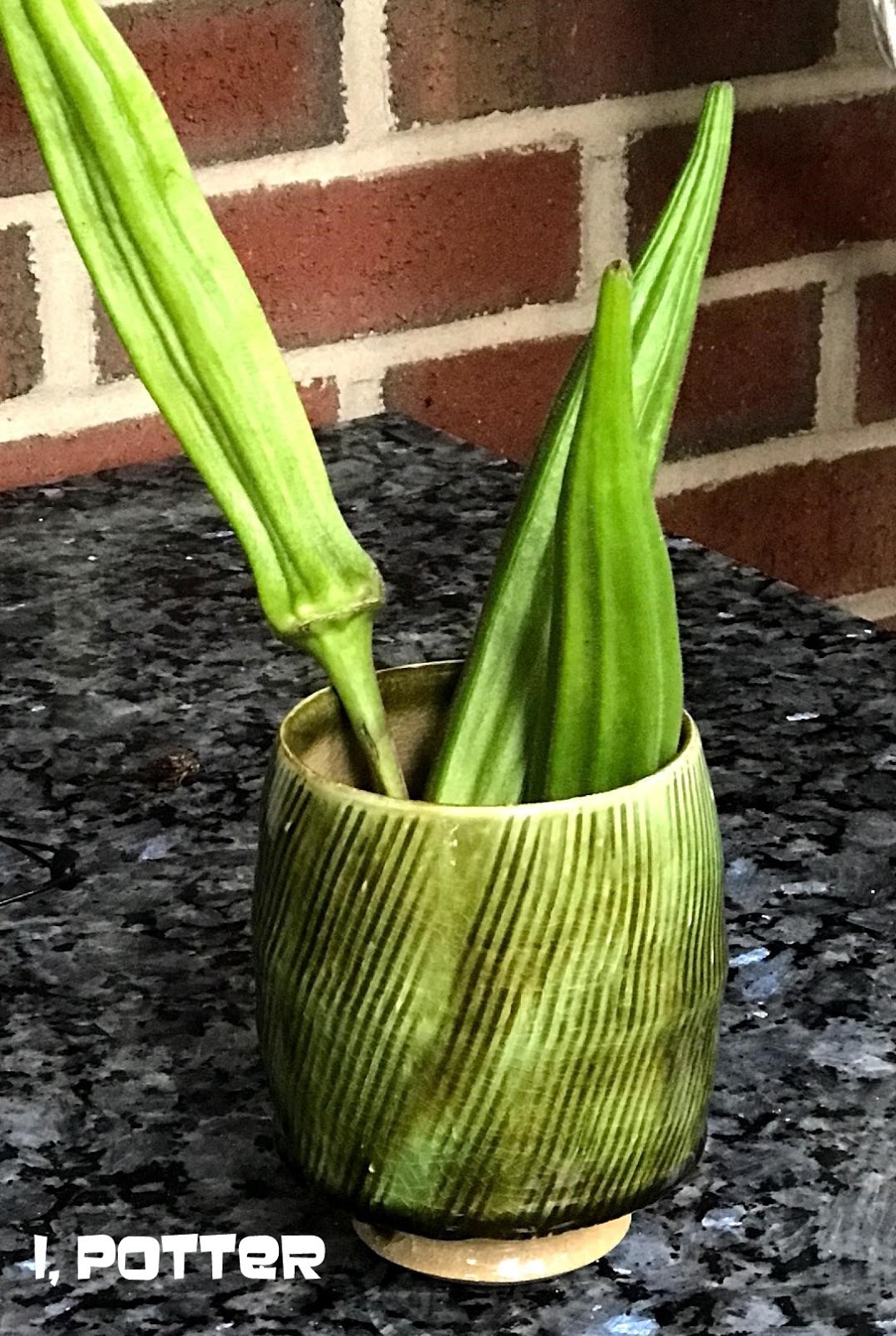
I received this photo of some "local" okra* right out of the garden and
in to my cup from a friend who is recently semi-retired, a man of leisure and
in pursuit of making pottery again after a number of years away from being a
production potter. Jim recently fired his first cone 9 glaze fire and ended up
with a number of rather interesting glaze affects including ash glazes which
show wonderful promise, quite nice results for his first firing since ditching
his tie and briefcase. Along with the vivid okra photo he sent along a shot of
his view while drinking his morning coffee on his back porch surronded by
foliage and a curtain of morning glories (?) blocking the sun and making for a
wonderful staging point to plan the events of the day. I like to receive photos
of my pots in use and this older medieval green kushime teabowl is a fine
container for the rich greens, the speckled stone countertop and the rustic
reds of the brick wall make for a great back drop, a pleasing photo taken by a potter.
Thanks, Jim.
(*I should mention that before you report me to the Okra Growers Association, I am not a huge fan of the allopolyploid, not even when it is dipped in golden batter and deep fried.)
Friday, August 17, 2018
HAND & GLOVE
It
is quite obvious that texture and Oribe go hand in hand all the way back to its
origins in the 16th century. This is not to say that Oribe isn't equally as
beautiful on even and untextured surfaces but rather the glaze accentuates
texture quite well, high lighting every mark, depression or raised area
creating a wide array of color variations without the addition of other glazes
or the need to necessarily be wood fired. In a recent batch of catalogues that
I received there was this illustrated Oribe vase by Wakao Toshisada that is a
textbook example of just how well the glaze and texture go hand and glove.
Wakao has thrown a wonderful Momoyama inspired vase that has been worked with
spatula and knife to create a study in naturally inspired texture that
accentuate the vertical nature of the form without masking the throwing lines about
the pot. Once fired, the Oribe glaze shows off every mark in various ways
adding a more classical narrative to the pot with areas around the mouth
creating a rich ring of deep green like a band to encircle and control flowers
put in the vase. For a potter that is mainly thought of as a Shino specialist
it is quite clear that Wakao Toshisada is a master of the various Mino
traditions with a profound foundation in the modern interpretation of the modern
Momoyama aesthetic.
Wednesday, August 15, 2018
A SINGLE BLOCK
Perhaps
best known for his large, dynamic and animated oni sculpture and even larger
ceramic and glass site installations, Mashiko artist Fujiwara Ikuzu has a broad
range of subject matter in two and three dimensions. This small ceramic stature portraying a whimsical and idiosyncratic Fudo-myoo
along with all of his tell-tale attributes including flames, fans, sword and
rope is clearly identifiable as the work of this mashiko ceramic artist and a
subject he has created numerous times. The really unique aspect of this piece
is that Fujiwara carves his pieces out of a solid block of clay adding detail
and definition along the way and that is how this piece was created. Another aspect
that makes this Fudo a bit different is that once wood-fired in his moderately
sized anagama, the flames behind the main image had a layer of gold gilt added
to create another layer of dimension to the statue. I can also relate from
having handled this somewhat weighty piece, it is quite obvious it was hewn
from a single block of clay much like a stone sculptor finding the image from
within and chiseling away until the hidden Fudo-myoo emerged.
Monday, August 13, 2018
MORE IRON & ASH
Illustrated
is a medium sized "lip bowl" that I made a while back as part of a
larger run of similiar pieces. I have been hanging on to this particular bowl
for a time because the glaze came out such a deep, dark temmoku with the ash
accenting the piece mostly on the interior. As you can see the glaze breaks
well on sharper lines and details allowing the infrastructure of the bowl to
show up as well as high lighting the impressed marks made around the bowl. This
temmoku glaze has been rather dependable over time but this individual bowl
probably is the epitome of what the glaze is capable of and there have been few
exactly like it. Besides being deep and rich in color you can see the sheen of
iridescence that shows up here and there on the surface giving hints into the
chemical composition of the glaze. I am not sure for a fact but I think the
base of this glaze is probably the simplest formula I have ever seen for a
temmoku and I have nothing more than a splash of clay on a greenware pot to
thank for the development of one of my most dependable glazes.
"Serendipity always rewards the prepared." Katori Hall
Subscribe to:
Posts (Atom)


