When looking at 20th century Shigaraki, Iga and Bizen pots in particular, it is quite clear just how many pieces are based on medieval archetypes mostly created during the Momoyama and early Edo periods. There are of course many exceptions especially as you look at the works of Kakurezaki Ryuichi, Kojima Kenji and others who though used these very same archetypes, they were used more as a framework and basis for their later work. The slideshow video I have posted here is a classic pot based on an archetype that many potters have tried their hand at and this one has that distinct feudal feel to it despite having been made in the last decade or two. Created by Imura Mitsuo (b.1946) this hanaire shows the classical influence of a much older pot along with hints of his master, Sugimoto Sadamitsu showcasing a blend of a well fired face with the reverse showing off both hi-iro and the real honest nature of the clay, tsuchi-aji in typical Ko-Shigaraki fashion. There are wonderful little details on this vase from running emerald green ash around the waist to a solitary deep, rich green bidoro drip perpetually suspended off the lip of this pot embued with a carefree, casual posture and character that spans the old to the new in only the time it takes to throw and fire the vase.
Friday, September 7, 2018
EXEMPLUM
Archetype;
the original pattern or model of which things of the same type are
representations or copies, a perfect example
When looking at 20th century Shigaraki, Iga and Bizen pots in particular, it is quite clear just how many pieces are based on medieval archetypes mostly created during the Momoyama and early Edo periods. There are of course many exceptions especially as you look at the works of Kakurezaki Ryuichi, Kojima Kenji and others who though used these very same archetypes, they were used more as a framework and basis for their later work. The slideshow video I have posted here is a classic pot based on an archetype that many potters have tried their hand at and this one has that distinct feudal feel to it despite having been made in the last decade or two. Created by Imura Mitsuo (b.1946) this hanaire shows the classical influence of a much older pot along with hints of his master, Sugimoto Sadamitsu showcasing a blend of a well fired face with the reverse showing off both hi-iro and the real honest nature of the clay, tsuchi-aji in typical Ko-Shigaraki fashion. There are wonderful little details on this vase from running emerald green ash around the waist to a solitary deep, rich green bidoro drip perpetually suspended off the lip of this pot embued with a carefree, casual posture and character that spans the old to the new in only the time it takes to throw and fire the vase.
When looking at 20th century Shigaraki, Iga and Bizen pots in particular, it is quite clear just how many pieces are based on medieval archetypes mostly created during the Momoyama and early Edo periods. There are of course many exceptions especially as you look at the works of Kakurezaki Ryuichi, Kojima Kenji and others who though used these very same archetypes, they were used more as a framework and basis for their later work. The slideshow video I have posted here is a classic pot based on an archetype that many potters have tried their hand at and this one has that distinct feudal feel to it despite having been made in the last decade or two. Created by Imura Mitsuo (b.1946) this hanaire shows the classical influence of a much older pot along with hints of his master, Sugimoto Sadamitsu showcasing a blend of a well fired face with the reverse showing off both hi-iro and the real honest nature of the clay, tsuchi-aji in typical Ko-Shigaraki fashion. There are wonderful little details on this vase from running emerald green ash around the waist to a solitary deep, rich green bidoro drip perpetually suspended off the lip of this pot embued with a carefree, casual posture and character that spans the old to the new in only the time it takes to throw and fire the vase.

Wednesday, September 5, 2018
PARADIGMA

One such alternative interest of mine is the works of Ota Minoru who made pots that he saw in his mind's eye and are rarely dedicated to a traditional ideal or archetype rather defining his own persuasive alternative paradigm. Ota's pots embody a sense of the casual, loosely thrown without a concern for many of the more practical aspects of pottery making which creates a body of unique and very idiosyncratic and often "quirky" in a good way pots. Case in point is this oddly thrown and distorted Shigaraki mizusashi which is obviously well fired with a rather traditional style surface but the pot is anything but. Looking just a bit like it is in the perpetual act of collapsing, this mizusashi has a wonderful posture and presence and I can see it easily being used in the tea ceremony or adorning a shelf. The lid easily compliments the body of the pot with an easy to use knob and covering the opening in its own non-chalant manner pronouncing that this piece is both a bit askew and distinctly purposeful all in the same breath.
Monday, September 3, 2018
LABOR DAY WIP
For Labor Day this year I thought I would share a work-in-progress
of an idea that was much more labor than I expected. This idea came about in a
rather curious way as I was looking at several teabowls upside down on a small
cedar board that has been banging around the studio all the way back to
Cleveland. I was looking at the bowl and wondering if I could make a lid like I
have seen on Haida bentwood boxes and decided to give it a try. I am sure that
right off it is clear I am no wood worker and using the tools at hand; a saw,
wood file, wood chisel, an ancient ball peen hammer and sandpaper I decided to
have at it. I have spared you a lot of the drudgery in terms of the slideshow
but for a bowl that has very little time invested in it, the lid ended up being
almost two hours of labor which included the three coat of polyeurathane to
seal the wood. After the lid was completed, I made a group of knobs and settled
in on two which were fired in a subsequent glaze firing. I choose the stupa
style knob and attached it by using a metal pin that ran into the wood and
ceramic knob with epoxy to hold it fast. As you may be able to tell, the lid is just
a bit larger than the pot and is angled upward to give the lid some visual lift. Now I won't say this is the greatest feat of wood working ever but
considering it was my very first attempt I am relieved that I did not cut
myself, break the bowl or incur any unforseen calmity all in the pursuit of yet
another out of the blue idea.
Friday, August 31, 2018
FUJI-SAN II

Wednesday, August 29, 2018
UNLIKELY INSPIRATION


After several ideas and attempts, I hit on the illustrated pot,
an oni-oke-wan (Oni bucket-bowl) that has what interested me the most in the
beautiful cedar buckets that I watched being made. Once the logistic of making
the piece were worked out I expanded the idea to also include cover jars,
bottles, serving bowls and vases like the illustrated covered water jar with
both ceramic and lacquer lid. I am constantly amazed at how a seemingly
unrelated inspirational spark can lead tonew things being made and in this case
creates the essence of what I was seeing in a wood bucket though in a far more forgiving
and plastic medium.
Monday, August 27, 2018
KOCHU-GAMA


I know I have mentioned the story of our first trip to Shigaraki and literally
standing in the rain in front of a potter's home and last week while converting
more slides into digital images, I came across the most appropriate photo.
Illustrated is the front gate of the home and studio, Kochu-gama ("Kiln
inside a Tsubo") of Honiwa Rakunyu II from late October 1990. Today the
kiln is maintained and run by Rakunyu III where many of the studio pottery and
ideals of the kiln are carried on. To this day I can only say of all the places
to be lost and confused at, this turned out to be one of the absolute best.
Also
illustrated is a three-view image of a classic Honiwa Rakunyu II chaire
showcasing an excellent firing and surface. The decorated shoulder is covered
with a sheet of glass which also spills off and down the form at several points
including over the dark face of the piece where the pot rested near charcoal
and reduced to this sobering coloration. As the image shows, this chaire is
like a three act play with each segment narrating a different aspect of the
story yet in the end, all is tied up in to one complete package.
Friday, August 24, 2018
HERE COMES THE SUN

Here is a great cover in a unique style;
Wednesday, August 22, 2018
BLUES WITHIN BLUES

Monday, August 20, 2018
OUT OF THE GARDEN AND IN TO THE CUP
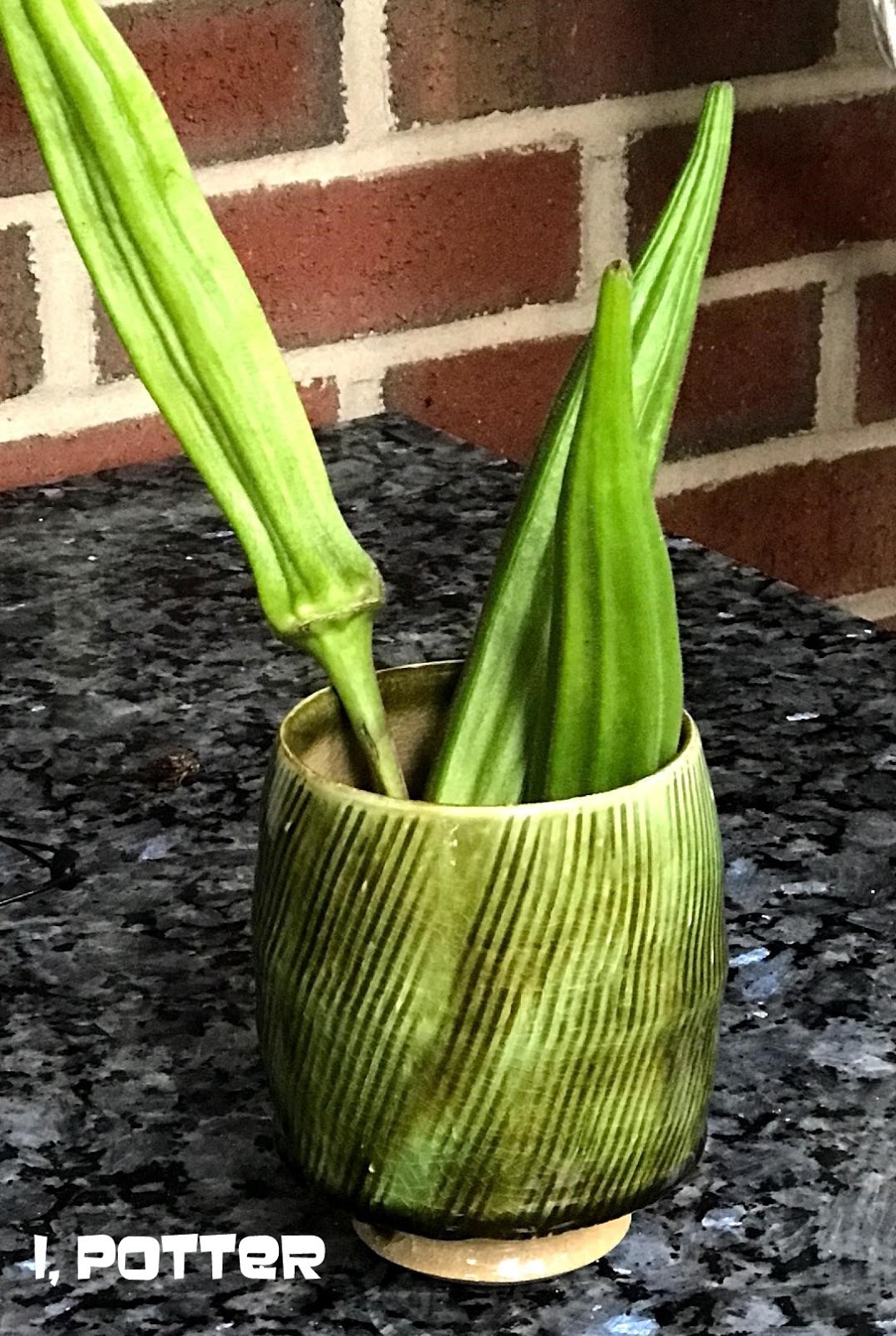
(*I should mention that before you report me to the Okra Growers Association, I am not a huge fan of the allopolyploid, not even when it is dipped in golden batter and deep fried.)
Friday, August 17, 2018
HAND & GLOVE

Subscribe to:
Posts (Atom)
.JPG)