Wednesday, May 12, 2021

SHINSEIDAI

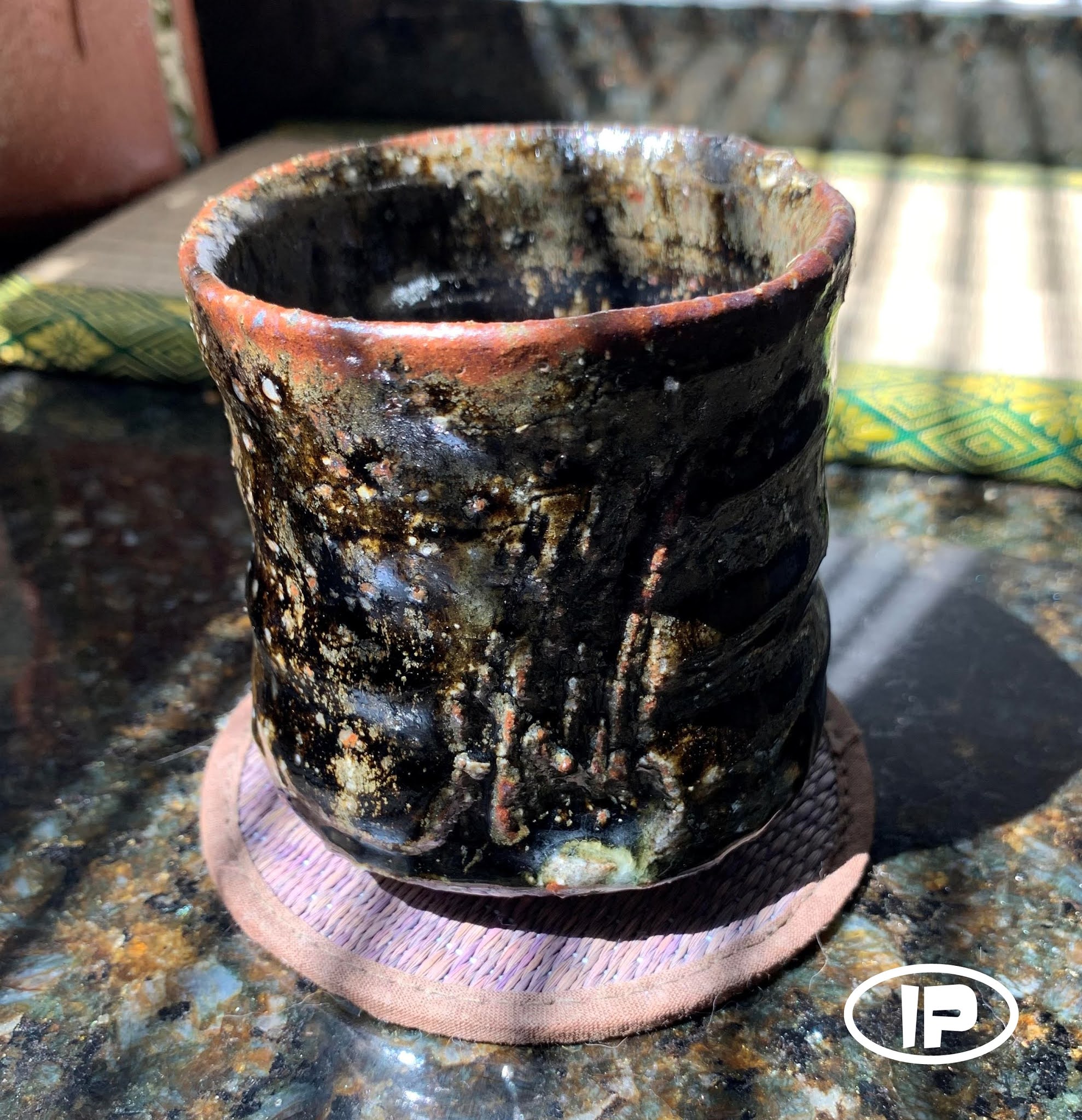
In an article I read just recently though from 2004 it talks about Sakikabara Keishi as part of the voice of the "new generation" in Bizen. In some respects I found this rather curious but as I survey several pieces from a collection I can see the movement toward a more mature, modern style of Bizen lead originally by potters like Mori Togaku and Isezaki Jun who in turn have taught, mentored or influenced quite a few of the "new generation" of Bizen potters. For Sakikabara his earliest training came while apprenticed to Isezaki Jun starting in 1978 where he was introduced to not only what it meant to understand tradition Bizen-yaki but also to see the potential from what was locked away in this wonderful plastic medium.    

Enjoying its momentary solitary slice of sunlight, this Bizen chawan is a nice tutorial in angles, planes and texture all further enhanced by a classic Bizen wood firing. Though I am reasonable sure this chawan was thrown first, it does have that hacked out of a solid block of clay look best known as kurinuki, before it was cut and impressed to create a rather singular look. Like the bowl itself, the foot is composed of several rather sharp, crisp cuts with a briefly tooled kodai excised out of the very center and botamochi areas where the pot was fired on wads. I should also relate that this is a substantial and solid bold, it has weight and dimension that blend tradition and modernism together with craft and sculpture which when you think of it is exactly what I would expect out of the "new generation" of Bizen potter.

Monday, May 10, 2021

BRUSHING OFF THE BISQUE(WARE)

Despite the fact that I have pots on hand at most times it always seems that what people want usually has to be made and in this case it was mugs. It was easy enough to agree on for the order of eight mugs with a particular form, medieval style pulled roundish handles and the medieval green and temmoku glazes to finish them off, the not easy part was just needing to sit down and make a group of ten to get the eight. As luck would have it, once fired I ended up with exactly eight mugs that were good to go and then there was these two, new additions to the kitchen as they both ended up with small crawl spots within the footrings. When I am getting ready to fire a bisque kiln, I normally sand the feet smooth and then once out of the bisque I take a toothbrush and clean out the footring and in this case I left a small amount of clay dust which lead to the crawling. Though rather minor there was just no way I could send these out and since one can never have enough mugs in the house to use, no fair no foul. Despite the small issues with both, I was rather pleased at how the surfaces came out on all of the mugs and think the surface goes well with both form and handles. That being said, I will be a bit more careful next time I am brushing off the bisque.

Friday, May 7, 2021

TSUKIMI

I have written about Kakutani Hideaki in a prior post which gives the briefest glimpse in to this seiji and porcelain specialist. Residing and working in Nabari-shi, Mie Pref. There are some tell tale signs of both his teacers, Kondo Yuzo and Kiyomizu Rokubei VI but if you have seen enough of Kakutani's work, it is clear that he speaks with his own precise voice. There is a wonderful balance of perfection and clarity in his pots and this large celadon platter is certainly no exception, wonderfully thrown, tooled, decorated and glazed it is not that virtuosity that one admires but rather the lyrical, poetic nature of the incised and sculpted flowers that linger across the pale blue canvas as if peering through a moon viewing window interrupted by a solitary lotus tree branch.. Elements of Nihonga and Rimpa painting meet on this porcelain backdrop where decoration captures the very essence of the subject.  

I put together this very short video slideshow that hopefully hint at what is I think far more apparent in person than in the photo. As for the photos in this slideshow, roughly the first half is taken using an artificial light source which shows off what I think of as the actual coloration of the piece, the next group, the detail shots are using no light other than ambient room light. I thought that though the color is a bit inaccurate this shows off the details of the carving and sculptured overlay reasonably well. 

https://albedo3studio.blogspot.com/2017/02/sounds-simple-enough-on-paper.html


Wednesday, May 5, 2021

SEPARATED

I received this yunomi picture just yesterday and I really liked how the simple act of basking in the sunlight can really show off the character of a pot. This Oni-Iga yunomi was made by Tsukigata Nahiko and is quite frankly a textbook example and would make a great match to the one that I acquired several months back despite the fact that they are different and yet the same. In this photo the rich, iron lip shows well and is complimented by the normally dark black-brown glaze is brought to life in this lighting adding to the multiple personalities pottery inherits depending on how they are light and viewed. Though I have not handled this particular yunomi what I can say from past and present experience is that they are generous in form and scale, perfect for the task at hand with just the right weight and feel to make for that great blend of aesthetics and function. After taking the time to study the picture what I can say is that though separated by quite some distance this yunomi and mine make for a perfect pair.

https://albedo3studio.blogspot.com/2020/09/one-ping-only.html

Monday, May 3, 2021

OUT OF SEASON?

I threw a small group of covered serving bowls (CSB) last week, tooled them and then set them aside, well wrapped for over the weekend. First thing in the studio today, I unwrapped the CSBs and set about first carving the sgrafitto part of the design and then slip trailed the white dots to complete the snowberry designs on top and bottom and across the other pieces. I often wonder if there is a seasonal interest in certain types of design and decoration and I will assume as long as they are being ordered that they are not out of season. Once dry, into the bisque and then a thin clear glaze firing and that is all she wrote until the really fun task of packing them up and shipping them out. I guess I'll just live in the moment and remember that I like to throw and all the rest is just what it takes to get to that point.

Friday, April 30, 2021

SHARKSKIN

I received a package yesterday that I was expecting as I had received an email and tracking info for it and it contained a small gift, very small and a chawan that a collector was parting with as he is collecting only guinomi and tokkuri moving forward. That being said, the gift was a great little pair of funky hashioki by Kato Yoshiaki as well as the chawan that is illustrated here. Though I can imagine it may be a bit difficult to categorize, Kato is from Tokoname and therefore this is Tokomane-yaki and the Shino like surface is called samehada. Action packed with lots of texture and movement caused by the varying size nodules across the surface, this chawan is animated and rugged with a loosely thrown form, undulating lip and areas of faceted spatula work around the bottom half of the bowl. When I look at Kato's work I find much of it imbued with  primitive and organic qualities that appear to just happen spontaneously without contrivance or any undue amount of effort. Overall there is a lot packed in to this heavily textured surface with a wide array of techniques and qualities that Kato Yoshiaki was well known for and stands as a classic example of a rather idiosyncratic body of work. 

You can see more of this chawan over on my Trocadero page here; 

https://www.trocadero.com/stores/albedo3studio/items/1444399/BOLD-TOKONAME-SAMEGAWA-CHAWAN-BY-KATO-YOSHIAKI

Wednesday, April 28, 2021

SOME CLAY, SOME SLIP AND AN IDEAL

My first encounter with the work of Ochiai Miyoko dates back to the Kikuchi Collection exhibition and the wave of simplicity and subtlety is immediate, a dialogue of potter, some clay, some slip and an ideal. Learning much of her craft and perhaps some of her sensibility in clay from Suzuki Osamu (Kyoto), Ochiai made her way to creating Chinese T'su chou inspired slipware at which she excels. Using very few materials and most times sparse and simplified decorations the work is alive with white, black and shades in between that seem spirited and alive on the clay canvas. Flowers, butterfly, birds and even cats are stripped down to the barest essentials and are in flight, moving and even manipulated by the wind though the curves of the pots has something to do with it as well. I am really not sure that I have seen such simple pots that say as much with so little as does the work of Ochiai Miyoko.     

Illustrated is a B&W picture of an eminently simple Ochiai Miyoko meiping influenced vase in the T'su chou style casting its shadow in the late afternoon. The vase is seductive and the lines unfettered creating a rather graceful visage that is as much about purity of form and curves as anything else. The body of the buff white stoneware is first dipped in a rather pure white slip, you can see her finger marks at the base of the piece and then she brushes on deep, black slip which is carved to define the decoration and then fired with a thin clear glaze over. The results seem to spring right out of a different time, perchance the Sung Dynasty though all of the work says as much about modern times as it does of antiquity and that is certainly a rather good thing.         

"The subtlest of subtleties, this is the gateway to all mysteries." Lao Tsu           

Monday, April 26, 2021

CLEAN UP

Among other things, I threw a group of four "lip bowls" this morning. They are stoneware and were thrown out of about 4lbs of clay and once thrown the lips were altered and the stamps were impressed at the four points around the bowls. Once they start to set up a bit, I go in and correct the lines of the lip so that they have a continuous and even curve especially where they have been stamped as well as smoothing off some of the sharpness that was left from the throwing. This clean up part takes just a minute with a damp sponge and then I wait until they are leather-hard to tool the pot and give them pedestal still feet which gives them a small, stable base and a compatible profile to the form. In the end I only threw six pieces today as we had to wait on the heating/cooling guy to clean and service the furnace today and I set about making three various slips and just waited. I think it is always interesting how a window of Noon to Two becomes 3:40 in no time.


Friday, April 23, 2021

AN EXPANDING TRADITION

When I think about Oribe I am always struck by the sheer variety of colors, textures and use of the glaze beyond the established, traditional norms. Even with my own work using Oribe there is a nearly infinite (?) amount of possibility with each new use just around the corner or out of the next kiln. This large Oribe vessels is a perfect example of potential, adding dramatically to an already expansive tradition through the use of incised decoration with washes and inlaid color to alter the designs and surfaces. Though there is a great degree of precision in Usui's works, there is a calculated and almost cerebral playfulness that sparks the mind and emotion into action. I put this short video slideshow together in an attempt to capture the depth and dimension of this Oribe vase and hope that it gives a better glimpse in to what you would see if it were right in front of you.


Wednesday, April 21, 2021

FIRE TESTED GUARDIAN

Admittedly, I really don't know much about the Shigaraki potter Kawai Koji other than what I have observed from the couple of dozen pieces I have seen by him but this is not really surprising given the sheer number of "everyday" potters in Japan. The pieces, all Shigaraki and all molded except one piece, a thrown small tsubo, have been very well fired and have rather fun, playful features. Other than the ko-tsubo, the other pieces have been suiteki, kogo and koro like this handsome beast, a shishi with removable head, a rather fire tested guardian at that. 

As you can see in the photos the form is compact and effective, the one side is entirely covered with an all natural thin skin of green glass while the other side has some running ash and beautiful fumed fire color that really paints this figure and brings the piece to life. The well sculpted head was fired on the pot using wads and where one wad stuck, there is a small gold lacquer repair which I suggest was done because the maker was rather pleased with the overall firing and thought best to salvage the piece. This is not a great piece but I think that the playful, whimsical qualities of the koro are certainly more than enough to even the critical of collector pleased to have it up on a shelf, guarding the room.