Friday, June 11, 2021

MAKER'S MARKS

I was thinking about  marks made, various maker's marks and I remembered this picture of an incised, marked Iga vase by Furutani Michio. While I realize that a large number of marks made on a the breathe of modern wood fired Japanese pottery are in fact based on historical archetypes, most potters add their own unique qualities to these renderings much the same way that handwriting differs from one individual to another. I am not going so far as to say it would be easy to recognize this design and marks made as those of Furutani Michio but there is certainly a way in which he worked that is possible to clue in on from tools used, his existing vocabulary of marks, the speed and even depth of these traces made permanent. 

In regards to this decoration, I have seen this on two other vases, both Iga style that though not exactly the same they certainly bare enough similarities that if you showed all three it wouldn't take much of an argument to conclude they are all by the same hand.  One other thing that I wonder about regarding Furutani Michio's work is do these marks have some deeper, personal meaning beyond their use on older, feudal pieces?  The first time that I saw this design I was struck that it immediately conjured up memories of small road side shrines (dosojin) that you occasionally encounter while travelling in Japan and now find in antique shops, flea markets and even museums. As I look at these marks, I know what springs to my mind and am curious what did Furutani Michio see as he moved clay and articulated the surface with these simple marks?

Wednesday, June 9, 2021

ONI-HAGI

This tall, elegant henko has an intriguing history though I suspect a common one among collectors. Years ago I was offered this piece by a Japanese dealer and realizing the price was beyond our budget, I asked if I could show the photos to a fellow collector and as luck would have it, he wanted the vase. the pot was packed up and shipped to me first, I got to handle it for an afternoon and then it was repacked and sent on its way out west. This was not going to be the end of the story though as years later the collector decided to get out of modern Japanese pottery and move on to something else and luckily I was able to trade for this Hagi vase and several other pieces some of which we kept and others we found new homes for. At any rate, long story, short this Miwa Kyusetsu henko now has a space on a shelf somewhere in central New York.   

I first saw a group of these Hagi henko on display at a dealers in Kyoto in the early 90s, there were seven of this nearly identical form, all by different potters including Miwa Kyusetsu XI (late Jyusetsu 1910-2012) and a student and some contemporaries. I was immediately struck by the forest like grouping but more so by the wonderful towering proportions and posture of this piece, with a slight twist and ever so slightly leaning curvature as if standing against the wind, bracing itself to insure it function, its purposes sculpted in to clay. If you study the form made of a rich daido clay and surface made up of ash and a handful of other materials you can almost read 350 years of tradition and experience of the Miwa family in each and every pot. It is hard to not be engaged, enthralled even in the way the form and edges create a mixture of the formal and casual in the clay and the white surface, blushed pink with white crystals sprinkled across the piece paint a timeless and intoxicating landscape best known as Oni-Hagi.

Monday, June 7, 2021

BLANKS

This is just a quick picture of a blank canvas, an unadorned pot, I made this teabowl as a test and need it bone dry before I can proceed. When I was looking at this bowl, just after tooling the foot I was reminded of a workshop I taught quite a while back where I was asked by a participant who did not throw* if I could make her one of my teabowls so that she could decorate it. Since the workshop revolved around testing surfaces, I had a dozen teabowls made as "blanks", tooled one and gave it to her but it was the next part that really has stuck with me all these years later. She asked, "what should I do with it now?" and without really giving it any thought I simple responded, the possibilities are endless and it was at that moment that I concluded that was the most honest thing I have ever stated regarding pottery. If you take even one minute to look around the internet, what do you see? We live in an age where everyone who works in clay has not only a different approach and surface but luckily many show off the endless possibilities over the web. Though much of my work revolves around styles that I have been working with for most of my pottery career, every time I test and try out new ideas I realize, if I had ten lifetimes that it is still quite likely that the possibilities will continue to be endless and that suits me just fine. 

(*FWIW I offered to teach her to throw as the "give a person a fish, teach a person to fish parable sprung to mind but after 40+ years of making pottery, she was just not interested.)

Friday, June 4, 2021

ALL BUSINESS VIDEO

I took a few minutes this morning to build a short video slideshow of the Fujioka Shuhei Iga chawan that I put up in a previous post. As I mentioned before, this bowl is all business though filled with character, purpose and an homage to a medieval tradition. As I look around the bowl, well the pictures, I am reminded of an old emakimono scroll from the Momoyama period where the story and narration unfold as you go around the chawan with varying details painting a simple and deep picture of Fujioka's understanding of tradition. I hope this short video slideshow gives a slightly more in-depth understanding of this Iga chawan.


Wednesday, June 2, 2021

TIMES TWO (X2)

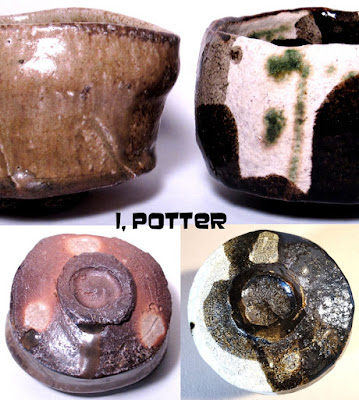
Now I love drippy ash and unctuous Shino, thick fractured celadon, large, wonky forms, brazen postures and forms but when I turn that chawan over and find a brilliant kodai that is well beyond the perfunctory and is devoid of flash and gimmick, quite frankly, I am really happy! A kodai that has true purpose and is distinctly creative that completes a form should be a given as a feature of a 360ยบ, six sided object and anything less just takes away from what could have otherwise been a rather nice bowl. I have never really considered myself a "foot" person but over several decades it has become perfectly clear just how absolutely essential the skill of creating a good kodai really is and how many potters abdicate their responsibility for expediency and economy of time and simplicity of form. A  good kodai takes time, effort and lots and lots of practice where learning the mastery of throwing a bowl may only take several years, the foot can take a lifetime of evolving, mastering the art of removing, sculpting and crafting that creates an element that is not only complimentary but serves its "prime directive" of function is a delicate process despite how seemingly brutal the actual cutting and creative process can be.

Illustrated are two uniquely different chawan, almost as different as night and day though linked through the commonality of purpose, size, form and of course the necessity of a foot. On the left is a well fired Iga chawan with a great presence, a casual posture and just the right amount of "wonkiness" to captivate the eye and underneath the chassis is a very well cut kodai that not only is a perfect fit but it is pleasing to the eye and hand as well. The chawan on the right is a fun, almost playful hikidashi-guro chawan that obviously takes its cues from modern Oribe pottery at some level and like the Iga chawan, the kodai is very well matched to the chawan in both spirit and purpose. As disparate as this two chawan are, there is an even greater connection between them, they were both created by the same potter, Kojima Kenji who created these two unique styles and forms and made a somewhat similar style kodai match perfectly despite all the differences in form and surface. As I have mentioned, I love a really good chawan with an equally good kodai, I enjoy the enthusiasm of the process and the finished effort, the spirit of the creative solution and boundaries that can be pushed at, stretched and warped a bit and in the end be mindful to a function that goes back to the earliest pots ever created, does the pot work?

Monday, May 31, 2021

MEMORIAL DAY 2021

I live in the constant hope that as we move on in time our need for more fallen decreases daily though we must always remember those that have, to found and safeguard our fragile and experimental Republic.

"Those who have long enjoyed such privileges as we enjoy forget in time that men have died to win them." Franklin D. Roosevelt

"Some people live an entire lifetime and wonder if they have ever made a difference in the world. A Veteran does not have that problem." Ronald Regan

"There is nothing wrong with America that cannot be cured by what is right with America."   William J. Clinton

Friday, May 28, 2021

ALL BUSINESS

I am easily attracted to this Iga chawan and if I had to sum up why I would say it is all business. Though I like some of Fujioka Shuhei's new work and perhaps it is telling about my character but I prefer his simpler, older pieces that were a balance of function, tradition and aesthetics of which this chawan is a classic example. Based on feudal archetypes, you can see the rugged qualities and modern strength that Fujioka is known for and as this chawan was fired on its side, the top half is covered in a nice, inviting coat of glass while the underside is fire color and details that treat the eye and the hand when in use. The way the ash runs to the resting place where the shell held up the bowl has created a permanent visual punctuation made of calcium and ash that is one of those serendipitous rewards of a fight well fought in a crucible that Fujioka twists and manipulates as best he may to his vision of modern Iga.


Wednesday, May 26, 2021

CONTRAST

There is a fair degree of diversity when looking at the body of work that Matsuzaki Ken has created over his time working in clay. Spanning the Mino tradition and well beyond, Matsuzaki turned his attention to unglazed wood fired surfaces and has not looked back while bringing along the bulk of his oeuvre with him which also benefits from his intense firings. This particular haiyu mizusashi is no exception, though seeded with glaze when put in to the kiln, the natural effects and intensity of the firing have created a pot that benefits from both. The sturdy lobed form has a wonderful coating of ash that accentuates the form and due to the heat, the ash has dripped down the pot adding more movement and interest to the form. As you can see in the photo there is a great contrast between the upper and lower portions of the pot which adds a subtle degree of visual tension to the pot while also acting as a transition that makes for a rather unified piece. There is an ongoing debate between the simplicity of the pot with the various complex elements that bring the pot to life which is all capped with a wonderful lobed lid which has a marvelous border of deep shimmering olive green glass that adds "that" visual punch to the mizusashi that is rather hard to ignore. 

"There is no quality in this world that is not what it is merely by contrast. Nothing exists in itself."  Herman Melville

Monday, May 24, 2021

PERSPECTIVE

It seems like I always regret leaving things to do over the weekend, in this case, I had to carved 5 terra cotta slipped pots including a covered serving bowl. I had a brief window on Saturday to attend  to the pieces but caught up with some house things and dealing with a guy quoting on some much needed yard project well beyond my skill set. So the day started with having to carve the pots, then I made two square plates and last but not least I did get to sit down and throw two covered serving bowls/ lids (CSB) and two 3lb cylindrical covered jars/ lids. I would have liked to have gotten more done but there were other studio "chores" that needed to be addressed including making up black and white slips and making a small batch of sandy stoneware so that it has some amount of time to mature (perhaps a week or two?) currently drying out a bit on plaster bats. In the end the results of a Monday weren't all that bad and driven by some classic 70s rock, which is IMO better than digging holes in the ground and expecting to find the lost treasure of the Maya in upstate NY. It is all about perspective.


Friday, May 21, 2021

LARGER THAN LIFE

This great illustration came from a 1999 issue of ART GRAPH and shows the imposing scale that Tsukigata Nahiko worked at in clay to produce monumental bronzes. In this photo, clearly shown at the right of the photo is the original maquette of this sculpture and is close to the scale of the edition bronzes of his various subject, in this case the great 16th century warlord, Uesugi Kenshin. I have seen quite a number of Tsukigata's larger than life sculpture and even more of his maquette editions but this was the first photo I had seen of a work in clay, being fine tuned and made ready for the casting process. Capturing the living in this static plastic rendering is only further enhanced by the attention to detail and attributes that make the subject matter immediately identifiable but this should comes as no surprise from the hand of the Picasso of Japan.