Friday, July 1, 2022

BALANCE

Looking like violently created rock strata surrounding a moving stream, this Oribe futamono, covered box is a lesson in imaginary landscapes and vivid texture. Having some elements to older Rimpa decoration, the texture plays a key roll in articulating this form as well as inviting the eye from side to side and top to bottom of this pot which at its core is a simple box, simply executed but the potter has whipped up the surface in to a turbulent and frenzied vision with areas of placid calm to balance the landscape out into a harmonious vision.    

This Oribe covered box form was made by Kato Kuniya (b.1940)  who over his career in clay he has specialized in Oribe, Seto-Guro and Karatsu and exhibited at various venues including Asahi Ceramic Art Exhibition, Japan Traditional craft Exhibition and the Chunichi International Exhibition. The are elements of tradition blended with modernism and hints of Rimpa thrown in for some measures harkening back to the sylized decoration of Ogata Kenzan without being too overt about it. The interior is simple and calm by contrast though decorated with a few errant plovers exactly like those that are seen on quite a few older Oribe works as well as on various Rimpa paintings where they can be spotted about the waves and sea spay in 2 and 3 dimensions. As with much of Oribe pottery, it is the carefree attitude of this piece, both the exterior and interior that truly ties it to the early Edo tradition of the casual and playful nature nurtured over the centuries and certainly still alive and well in the pottery of many modern Oribe potters, Kato Kuniya included.

Wednesday, June 29, 2022

CARVED GEOMETRY

This large tebori wall bowl is from the same firing as the 3s & Es bowl that I posted previously. Thrown out of terra cotta and covered in a layer of dark, black slip the double saw blade was hand carved after the basics for the design were laid out in black ink to try to get it right. Though I generally go for more organic designs and decoration every now and again I rely on geometric and stiffer patterns to use on pots like this revolving saw tooth design, especially the tebori pieces. As you may be able to see in this picture, this particular technique is hard to photograph and makes the pieces look harsher than they are in person but I think you get the general idea from the provided picture and the combination of the rich red terra cotta and dark, black slip make for an easy surface but generally an inviting one as well.

Monday, June 27, 2022

FIRST ENCOUNTER

I think it is quite easy for sculptural ceramics to spring to mind when discussing the works of Ohira Kazumasa from large outdoor installations to small, intimate almost pieces that are far more than function. Over the years however there is a portion of his work, much of it based on old Iga pottery that at its core it is both very functional and medieval in both appearance and construction. This large medieval style Iga o-hachi is just one such piece that was my first encounter with Ohira's works back in 1991 or 1992 and is clearly a piece where function and tradition play a key role in both its creation and purpose. Close to two feet in diameter, the clay is coarse, yet wonderful to handle and admire while the ash has both covered the entire form in a fine wet mist while built up deposits have melted around the rim and run in to the interior of the pot creating some abstract landscape, an imaginary vista that compliments both form, function and food in its use. While I have nothing against sculptural ceramics, a style that I am quite fond of, at the end of the day I generally choose the fusion of form, function, clay and surface in those objects that play a role in our everyday lives and I think a large Iga platter like this fits that bill to near perfection.

Friday, June 24, 2022

MISHIMA IN THE ROUND

I put up a blog post some time ago depicting a classically decorated and presented mishima mizusashi by kohiki and slipware specialist, Ogawa Tetsuo and decided to build this short video slideshow to fill it out a bit. As you can see in the slideshow, Ogawa relies heavily on the Korean archetypes and style of decoration while adapting them to traditionally Japanese vessels and objects putting on a display of mishima in the round. In this case the mizusashi was divided into bands of highly articulated mishima inlay that is sandwiched by horizontal lines that seemingly contain the expanded volume of the form. 

The top of the form creates a visual pathway into the mizusashi that is then terminated by the black lacquer lid which creates the perfect vessel for both use in the tea ceremony and admiration as a solitary and contemplative pot. The surface of the pot does go beyond just the mishima decoration with areas of mishima, grey-blue for where the glazed stoneware can be seen and some very enticing blushing resonating about surface breaking up any sense sameness as the viewer surveys the piece. Like most pots that I favor, this is a simple pot, no bells and whistles with a traditional form that as you see all of the pot through this short slideshow the flavor and subtle complexity becomes all the more apparent.


Wednesday, June 22, 2022

SOME TIME TO SPARE FOR TEA

Though I doubt he would even remember our stop, our short visit with Otani Shiro was rather pleasant and informative at the same time. We were given a tour of his kiln, studio and gallery and then we had in his words, "some time to spare for tea" including some delicious, home-made small cookie-like biscuits to go with it while drinking out of generous, Shigaraki yunomi made by Otani-san himself. I should have apologized for all of my questions but back in the early 90s these face to face interviews were as good as gold. The topics ran from his influences and philosophy on pottery making to kilns and firings to the American wood firing scene and his relationship with Rob Barnard and several other US potters as well as several who claimed to have worked with him that in deed had not.          

At the time of our visit he had recently fired his kiln and the majority of pots were thrown tsubo of various sizes and of course various surfaces. An old blog post for 2013 (https://albedo3studio.blogspot.com/2013/10/first-quarter.html) shows a large thrown and slightly altered tsubo that was recently fired with a rather sublime and ethereal blend of hi-iro and tsuchi-aji, a bit like three dimensional poetry and a pot that was hard to get out of my mind for quite some time. The afternoon slipped away rather quickly, we thanked Otani-san profusely for his time and knowledge leaving with a small tsubo and a presento of boxed guinomi and we were on to our last meeting in Shigaraki with Ueda Naokata who despite his busy schedule afforded us an hour of his valuable time and where we parted with a wonderful chaire and a gift its equal if not better. This trip, though poorly planned and cramped for time everywhere we went in Shigaraki Valley was a trek that will not ever be forgotten even all these years later though a few pictures and pots do help jog the memory.

Monday, June 20, 2022

WAIT, FIRE & WAIT SOME MORE

I set about starting the glazing process on Monday as I mentioned in my previous blog post on Michael Simon. I am sure there isn't anything very different from the way I glaze to that of most potters who glaze simply, the biggest issue is segregating the various groups according to their final surface, keeping orders together to be fired together for some uniformity and finding the various spots, including two additional folding tables, my large eight foot table and various other flat spots around the studio including this one in the picture. This firing has a group of saffron serving pieces for an order as well as a small set of dinnerware in temmoku, a group in Oribe, Kuro-Oribe, Ao+ and more test pieces in the Hagi white with iron yellow over. The in-betweens this firing are being filled with about a dozen or so test cylinders and about 40 to 50 pods all trying out new glazes and glaze combos as tests, in other words the kiln is quite packed. I am quite anxious now that the kiln is fully loaded as is rather normal before a firing and have my fingers crossed on more than a few of the tests that also as usual, I am way to invested in. Now all I can do is wait, fire the kiln and wait some more.     

I should note the attached photo is just a small portion of what is glazed but these pieces were set out of the way early on due to the fact they are finished being glazed and all clean off.

Friday, June 17, 2022

HINTS


Illustrated is a rather good size gosu futamono decorated in sliptrailing and glaze additions in the overall feel of the Kawai school, made by Mukunoki Eizo. Though Mukunoki was one of Kawai Kanjiro's very last students there are qualities and characteristics that show in much of his work that were clearly influenced by the master and have dictated the direction of his pottery after his apprenticeship. In general, it is rather easy to say, "well that wasn't made by Kanjiro" or "that was made by Takeichi, Hirotsugu or Mukunoki Eizo", while that is still obviously the case with this press molded hexagonal box form what initially struck me was the wonderful slip trailing and colors which did bare a stronger than normal resemblance to Kawai Kanjiro than I usually see in Mukunoki's works or that of most of the other apprentices.

  Molded out of white stoneware clay the overall form is quite intriguing with a strong, stout form, crisp well considered lines and a chamfered bevel from the walls of the exterior to the base creating a rather engaging first impression. Once the form was made decoration was placed in the center top of each of the six vertical panels and the lid had a rather intoxicating floral decoration applied that truly articulates the hexagonal lid. The form was then glazed in a gosu blue glaze with the addition of green and red accents further articulating the form and design concurrently making for a rather stand-out Kawai school covered piece which follows the ideals of mingei, function and beauty with hints of his master mingled in for maximum affect.   

From an interview with a number of Kawai Kanjiro students, Mukunoki Eizo recounted life altering advice that he received from his master; "Be honest and make strong objects." he said. "Be careful, work without cutting corners and you must make objects that are loved by everyone.". I think it is quite safe to say that though these are lofty goals, Mukunoki Eizo has followed this advice during his long pottery career and to my eye, this covered box is not only a strong object but one that isn't all that difficult to love and even easier to use.


Wednesday, June 15, 2022

ON THE DOT


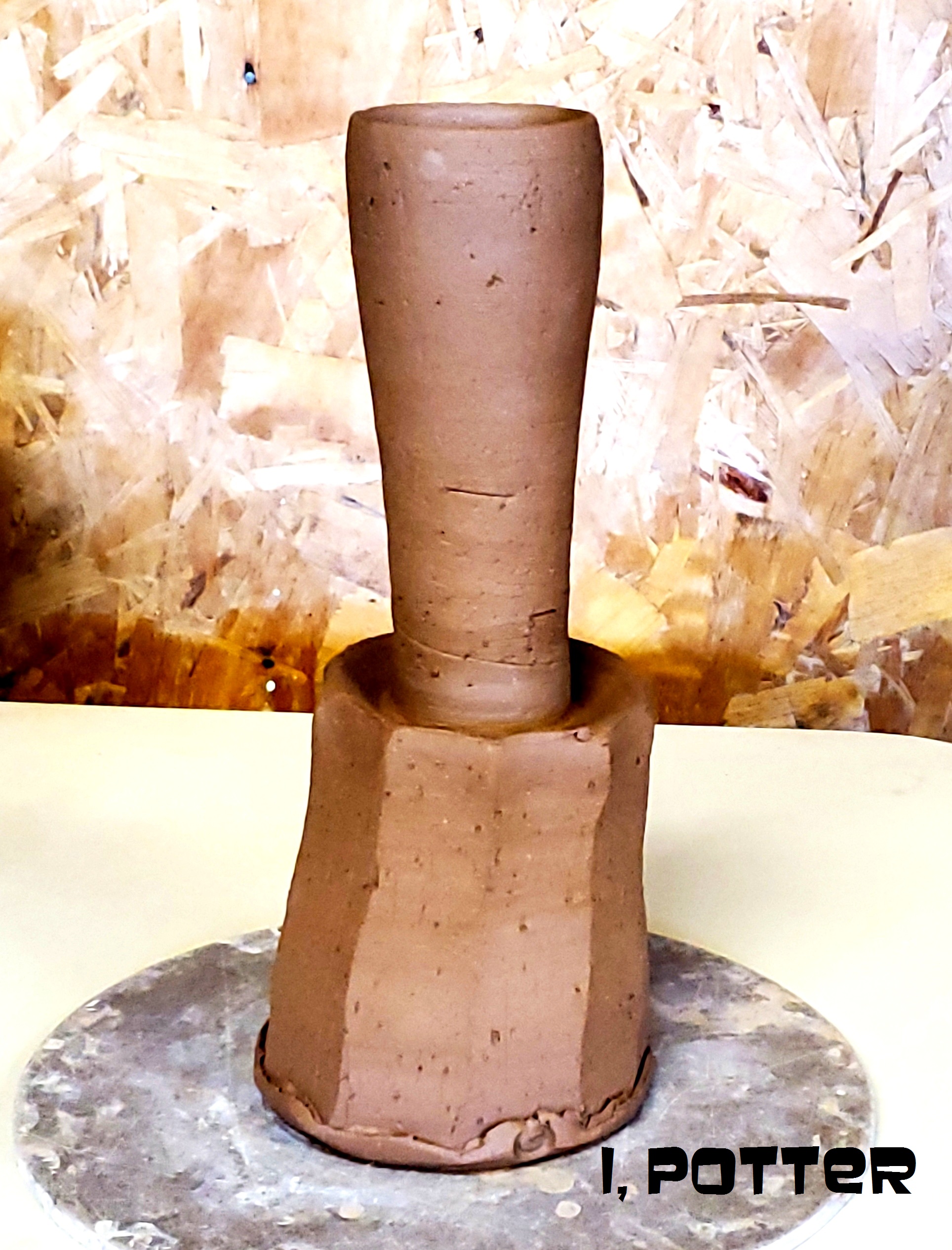
 This particular vase is a result of two distinct project, the one was to use up roughly two and a half pounds of trimming scrap that had been put in a plastic bag to reclaim for use and the other was a simple 15 minute time limit project and this one actually came in at just 15 minutes on the dot. In this case the time started once the clay was wedged and then the simple, slightly thick base was thrown and then faceted at which time the pot was pulled off center a bit and dried just a bit at the shoulder. At this time the base was turned upside down and had a foot tooled in the piece saving the trimmings and the faceted slabs removed from the pot to throw the neck. Once the neck was thrown, it was dried just a bit as well and then luted to the base making sure the neck was straight up and down despite the tilt of the base. As you can see the shoulder area is recessed and should make for a great reservoir of glaze to collect and the rough rim around the foot should also act to slow down any glaze runs. At this point I am thinking about using the Kuro-Oribe or the newer Hagi white with iron yellow surface but might give it another 15 minutes or so before I make up my mind, the next step is it needs to dry and survive the bisque. At some point I'll see if it was 15 minutes well spent or not, like with most of these projects, I am not holding my breath.

Monday, June 13, 2022

POLAROID TRIANGLE

Today has been a rather busy day, first up really early and out to run some errands including a stop at the infamous big box store and then it was on to glazing. I broke up a fairly large number of pots in to four groups and set about waxing and getting each group base glazed into its designated glaze. This took up all of my day so I thought I would just put up a rather inspirational pot, this thrown and altered triangular pot by Michael Simon. Way back when we acquired this pot, through polaroid pictures I should mention, I was aware of Michael's thrown work, his faceted pieces and his square pots so this triangular one interested us right away. The deep blue harlequin style decoration really breaks up the triangular form and the light addition of salt fuming and residue make for a soft and blushed surface and has always been welcome perched up on a shelf through quite a number of moves and has been carefully packed and later retrieved through all those moves and all those houses helping us create a perfect environment  filled with pots and more than a few books, CDS and DVDS as well.

Friday, June 10, 2022

JUST AROUND THE CORNER

If memory serves me, the very first piece we ever purchased off the internet by way of Japan was a plump, very well fired en-yu kushime tsubo by Iwabuchi Shigeya from Robert Yellin. This of course was quite some time ago and we still own that pot, this illustrated piece in the very same style has a few qualities that differentiate that pot from this one making this tsubo stand out a bit more than usual. Speaking in general terms, I have seen quite a few of these pots and though a number of his pieces are predominantly white with areas that have blushed to pink, this tsubo is as colorful a pieces as I have encountered with a thick skin of salt glaze that is wet and fat and a lot of blushed areas around the entire pot and the beautiful color of colors around the collar of the neck.   

Being one of the real champions of salt firing in the earlier days of post-war Japan, Iwabuchi is best known for these surfaces which include vividly combed wave patterns and mentori style tsubo that resemble old style Chinese lanterns but it is the crackled, cracking surfaces that truly stand out where a thick slip was applied on the pot that then contracts more than the clay body leading to a master class in texture and depth of surface. Seeing this pot made me a bit nostalgic for those early days of the internet and collecting but it really reminded me of the fact that every time you think you have seen what a potter or style is capable of a pot comes along that reminds you, just around the corner (or a mouse click away) there are lots more to see and hopefully even more to handle.