A normal cycle for making pottery, a bisque and a glaze fire usually runs about 3 weeks or so. When I started the current cycle, I thought I would make a few handbuilt pieces, throws some jars, vases, bowls and teabowls and that would make for a quick turn around. As you know, the “best-laid plans” often times don’t work out the way you expected. From the beginning the constant rain, humidity and heat made the drying very slow, so it gave me more time to throw just another pot or two for a small order here and there all prolonging the drying that much more.
I finally drew a line in the sand and decided I had to stop throwing yet more pots. I set about making up small batches of 4 different glazes to top off my glaze buckets. Then a small order had to be packed up, and another and a third and forth and lastly a bigger order as well as a package to a friend and some moments spared to write a bit here and there as well. Now more time has gotten away from me, time really does fly. Add to the misc. stuff around the studio and home, a routine dental appointment, several days down for July 4th and then several days in line waiting for the new Harry Potter movie, oh wait, that wasn’t me, I had better things to do, and another week is gone by. I finally got back to the pots and sanded and prepped them for the bisque which will probably be off by the time this is posted. Tuesday and Wedsday will be those days I truly love, glazing. Unloading the bisque, cleaning, prepping, waxing, dipping, dunking, drying, cleaning and load the glaze kiln, two more days added to the total. Hopefully, baring any additional interruptions or unforeseen occurrences and I will fire the glaze kiln on Thursday bringing to a close one of the longest cycles in recent memory. I am not sure if it is just a summer pace or life corrupting plans made prior, but either way, I will be very happy to complete this firing and move on to another cycle which, no doubt, will probably take just as long……………….
“Time is the wisest of all counselors.” Plutarch
Monday, July 18, 2011

Friday, July 15, 2011
ALL THAT GLITTERS

Ono Hakuko not only learned the technique from her mentor, but decidedly made it her own in how she made use of it in bold geometric patterns as well as delicate foliage and naturalistic patterning. Well known for her large circular pattern as well as birds and triangular designs, Ono made excellent use of not on the technique but its integration with the porcelain clay body and use of Persian blue, green and golden yellow glazes. She was rewarded for her exceptional body of work and addition to the style with the prestigious Japan Ceramics Society Prize in 1980. In turn, Ono Hakuko passed this demanding technique on to her son, Ono Jiro, who has not only mastered the kinrande process, but he has also added to the possibilities.
Illustrated is a wan-gata style chawan by Ono Hakuko. This jiki, porcelain chawan has a Persian blue style glaze over the underglaze gold which is composed of large bold geometric areas with fine lines separating the monolithic shapes. To see her work in person is of course the best way to enjoy them. The underglaze gold creates a luminance that shines from within the glaze and makes the spirit of the bowl come alive. In this achievement, Ono Hakuko is unrivaled.
Wednesday, July 13, 2011
MOSTLY BLACK & WHITE

Illustrated is a large, about 24” platter made of stoneware that combines a number of influences. The crackle slip comes from Randy Johnston, via Warren MacKenzie, the ash glaze over the slip is from Kirk Mangus and the vivid black overglaze cames from Warren as well. The decoration comes from years of studying and absorbing Zen ink paintings, especially from Nakahara Nantembo (1839-1925). Though I relied on a variety of sources, the platter comes together as something that I have to say. Using what has come before to create something original is the best that I can ask for.
Monday, July 11, 2011
IPTV; SHORT BUT SWEET
When I think about the giants of Japanese pottery of the 20th century, there are a number of potters who spring to mind, however the ones who always top my list are Shoji Hamada, Kawai Kanjiro, Okabe Mineo, Kato Tokuro and certainly not the least of which is Arakawa Toyozo. I was lucky enough to see my first Arakawa chawan back in 1982 and over the years have seen and handled a number of his works. Despite the seeming simplicity of his pottery, there is a combination of timelessness, elegance, brilliance and power all infused into his works. His mastery of Seto-Guro, Shino and Ki-Seto is made all the more remarkable as he pioneered the clay, glazes and firings that had almost entirely disappeared from Japan. It is thorough his remarkable artistic and creative genius that these arts have made such a dramatic comeback.
For my 200th post, I am putting up a very short but sweet video exerpt from an older National Geographic special that I first saw on PBS Television, it was entitled; LIVING TREASURES OF JAPAN. At the time I saw it, I had recently met with Ningen Kokuho swordsmith, Gassan Sadaichi (Sadakazu) so the segments on him and Arakawa Toyozo were of extreme interest. As I mentioned, this is short, but I hope it is as fascinating to you as it has been to me for all these years.
For my 200th post, I am putting up a very short but sweet video exerpt from an older National Geographic special that I first saw on PBS Television, it was entitled; LIVING TREASURES OF JAPAN. At the time I saw it, I had recently met with Ningen Kokuho swordsmith, Gassan Sadaichi (Sadakazu) so the segments on him and Arakawa Toyozo were of extreme interest. As I mentioned, this is short, but I hope it is as fascinating to you as it has been to me for all these years.
Friday, July 8, 2011
BOOK LEARNING
“ ‘I want to learn about pottery. What book should I read?’ I am sometimes asked. ‘I want to see a pretty girl, what book should I read?’ That’s what the Zen monk Sengai (1750-1837) would retort if he were alive.” Kitaoji Rosanjin (1883-1959)
I have often found this quote by Rosanjin particularly interesting. In over two decades of making pots, I have been asked that question more times than I care to recount, but the irony is that was the very same question I asked many years back. While engaged in writing an article on modern Japanese pottery, I met with Bill Klock and one of the first questions I asked was; “what book should I read to learn how pottery is made?”. Though Bill is not Rosanjin, he simply smiled and replied; “all of them”. With a grin still on his face, he suggested I come down and get my bearings by watching people make pots and trying it out myself. I am still not sure if going to the pottery studio for that first time was a good idea or not. The verdict is still not in.
I have often found this quote by Rosanjin particularly interesting. In over two decades of making pots, I have been asked that question more times than I care to recount, but the irony is that was the very same question I asked many years back. While engaged in writing an article on modern Japanese pottery, I met with Bill Klock and one of the first questions I asked was; “what book should I read to learn how pottery is made?”. Though Bill is not Rosanjin, he simply smiled and replied; “all of them”. With a grin still on his face, he suggested I come down and get my bearings by watching people make pots and trying it out myself. I am still not sure if going to the pottery studio for that first time was a good idea or not. The verdict is still not in.
Wednesday, July 6, 2011
ONKO-CHISHIN

Illustrated is a classic Momoyama influenced Shino chawan by Mino veteran potter; Yamada Seiji (b.1932). The form, glaze quality, sparse and fluid decoration and wonderful kodai make for a splendid statement about modern Shino which takes its cues from the Momoyama archetype.
More pictures of this chawan can be seen here;
http://www.trocadero.com/albedo3studio/items/1087584/item1087584store.html#item
A short video of this chawan can be seen here;
Monday, July 4, 2011
LIBERTY
“What light is to the eyes- what air is to the lungs- what love is to the heart, liberty is to the soul of man.” Robert Green Ingersoll (1833-1899)
Friday, July 1, 2011
THE FIRST
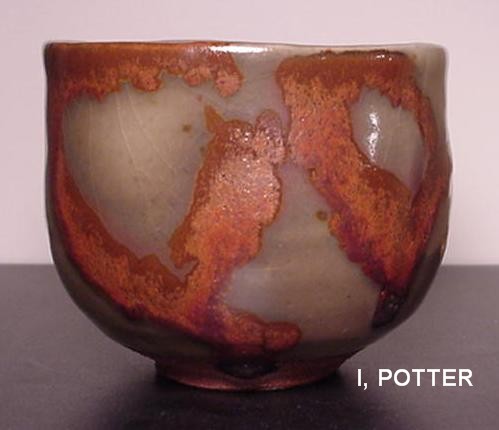
Illustrated is the very first chawan we ever collected and we actually still own it. It never ceases to engage me and the dialogue a bit more mature than when I first obtained it. The chawan is by Takahashi Wasaburo (b. 1948) who studied with Ueda Naokata IV and Ningen Kokuho, Shimizu Uichi. This chawan was wood fired and is a really deep and intense seiji glaze with splashes of rich iron splashed around the surface. This chawan shows the influence of Shimizu and the shape feels wonderful in the hand and my eye always sees something new even after 25+ years. I am glad it has decided to stick around.
Wednesday, June 29, 2011
LEAVING WELL ENOUGH ALONE

Taking a minor cue from Tsukigata Nahiko, I have been playing with the iron content and thickness in the glaze that started out as my “new” partridge feather glaze. As I have nudged it a bit, here and there, I have been seeing a new glaze quality periodically that resembles some modern Tamba pottery. In my most recent firing, I glazed a severely paddled teabowl in my temmoku and tetsu-yu glazes and the illustrated bowl is the result. It is a really nice mixture of runny ash and iron intermingled in the one glaze. I wonder why I just can’t leave well enough alone, but the real question is why would I want to, it is just not in my nature.
“There is only one thing stronger than all the armies in the world, and that is an idea whose time has come.” Victor Hugo
Monday, June 27, 2011
AND NOW FOR SOMETHING COMPLETELY DIFFERENT

This weekend, flipping open the folder, it opened up to a series of sketches of slab built bottle forms. So without thinking it through, I went down Sunday afternoon and rolled out slabs for a Monday build-a-thon. I set about cutting slabs to a form I had sketched out and set about building several bottles. I should interject here that I am not a great hand-builder by any means and the process is slow, tiring and wrought with problems along the way. After a full day of working and trying to set the lines of the piece to something akin to straight and even, I end up with two bottles with thrown necks. The larger bottle, illustrated, is about 18” tall and what I didn’t take into consideration was how to glaze them. The bottles ended up much wider than my current glaze buckets. Should have stopped, smelled the coffee and thought this one through to its conclusion.
In the time I built these, I could have easily thrown a dozen pots or more. Now remind me please, what was my motivation?
Subscribe to:
Posts (Atom)
.JPG)