Monday, August 18, 2014

DIVERSITY

I am drawn to simple work, work built on tradition and individuality, works the have a lot to express in their simplicity. Mizuno Takuzo (Taizo) makes simple, yet elemental works that speak as much about the nobility of use as they do about pushing forward an aesthetic now many centuries old. The works of Mizuno are easily recognized despite the diversity of surfaces, textures and styles in which he works, it is the somber and practical manner that he infuses his pottery with that creates a recognizable style and draws the viewer into his pottery. The illustrated Shino chawan is just such an example blending subtlety, warmth and power into one simply thrown bowl, the decoration and glaze further adding to the narrative that speaks as much about an individual as it does the tradition from which it springs. There are a great number of potters who steer clear of tradition and function, I am glad to that Mizuno Takuzo is not one of those.


"I have truly come to love the heritage of Mino, including the rich ceramic clay under the village and the wonderful treasures left by our predecessors. Will I be able to challenge myself in the months and years left in my short life and without relying too overmuch on tradition? I want to do my utmost in my struggle with the God of Fire." Mizuno Takuzo

Friday, August 15, 2014

FLUFF & FOLD

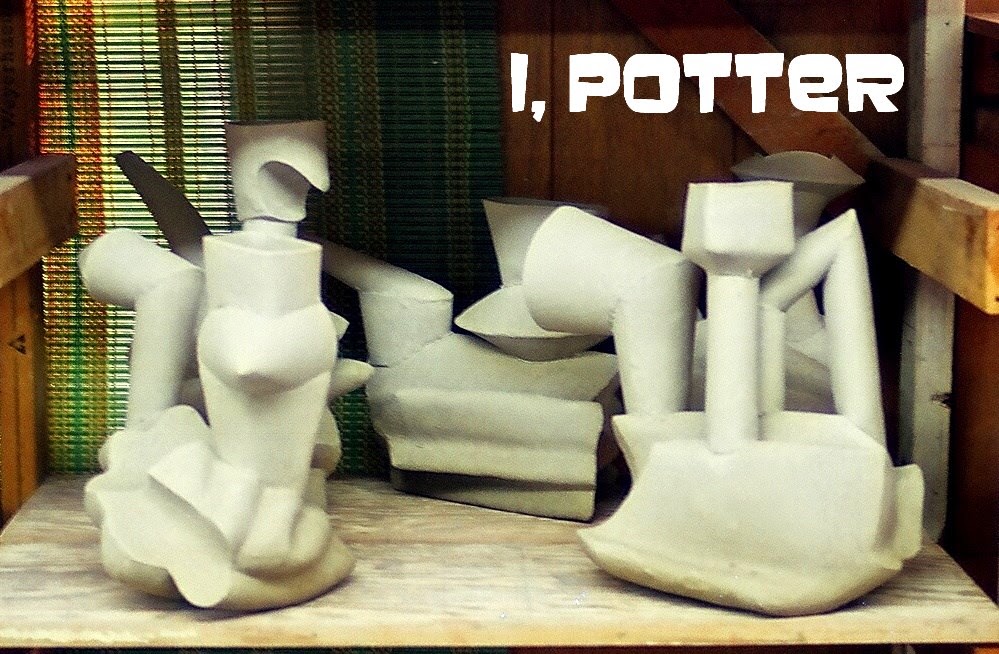
I mentioned having studied with John Gill and it made me realize that I had a nice group of photos from my time at Kent State. In 1993 I had an arts scholarship to work/study at Kent State which was in a roundabout way how I was accepted there for the master's program in ceramics. While there besides (the late) Kirk Mangus the other artist present were Eva Kwong, Marie Woo and John Gill. Up to this point I was a devoted and unwavering thrower, but watching Gill fluff, fold, cajole and coerce sheets of clay into fantastical and innovative form was enough to create a chink in the armor. John has a unique approach to clay and how to work it which was a continuous exploration of texture and form. Having taught at Alfred University since the late 1980s he has had ample opportunity to pass on his enthusiasm for creation to a large number of potters. Illustrated is a group of his ewers recently finished and drying waiting for a bisque and a glaze bath.
I came across this artist statement by John Gill and thought it said far more about his work than most people could say; "In my work I try to utilize simple techniques. This allows for a freedom of ideas and process. Shape, form, use and color inform and question other possibilities. My work uses shape and form to inflate color. Working within the realm of function expands the potential. History of ceramics, painting and sculpture collide. Clay has a simple directness - it prints beautifully."  John Gill

Wednesday, August 13, 2014

GEM LUSTER

Within the numismatic community there is a term that describes the patina of exceptional brilliant uncirculated coins, the term is gem luster. As soon as I saw this wonderful Kato Takuo that is exactly what sprung to mind. The process to creating such a piece appears somewhat simple, the chaire is thrown, bisque and then it has blue underglaze applied and then it is dipped in a low-fire faience style white glaze and fired. Once fired, the ochre based luster is applied, dried and then additional decoration is scratched through the design, sgraffito style. The piece is then refired, again at low temperature though in a reduction atmosphere and presto-chango, Persian luster. Now, I did say the process seemed simple but if you have ever tried it, it is anything but. The ability to create such a fine gem is honed by experience and I am also assuming a fair number of failures prior to getting to this level. Even among the great potters, like Kato Takuo, making pottery and getting the pot from out of your mind's eye is a rocky road paved with trial and error which hopefully leads you to your point of destination and the reward of success.
"All you need in this life is ignorance and confidence, and then Success is sure."  Mark Twain

Monday, August 11, 2014

T&A 2

I have had the fortune to study with John Gill and Jeff Oestriech and one of the most enduring (and frustrating) lessons that I took away from the experience was that if you have enough patience, you can make clay do almost anything. Though I have made it abundantly clear on my blog, I am lacking in the patience gene, on occasion I have the bug to make something that takes both time and patience as well as lessons learned years back. Illustrated is a terra cotta ovaled baker in my abstrakt decoration with a well fitted oval lid. The body of the pot was first thrown and then altered with a slab bottom attached and the lid was made by humping a slab of clay over the form. The lugs on the baker and lid tie the pot together which is further accentuated by the decoration and ribs around the pot. This pot in no way matched the level of patience that either Gill or Oestriech process but I can say with absolute surety, this pot exhibits far greater patience than does throwing a simple teabowl and for someone lacking this particular gene, this is a step in the right direction.
"Beware the fury of a patient man."  John Dryden (1631-1700)

Friday, August 8, 2014

OST

Illustrated is a tsubo of classical form and proportions with a modern surface of an iron and ash rich Oni-Shino. This Oni-Shino tsubo is by Tsukigata Nahiko and represents yet another facet to his work in which the use of iron and addition of natural ash from the wood firing predominate the surface of the pot. The Shino is used as much as a flux as a base glaze to aid in the melting of the iron and ash which has built up wonderfully on the shoulder and at the right temperature turned to a liquid and ran down all the way to the base of the pot. In certain respects this tsubo is reminiscent of certain pottery of the Arts & Crafts movement but under even casual observation, it is all Tsukigata. The form borrows loosely from the tradition of feudal tea jars but as with everything that he did, Tsukigata has put his own unique stamp on the pot from the casually thrown pot and mouth to the highly active, flowing surface. Though I have seen a great number of pots by Tsukigata Nahiko, I am never disappointed in the nearly infinite variety created by blending the elements of clay, glaze application and ferocity of fire that only "the" pre-eminent master of Oni-Shino could achieve, time and time again.
(Photo used with the kind permission of a private collector.)

Wednesday, August 6, 2014

IMPLIED

I have seen a number of Oribe pieces by Kitaoji Rosanjin over the years, in particular a number of tsubo ranging in size from very small to about 16" tall and truth be told, each and every one was fascinating and has had a lasting imprint on my work. Taking a cue from a quotation by Rosanjin and realizing that "all pottery is a copy", over time I have figured out what it is about his tsubo that interests me and it is those individual qualities that I strive to recreate. Obviously, the glaze, rather myriad of glazes is a point of specific interest but I am also interested in the sense of tenseness that he achieves in his pots. I am looking to capture a spirited fullness in the form and that is a primary aim of my Oribe tsubo. The illustrated tsubo, maybe 9" tall has the fullness of the pot accentuated by the incised "fence" design created around the belly of the pot and the tautness of the form is further implied by how the Oribe glaze has stretched thin around the decoration. Now, I understand I am a far way off the expressiveness of your average Rosanjin, but each piece is another step toward an expressiveness that communicates my own unique style.

Monday, August 4, 2014

WINTER MOON

Illustrated is a wonderfully lyrical  bowl having a lotus like quality to the form by Buddhist nun and artist Otagaki Rengetsu (1791-1875). Her works on paper and clay are quite common but many are fakes created not only since her death but also during her lifetime attesting to her immense popularity. This bowl has the calligraphy thoughtfully incised about the surface evoking imagery of dancing snowflakes flittering about under a winter moon. Rengetsu not only created the canvas and poem but set about to create the atmosphere in which her poem takes place.
"A wind so chill-
The winter moon over the Katsura River
Casts a shadow so strong
It seems to freeze the rapids. Rengetsu" *
*Translated and authenticated by John Stevens

Friday, August 1, 2014

FRIDAY CONCERT

I listen to a lot of music while I work and just in general and though to share a few songs from a remarkable and dedicated Bluegrass talent, Sarah Jarosz. I hope you enjoy these as much as I do.
BUILD ME UP FROM BONES

RUN AWAY

Wednesday, July 30, 2014

RDO

Admittedly, I am a glutton for punishment. The constant testing gets tiring at point, especially as the tests batches just don't yield anything worth pursuing. On a more positive note, the constant testing or tweaking of existing glazes can yield better, richer and deeper surfaces and at times morph into rather unexpected results. Though it is a constant love/hate relationship with testing, it is both an essential and rewarding part of making pots. The illustrated close-up is of my most current Oribe glaze that I am working on yet again. After the recent tests, I am able to get a more variegated surface with a clean iridescence about the pot. Before I glaze the piece I apply a thin iron-ash glaze to the impressed decoration and then dip it into the Oribe twice, the second coat is done rather unevenly. The result end up being a richer, deeper Oribe (RDO) and the impressions and area around them are well affected by the addition of the applied glaze. On second thought, testing isn't all bad and it keeps me moving forward.

Monday, July 28, 2014

LOCATION

Illustrated is a rather simple, even straight forward guinomi by veteran Iga potter; Kojima Kenji. The piece was thrown with a slight amount of rhythm layered into the surface, a practical foot and the rest was done by knowing where and how to fire the pot, after all, location is king. It may sound simplistic and obvious but each and every pot fired in yakishime style has to have its location and form well thought out prior to and during the loading process. Any well made piece can be fired willy-nilly, but the best show that their placement was thought out as to wrestle the absolute best from both pot and firing. I have seen quite a number of pots by Kojima Kenji and for the majority of his work, it is obvious that each piece, no matter how seemingly insignificance, receives the attention it deserves to be the best it can be and this simple guinomi is no exception. As I reflect on the wood fire potters that I most admire, it is perhaps this quality that is a common denominator that sets apart those who truly understand their kiln and firing and it shows on nearly every pot that they fire.