Showing posts with label chaire. Show all posts
Showing posts with label chaire. Show all posts
Wednesday, February 5, 2020
CHA-TSUBO
The
maker of this diminutive little cha-tsubo is Kutani-yaki legend, Hasegawa Sojin
of Kanazawa perhaps best known for his wispy aspara-like fairies and various
naturalistic designs created in a painting technique that he calls Yosai. This
particular piece is housed in a box that reads; KUTANI CHA-TSUBO and is more
akin to a chaire than it is what one thinks of as a traditional cha-tsubo,
tea-leaf container. Thrown out of porclain with a matching lid, the piece is
first fired with a clear glaze and then it is painted with overglaze enamels in
his particular style and in this case of the wispy, lively aspara style figures
floating freely about the base of the piece. Considering the normal atmosphere
and formality of enamel painting, there is a casual feel to this piece which
makes it very inviting and thoroughly functional whether it is used for matcha
or sea salt, it has a place in almost any household. I hope this short
slideshow video conveys the sense of playfulness that I had while handling this
pot and gives a glint into Hasegawa Sojin's unique Yosai style.

Friday, June 21, 2019
GLASSY GEM

Wednesday, January 23, 2019
THE DARK SIDE
I recently spent a little
time with this rather nice chaire by arguably, the father of modern Iga,
Tanimoto Kosei. The chaire is of a rather sturdy and classic medieval form with
a great surface which, like the Moon has a light side and a dark side. The area
facing away from the fire has a wonderful, green ash surface with areas of deep
pooled effects that add a sense of animation to the pot while the area that
faced the fire has a dark, almost ominous surface of dark greys and a shiny
black that masks much of the surface in shadows and mystery. I have seen quite
a few chaire by Tanimoto Kosei over the years and for me, it is a safe bet this
is among the finest I have seen showcasing a great form and even greater
surface to create an excellent Iga example. I took quite a few photos of this
chaire and put together a short video slideshow to give a sense of what this
Tanimoto Kosei Iga chaire offered in person, I hope this gives you the sense of the
pot.
Friday, March 2, 2018
TANPAN
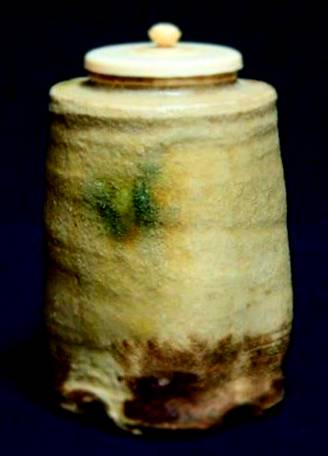
Wednesday, July 5, 2017
TANG AGAIN

There is an old misconception that the
drink, Tang was invented as a result of the NASA space program but the truth is
it was around before manned space flight but its association with NASA
certainly made it quite popular and a must have household item. As for this exhibited Tang influenced Sancai chaire,
though it is not necessary a household item it could be a focal point of any
tea ceremony most pottery collections.
Made by Kato Kobei VII, son of Ningen
Kokuho Kato Takuo, this full and rounded chaire was thrown out of a fine white
clay and then glazed in an alkaline based clear glaze with accents of copper
and cobalt added to the surface which became droozy and melted down the pot. The
fine incised line which circles the pot acts as a strong focal point especially
where the rich green and blues become a bit deeper in the recess capturing the
eyes attention. Kato Kobei VII comes to this style, inherited from the vast
experience, experimentation and interests of his father creating works in the
Persian and Tang Sancai styles which bare a resemblance to his teacher but shows a careful and studied approach to the work which defines the pottery of a
unique voice in not only form but application, design and decoration. There are
few potters carrying on this pursuit and this chaire serves as another brick to
shore up this distinct tradition.
Monday, March 13, 2017
SMALL PACKAGE, SMALL POT
On
Friday I had a small package arrive from a fellow collector, in it was a nice
Shigaraki chaire by Kanzaki Shiho. I assume Kanzaki needs little introduction
as he is well known in the West and is a ubiquitous figure on the internet. I
took a group of photos and built this short slideshow video to give a sense of
what this all natural wood fired chaire looks like in person and hope it helps
show the pot with a bit of depth. You can also see a feel images of the chaire
over at my Trocadero marketplace;
Wednesday, December 7, 2016
HALF & HALF II
I put together a short video slideshow of a chaire by Yamada Masakazu who
specializes in wood fired Shino, Oribe and Haiyu glazes. The small lidded
chaire is glazed just over the shoulder and the rest of the effects are all
natural from the wood firing making for a half and half blend of all natural
and applied surface. Appearing feudal in its origins, this pot is a
purposefully made chaire ready for use in the tea ceremony or equally at home
on a shelf on display; enjoy the video.
You can see more of this chaire over at my Trocadero market place;
http://www.trocadero.com/stores/albedo3studio/catalog/
You can see more of this chaire over at my Trocadero market place;
http://www.trocadero.com/stores/albedo3studio/catalog/
Monday, August 22, 2016
SHOWA-YAKI

Illustrated is an early chaire, circa Showa go-ju yon (1979) by the now veteran Hagi potter, Hatano Zenzo (b.1942). Studying under Yoshiga Taibi (1915-1991), Hatano learned a strict sense of form, glaze and firing from his master and it shows in both his earlier works and his pottery of today. The wheel thrown and crisp form is accentuated by the wonderful blushing and zirconium (?) crystals speckling the surface with a stiff flattened shoulder capped off by the lid. Though over three decades old, the pot is a distinct reminder that the pottery of the Showa era is as fresh as ever.
Wednesday, December 30, 2015
MOMENTARY RESULTS

Like
a lot of the rest of the country, the weather has not been exactly ideal here
and there are those times when I am certain I may never see sunshine again and
the past two days have been just that. Yesterday we had ice and snow with more
ice on top building creating a blanket of crusty ice across the region, but no
sun to speak of and today between intermittent icy rain and thick fog the day
has been bleak at best until for a brief few moment that sun poked through the
clouds and the resulting picture is the momentary result. I grabbed the camera
and took the shot just in time for the sun to disappear and then checked to see
if the camera captured what my eye had seen and luckily enough it did. Half
cloaked in darkness a chaire emerged from the shadows to reveal a wonderful
surface of ash with a rich bidoro drip reminding me of an ice coated rock face
in the midst of a spring thaw. This particular Shigaraki chaire is by the late
kiln and pottery master, Furutani Michio and was made sometime in the first
decade of his career. I have made a slideshow of the pot and will put it up at
another time but I thought for today, this image would suffice and would make a
dreary Wednesday just a bit brighter.
Friday, April 3, 2015
MELTING SNOW II

I
would appear that Spring has finally sprung in our neck of the woods. The real
tell tale signs of Spring is the incredible melt off and running water that
makes its way from the hills in to the river at the center of the valley. When
I think of the last throes of Winter only recently departed and the onset of
Spring, I am reminded of a fine chaire made by Tsukigata Nahiko. This Oni-Shino
chaire shows drifts of snow being cut through by small ravines created by
flowing water creating a microcosm that epitomizes the season in my mind. One
of the reasons that I admire the Oni-Shino of Tsukigata is the complexity of
the surfaces and the endless landscapes and memories that they can conjure.
Monday, February 16, 2015
ANOTHER GEM

What
is a gem? The dictionary describes it as follows; 1) a precious or sometimes
semi-precious stone cut and polished for ornament 2) something prized
especially for great beauty or perfection (excellence) 3) a highly prized or
well-beloved person. Can this term, gem really be used as an adequate
description of a pot, well I certainly think so but I am admittedly biased. The
illustrated piece is in my book a textbook gem, it is a chaire by Tsukigata
Nahiko that used to belong to a friend of mine. Though many may consider it
Oni-Shino, I would classify it as Ko-Shino where the thin Shino is infused with
ash and the shoulder has areas of rich brown textured and the runs are glassy,
ending in bidoro. It is a dramatic and poetic pot that is housed in a tea
masters signed box with three compartments for the three luxuriant shifuku
accompanying the package. Though I am sure what comes to mind for most when
speaking about gems is diamonds, sapphires, emeralds and rubies, this is what I
think about when someone mentions gems around me.
"There
are little gems all around us that can hold glimmers of inspiration." R. Mead
Friday, December 26, 2014
RULE OF THREE

Up
until a couple months ago, I had never had any chaire by Mizuno Takuzo come my
way and just recently, a collector sent me two more to help find a new home
for. Do chaire follow the "rule of threes"? The first one that came
my way was a rather nice Oni-Shino style chaire, the recent two are Aka-Shino
and Seto-Guro and I can see why they were collected together as both exhibit very
similar characteristics in their presentation. The Aka-Shino piece has a tall
and graceful form with two tiny additions to the shoulder with a rich and thick
glaze with dark accents around the shoulder and a thick and foamy trail down
the face of the pot. The Seto-Guro chaire also has a tall and noble posture
accented by a dark, rich and textured surface with mimi-tsuki style additions
running down from the shoulder and in both examples there is just enough clay
showing to create a nice contrast with the glazed surface. It has been a
pleasure to have all three of these chaire in hand to study and for the future,
I can only hope the "rule of threes" always applies when it comes to
pottery.
Monday, September 8, 2014
A SIGNATURE POT

I have written about Mizuno
Takuzo in several previous posts, his work is both visually engaging and
functional in its execution, he has a precise sense of appropriateness in relationship
to chadogu and its design. This wonderful Oni-Shino chaire is a classic example of
his work and the possibilities that he sees within the tradition and the
stereotyped vessels used for tea ceremony. The Momoyama influenced piece has an
evocative, almost Rimpa style decoration in rich iron slip that once covered in
several varying layers of Shino glaze creates a variety of atmospheres that conjure
up thoughts of both misty moors and a myriad of tales of ancient Japan. What
never disappoints about the work of Mizuno is the unique quality of his glaze
with its thick, translucent nature and the fine cells and crawling that appear
like a signature of an individual potter, there is a calming nature to his
surfaces even when they present rich, complex and even turbulent visions.
You can see more of this
chaire by following the provided link to my Trocadero marketplace;
Wednesday, August 13, 2014
GEM LUSTER

Within the numismatic community there is a term that describes the
patina of exceptional brilliant uncirculated coins, the term is gem luster. As
soon as I saw this wonderful Kato Takuo that is exactly what sprung to mind.
The process to creating such a piece appears somewhat simple, the chaire is
thrown, bisque and then it has blue underglaze applied and then it is dipped in
a low-fire faience style white glaze and fired. Once fired, the ochre based
luster is applied, dried and then additional decoration is scratched through
the design, sgraffito style. The piece is then refired, again at low
temperature though in a reduction atmosphere and presto-chango, Persian luster.
Now, I did say the process seemed simple but if you have ever tried it, it is
anything but. The ability to create such a fine gem is honed by experience and
I am also assuming a fair number of failures prior to getting to this level.
Even among the great potters, like Kato Takuo, making pottery and getting the
pot from out of your mind's eye is a rocky road paved with trial and error
which hopefully leads you to your point of destination and the reward of success.
"All you need in this life is ignorance and confidence, and then
Success is sure." Mark Twain
Monday, June 30, 2014
GEM II

A while back I posted a chaire by Oni-Shino
pioneer, Tsukigata Nahiko. The previous chaire was a classic Oni-Shino piece
with all of the qualities one should think of when thinking about the style. The illustrated chaire is a bit
different, looking a bit like a seated Daruma character from a Zen painting and
hardly recognizable as Oni-Shino. The Shino surface is tinged with ash coating
the piece creating a beautiful light blue-green surface with the face of the
piece painted where fierce scorching and ash built up. One of Tsukigata's true
strengths as a potter was understanding his thick, complex surfaces and their
effect on form. The choice of form and varying surface and the possibilities was
paramount to his work and if you survey his pots, there is an appropriateness
that was carefully created, it may also account for why so many pots were
destroyed. The very nature of the violent process would create surfaces that
did not marry well with their forms and by necessity, they would meet the hammer.
This pot is the perfect blend of form and glaze and like the previous chaire, a
wonderful miniature universe the fits into a beautiful silk bag.
Friday, January 31, 2014
GEM

Acting like a macrocosm of Oni-Shino, I am made
to think of the concept of ko-uchu (miniature universe) while studying this
enticing chaire by Tsukigata Nahiko. Though not necessarily a rarity Tsukigata
did not leave a tremendous amount of chaire, with chawan and mizusashi
outnumbering this particular form, though most of his chaire are expertly
created as both functional pot and visual and contemplative treat. The pleasant
and full shape of this wonderful gem like pot is enhanced by the use of iron
and Shino glazes. It is completed with an accumulation of natural ash
produced during the intense wood firing that has left trails of iron infused
ash running down this piece. Appearing like a miniature of the myriad of tsubo
that he made, this chaire has all of the broad characteristics of what Oni-Shino
is all about; from the complex layers composed of rich iron, thick and diaphanous
Shino and the addition of running ash, defining the form hidden beneath as
canvas yet creating a piece of definition, purpose and startling authority.
This chaire, like most of his work is compelling, attracting the viewer to
drink in the power of the combination of clay, glaze and fire; such is the
power of a good narrative at which Tsukigata Nahiko excelled.
Friday, December 6, 2013
TANG POEM

Simple in design, execution and
decoration but regal in its bearing, this Tang dynasty influenced melon shaped
chaire exudes a sense of luxury and brings to mind the lyrical poetry of that
period . As a combination of his father's work, historical archetypes and his
own personal expression, this chaire by Kato Kobei VII is a visual gem. The
fluted form has rich aubergine tones that define the form vertically while the
whole is cloaked in a soft and tranquil amethyst glaze with accents of a stark
yellow and green which calls the eye to this sancai influenced pot. Kato Kobei
VII has blended not only Chinese and Japanese elements in this distinctly
Japanese pot, but has put his own stamp on the style in the manner in which the
elements of this chaire were created. Though an amalgam of time and geography,
this pot has a sense of being distinctly ancient and modern at the same moment.
"When Cold Mountain (Han
Shan) is cold
Ice seals the rocks
Storing mountain-green
The sun shines forth
The ice melts a while
And on this warmth
An old man survives." (An
early Tang Dynasty poem by a mostly anonymous poet)
Wednesday, November 27, 2013
CARVED CADDY

Over the years I have seen a
number of these carved, three piece tea caddies, both simply executed and
carved to varying degrees. They seem rather prevalent during the Meiji Period and
continue to be carved to this very day. Of all the ones I have seen, this one
strikes me as a bit unique being heavily carved over most of the form with deep
relief flowers with virtually no damage despite the fragile nature of some of
the carving. Carved out of a single piece of wood, the caddy is wrapped,
seductively, in flowers and leaves that bring the eye entirely around the form
and give a rather pleasant feel when held in the hand. I am not sure as to the
utility of these particular tea caddies in formal chanoyu, but as an experiment
a while back, I placed loose tea inside and put it up on a shelf for nearly two
months and the tea that emerged were still fresh and perfectly usable. The
combination of beauty and utility makes the piece that much more special and a
wonderful object to enjoy on a shelf or on the table ready for tea.
Friday, July 19, 2013
SEIJAKU
.JPG)
Seijaku is a term/word used in Japanese
aesthetics that is part and parcel of the Wabi/Sabi philosophy. In its most
fundamental sense, seijaku means "tranquility" or
"serenity" and in terms of objects, it is about defining a moment
outside of the everyday and being able to contemplate the now in its presence.
The illustrated chaire is all about seijaku in my opinion, in viewing the pot,
it is possible to escape the modern clutter and focus on the beauty and
tranquility of the piece. At first glance the strong and rugged form has a
common beauty to it with the ash running down its face mimicking some distant
waterfall with the constricted neck/mouth completed with the pure white lid. Despite
the almost rustic charm of the piece, there is a certain degree of grace and subtlety
that mask the deep complexity of this Iga chaire. Accompanying the chaire are
two unsophisticated but noble shifuku made by the potter's wife to go with the
piece which is also double boxed. This wonderful Iga chaire was made by the
late Shigaraki/Iga potter, Furutani Michio sometime in the mid 1990s. Though
small in stature, there is nothing small about this pot and it speaks volumes
about the mastery of clay and fire that Furutani Michio had achieved while
creating a focal point for the study of Iga-yaki, far into the future.
"Look for knowledge not in books
but in things themselves." William Gilbert
Monday, July 1, 2013
PROVENANCE

Provenance is defined as the origin or source of something,
the history of ownership of an object or a valued work of art. The term
originates from the French word meaning, "to come from" and that just
about sums up what most people desire to know about things, objects that
interest them. For many collectors, it seems the provenance adds some
legitimacy to the thing and can be of equal importance to the object itself and
for others the place where the piece was bought is provenance enough.
I am constantly being asked about or for the provenance of
various pots that I post on my blog or that I am selling on my market place at
Trocadero. Truth be told, for 95% there is no definitive provenance, someone
bought a pot from someone who had bought a pot from someone else or from an
auction, flea market, estate sale, tag sale, antique show or another internet
website. Basically it boils down to the provenance being somewhat illusive and
murky as the pot makes it circuitous route from its place of origin in Japan or
Ottawa, the point of origin is about the only
absolute in the equations. Not to lessen the value of modern pots, but
let's face it, we aren't dealing with Faberge eggs or Picasso paintings. For
those "collectibles" I can understand and even rationalize the insistence
on a concrete provenance, with most pots though the best that can be attached
to the pot is a guarantee that the particular pot is genuine.
As I have mentioned previously on my blog, playing detective
is a useful skill when trying to track down the sometimes illusive history and provenance of a
pot. The large Kohyama mentori vase is a good example where a certain part of
the history has been discovered, but the time in between the exhibit in which
the pot was photographed and its current residence, over two decades, remains
in the shadows. I will concede that having photos from exhibitions like that or
pots included in catalogues is about the best, sure fire provenance for most
modern pots, excluding of course, exceptionally famous and important pieces.
Illustrated is a very fine wood fired Yohen-Shino chaire photographed in front
of a picture of itself from an exhibit catalogue, much like a mirror image. The
chaire is by Shimaoka Tatsuzo student, Matsuzaki Ken and was fired in his large
new wood kiln. The pot was first glazed in a thin wash of Shino which he swiped
thick Shino over. The shoulder attracted ash and the introduction of large
amounts of charcoal into the kiln created a rich reduction atmosphere which further
affected the surface leading to areas of iridescence on the shoulder; the pure
white ivory lid just adds a punctuation to the piece. At the end of the day,
the picture of the chaire in front of the catalogue definitely defines its
origin, but the mystery still remains; what was this piece up to between then
and now?
Subscribe to:
Posts (Atom)
.JPG)