I
put together this slideshow of a rather unusual and maybe even rare chawan by
Kumano Kuroemon. The chawan is quite large and very rich in its presentation
and is described as Tetsu-Shino, Iron Shino. The surface is a mixture of iron
and Shino with a nice amount of natural ash to help activate the bowl which has
created a bold and masculine appearance with a rather unique feudal keshiki. I have
seen a few pots in this style, but this piece seems to be far more eloquent in
its presentation than most and despite the dark and dramatic surface, it is a focused
and contemplative piece that has a great deal to share. Large, complex and
dynamic, this is Kumano at his best.
Monday, December 1, 2014

Friday, November 28, 2014
CIRCA 1973
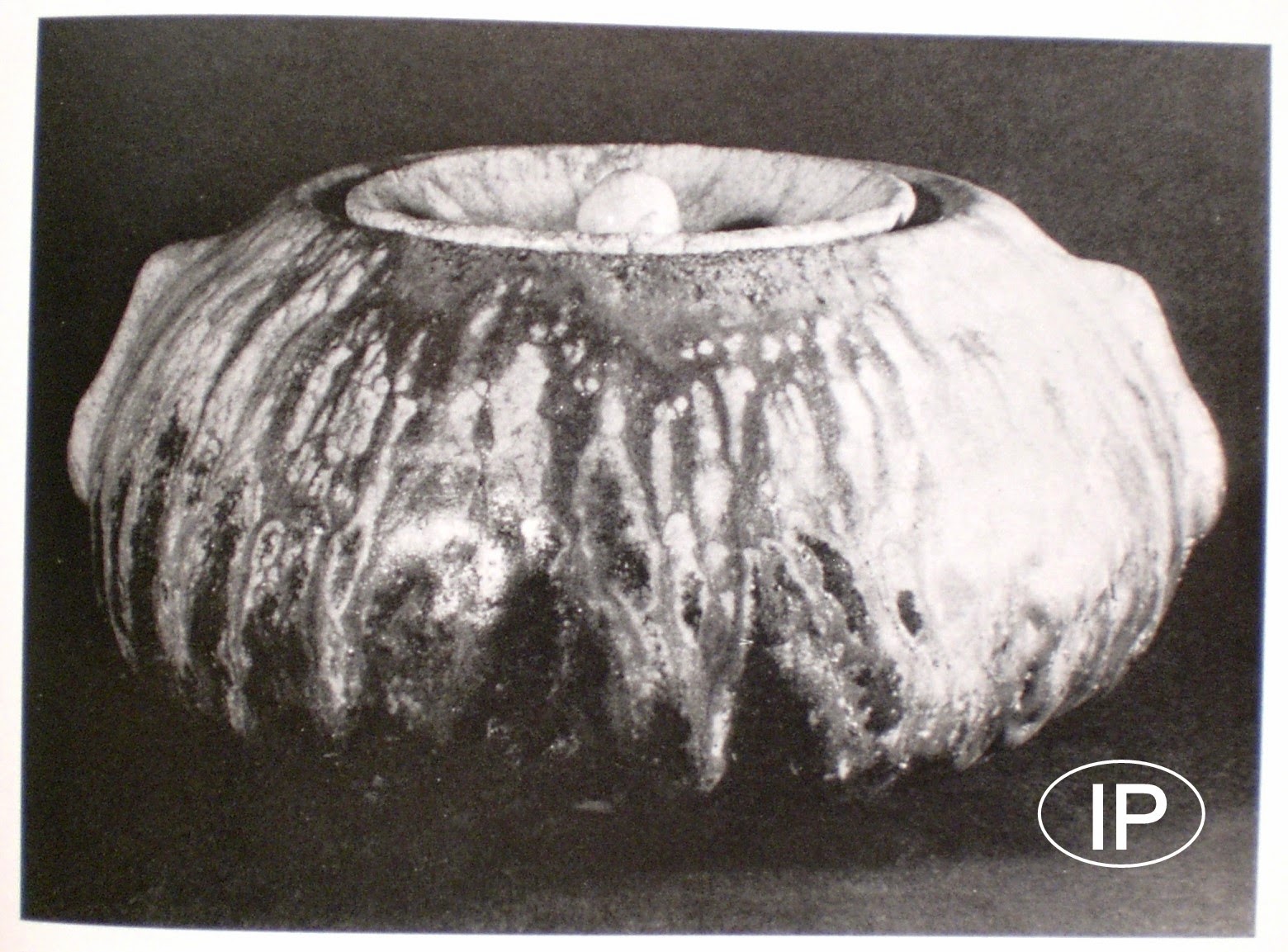
A
friend sent me a group of catalogues recently and in the package was two
catalogues on Tsukigata Nahiko from 1973. 1973 was the first year that
Tsukigata exhibited his new Oni-Shino and quite frankly it is amazing how far
developed the style was considering I have seen pots from 1969 and 1971 that
don't even hint at this revolutionary style. The illustration is of a Oni-Shino
from one of the catalogues and is a form that he used for most of his career.
Low and broad this mimi-tsuki Oni-Shino mizusashi has the quintessential
Oni-Shino glaze that Tsukigata is known for and the piece has a complimentary
lid with a generous knob to ensure a good grip by collector or tea master. Like
many of his pots, there is an enigmatic air to the piece that is well balanced
with certain aspects of Momoyama revival classicism that in many respects
defines the work of Tsukigata over his career of nearly six decades.
Wednesday, November 26, 2014
HAPPY THANKSGIVING
I
just wanted to take a moment to wish everyone so inclined, a very Happy Thanksgiving.
Though in many respects a truly American celebration, I can not think of anyone
who doesn't have something to be thankful for and like many, my wife and I and
even Khan the rocketcat have much to be thankful for. I hope that even though this day comes
around once a year, you are able to find thanks each and every day.
Monday, November 24, 2014
A SIMPLE MUG

Illustrated
is a simple mug made by Bill Klock back in the 1990s. Thrown in stoneware with
an iron slip under a Cardew Shino the decoration was made through the slip
while it was still wet. Bill made this mug shortly after working in South Korea
with Onggi potters and though not blatantly, it shows some influences of his
year long stay. It is a straight forward and direct mug that has a no frills
attitude and a comfortable handle and it and its mate has been in use in our
household for about 20 years for everything from schnapps, baked beans, cole
slaw, nuts, hot chocolate and everything in between. There is a subtle richness
to the pot that is made infinitely better while in use as many great pots can
testify. Thanks Bill.
"A
home-made friend wears longer than one you buy in the market." Austin
O'Malley (1858-1932)
Friday, November 21, 2014
SIDE FIRED II

Though
the picture came out a bit shiny, it gives a good view of the molten interior
of one of the side fired Oribe teabowl. The glaze on the top half of the bowl
was thickly applied and the addition of ash and iron made the glaze flow like
lava down the sides of the piece to pool at the bottom creating unique and rich
flows. Luckily the pitch of the pot was just right or the glaze would have run
right out of the bowl and on to the hunk of protective shelf just below. I have
learned my lessons with runny glazes over the years and now fire such pots on
pieces of firebrick or broken shelf. Better safe than sorry is this potter's motto.
HOT
LAVA by the B-52s;
Wednesday, November 19, 2014
IN MEMORIAM

It
was just about one year ago that pottery lost another great way too early. On
November 20, 2013, Kirk Mangus (1952-2013) passed away rather unexpectedly
leaving a void at Kent State University, among the wood fired community and with
family and friends. I knew Kirk and it was his teaching style and ability that
drew me to the KSU masters program. He was a driving task master who was always
willing to teach, share and help with a clever smirk and a depth of knowledge
and ability. Many of his pots shared the cast of thousands of characters that
swirled about in his head and just as many found their way on to paper in a
graphic and playful manner. Kirk was direct, as were his pots and his firings
in electric, gas, wood and salt but he will be truly remembered for his pursuit
and dedication to wood firing and the wood firing community. He is sorely
missed by anyone he came in contact with.
Illustrated
is a large, heavily carved and unfinished pot by Kirk Mangus. Ready to be wood
fired it reminds me of all the pots he made and all the pots he was yet to
make.
Monday, November 17, 2014
SLOW BLUE MONDAY

Like
a number of locations today, it is a dreary, overcast, snowy, rainy day here in
the central Mohawk Valley with temperatures hovering just above freezing. Add
to the bleak weather the fact that a package was absolutely, positively supposed
to arrive today but did not make its destination and you have some of the
components for another slow blue Monday. Despite various tasks at hand and some well
chosen music, today has somewhat mimicked the weather making for a slow Monday.
To brighten the mood a bit, illustrated is a vibrant, bright blue Persian
influenced tile by Ningen Kokuho, Kato Takuo. Framed and matted by pale
blue-grey fabric, the painting can transport the viewer to another time and
place with ease and this is just one of the gifts of this master of Toruko-ao
style work. I am always amazed at how quickly a good pot can clear the mind and
change a mood.
A novel twist on NEW ODRER's BLUE MONDAY;
Friday, November 14, 2014
SHOGA

At
this point it shouldn't come as a surprise that I love good brushwork on clay
or paper and the illustrated screen is no exception. Created by the
avant-garde expressionist calligrapher, Morita Shinryu (1912-1998) this work
is both powerful, expressive and visual poetry. During his lifetime, Morita was
a major influence on calligraphers and expressionist painter in Japan and
abroad and ranks as one of the most important calligraphers of the 20th
century. Painted on gold flecked paper, these two bold kanji command their
surface and hold the attention of the viewer whether you can read them or not;
they are pure ink expression(ism) and raw emotion. Few have the spirit,
confidence and intuitive ability necessary to make spontaneity work as well as
Morita Shinryu.
"The
final test of a painting, theirs, mine, any other, is; does the painter's
emotions come across?" Franz Kline
(1910-1962)
Wednesday, November 12, 2014
MORE GELT

Illustrated
is a larger version of a gelt box out of the same firing as the other one I
posted. This one is glazed in a subtle purple glaze made from finely milled
manganese carbonate and a touch of cobalt. The terra cotta box is decorated
with black and white slip which shows up well through the glaze and creating a
bit of dimension to the surface. The base glaze is something I found in a
ceramics book from the 1950s and it makes a great low-fire amber, purple,
burgandy and steel blue however since several of the ingredients are no longer available,
like colemenite and Albany slip a number of adjustments had to be made which
included using gerstley borate and dark yellow ochre/ red art combined as well
as altering the percentages to get the formula to work. This particular box is
about the largest I make, 4" diameter as the interior takes a lot of gold
to cover top and bottom and until I try my hand at making my own gold luster,
the commercially available luster is not exactly cheap limiting the scale to a
modest and affordable size.
"Gold
like the sun, which melts wax, but hardens clay, expands great souls."
Antoine Rivarol (1753-1801)
Monday, November 10, 2014
BUSHI-WAN

Illustrated
is a Tsukigata Nahiko Oni-Shino chawan that used to belong to a collector
friend of mine. At one time he had the largest group of Tsukigata pots that I
am aware of outside of Japan which included a number of chawan, a magnificent
chaire, a gem quality mizusashi, tsubo, hanaire and a framed tile to boot. But
when I close my eyes this large brooding chawan stands out, its energy and
presence palpable as if it were alive. The rich and molten surface frozen in
time when Shino, ash and iron coalesce to create a statement about both potter
and craft. There really is only one master of this style and this chawan a
vivid exclamation about the spirit, determination and mystery of the art of
Oni-Shino.
"This
inanimate object, this pottery thing holds within itself thought and feeling in
some mysterious way different from any other inanimate objects." Ted
Randall (1914-1985)
Subscribe to:
Posts (Atom)
