Friday, December 11, 2015

RANT WARNING

I had another one of those conversations regarding kamakizu the other day and let's be clear for the record, the word is easily defined; kama = kiln and kizu = flaw. In this case they were extolling the virtues of kamakizu and the wabi/sabi aesthetic and how this enhances the keshiki landscape of a pot. Now I am all in on the fact that cracks in certain vessels add to the sense of austerity and rusticity of a pot but a vessel that is intended to hold liquid, especially hot liquids is made all the worse with a crack that leaks. All you need do is ask the little Dutch boy about cracks and get his two cents. In the numerous times that I have wood fired going all the way back to 1989, I have never once seen a potter in the US or Japan jump for joy when a pot came out with a crack that in essence negated its purpose. What was missing was any commentaries about aesthetics and wabi/sabi, not a whisper, a cracked pot is a cracked pot. I have written and firmly believe in the sense of scarred beauty as it relates to wood fired pots and even see the appreciation of a pot with a crack that stands as a visual testament to the fury and violence of the process. At the end of the day, a chawan, yunomi, mizusashi or what have you is intended to hold liquid first and foremost and when it fails at that task, how does a kamakizu enhance the piece in any real or tangible way?
(I know, not much in the way of a rant but I thought I would warn off anyone that wasn't particularly interested in my editorial position on this issue. Any rebuttals, responses, criticisms or objections can be addresses to my attorney at the law firm of Dewey, Cheatum and Howe.)

Wednesday, December 9, 2015

HOMOGENEITY

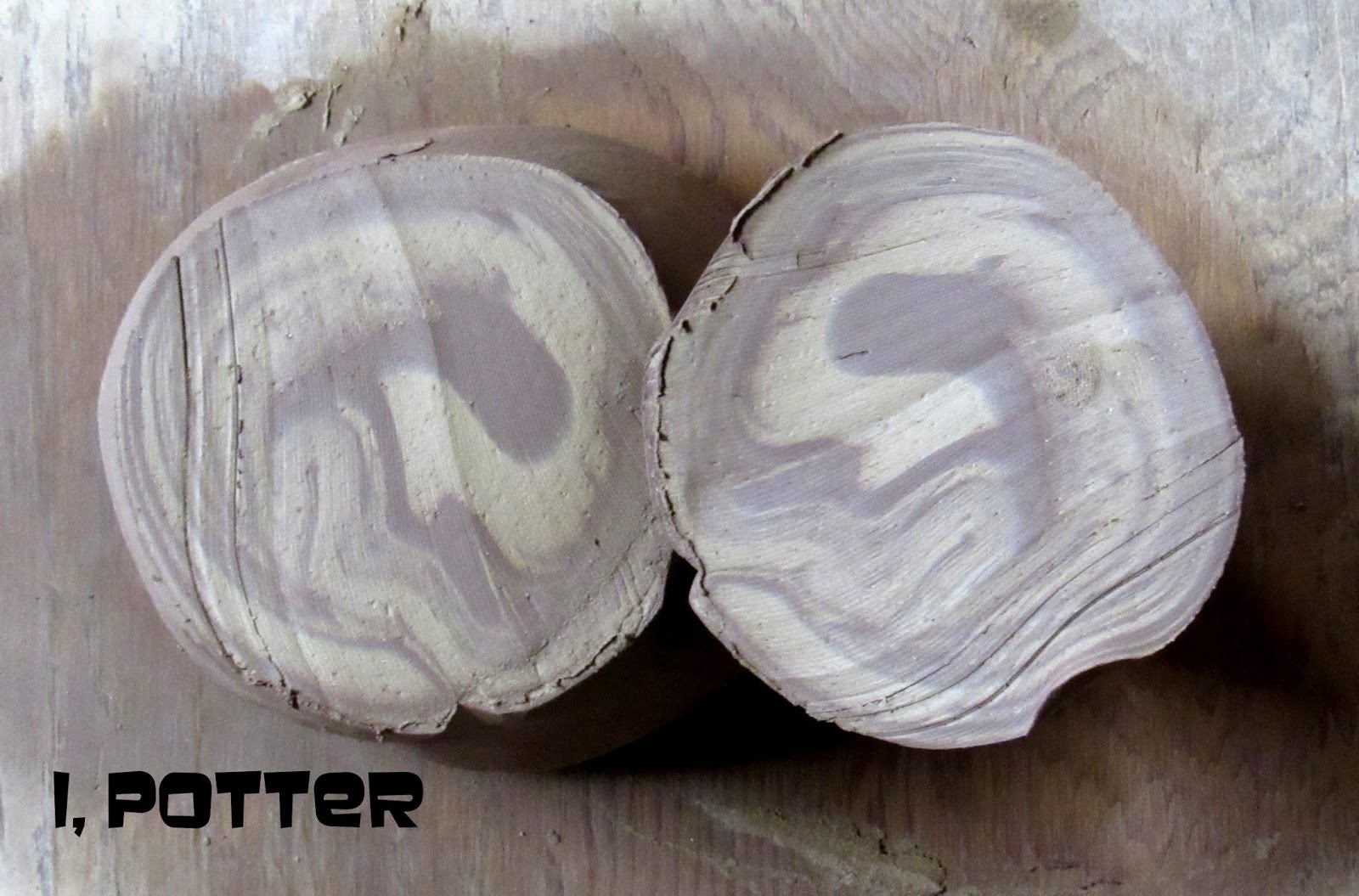
I am not a huge fan of making clay these days, even in small batches. Back at Cleveland State, Kent State and a few other place I have worked, I made huge amounts of clay, from dry to wet, from start to finish and by lots I mean tons and tons of clay for myself and various classes as the studio tech. I paid my dues and now have clay made for me or I buy commercially available clay for most of what I use. Like everything else though on occasion I get this bug to make up a clay body that I used to mix with my stoneware clay that I also made myself and we are off to the races. I tend to work in small batches, about 25 pounds dry for each and mix them up to a slurry consistency and then dry each of them separately on plaster until they firm up and wedge them together until they are completely homogeneous. Now after way too much work, they are ready to use.
I'll start by saying this picture is not of clay ready for neriage, this is the first wedge and cut of the mixed stoneware and iron rich clay that I made to be mixed. I wedge the clay 50 times or so and then cut it in half, reverse the surfaces and then do the same at least two more and usually three more times to get an absolutely thorough mixing of the two clays. I realize this may seem to be more work than it is worth but it creates a very different surface with the various Oribe and iron yellow glazes and throws like a dream. One of these days I need to get someone else to make a ton or so of this clay for me then I can just open the box and bag and throw.

Monday, December 7, 2015

THE ILLUSIVE LUSTER


This is one of those photos I wish I could say that I took and if I could it would mean I was able to handle this very cool pot by Wakao Toshisada. At times I forget that Wakao has made Oribe pots to go along with his phenomenal Shino works of both traditional and Rimpa inspiration and this large o-sara plate is one of those pieces that is very hard to forget. Cloaked in a great Oribe glaze the top-side is impressed with an undualting texture that runs the entire length of the piece but it is the underside, perched on three attached feet that the real beauty of this glaze becomes highlighted. Along the trail where the glaze was in motion and even formed a suspended drip, the illusive luster that rises to the glaze surface is in full view; a halo of various colors that many good Oribe pots exhibit but are rarely captured in photographs. While good lighting may be the key the truth is that irrespective of the skills of the photographer the luster is ever present just waiting for the right light source to illuminate the surface and unlock the nuances of the royalty of copper glazes.

Friday, December 4, 2015

WHAT A DIFFERENCE

I am amazed at the nature of photography, it seems that for the average person with a camera what results is a pot that either looks better in the photo or much better in person than the photos displays. I understand there is an art, a discipline to photography but let's face it, most of us are just not great photographers. Case in point is that I recently saw a yuteki temmoku pot by Kimura Yoshihiro that was just not that interesting, than I got to see the pot in person, what an incredible difference. In the original photographs the surface looks flat, almost lifeless and with just the hint of any color variations, in hand the surface is alive, in movement like a cosmic dance. The "oilspots" are each composed of a number of colors from black rings, rusty partridge feathers, hints of blues and greens and even hues of silver graded neatly in size from large at the top and growing ever smaller down the pot. I tried my best to capture the actual surface in a photo and came about as close as I can with my camera and tungsten bulbs what a difference a photo can make, now I know why  there is the old adage about pictures but it really should say,  "a good picture is a worth a thousand words".
"Photography, as a powerful medium of expression and communication, offers an infinite variety of perception, interpretation and execution."   Ansel Adams (1902-1984)

Wednesday, December 2, 2015

GEOMETRY LESSON

When I first saw this photo I immediately thought of some far off geometry lesson cloaked in a filter of green glass; it reminded me of the doodling I did in high school instead of concentrating on the subject at hand. There is a sense of geometry to much of the work of Usui Kazunari (b.1954) and this futamono covered box shows a pristine attention to detail that goes well beyond precision to create a piece that is immediately visually engaging and contemplative. Born and trained in Seto  and studying under Kato Shunto, Kazunari studied at the Nagoya University of Art before establishing his own studio in 1984 and has had a splendid career focused on a modern interpretation of Oribe with surface decoration that specializes in incised and inlay work. Using crisp incised lines and areas of inlaid color, the surface shares a wealth of color that communicates like a modern day artistic rendering of a mathematical fractal. If one were to simple describe his pots they could easily come across as technical exercises but when you see the finished piece nothing could be farther from the truth.

Monday, November 30, 2015

A LITTLE DEPRESSION

Illustrated is a detail shot of two vases with saucer style mouths that are flanked by a series of rings that allow the glaze to pool in little depressions made using the end of a wood tool. I like putting these depressed areas at various points around my pots to help collect and build up the glaze as it moves to create richer and visually fixating points for the various pieces. The use of this technique works well with not only glaze but slip as well as I usually wipe of the slip from the high points creating yet another visual texture to the surface which can be seen on the saffron, iron yellow vase on the right while the vase on the left clearly shows what happens as the Oribe pools and creates blue-green tendrils in each of the rings. I realize this is not rocket science but the rich, more diverse and engaging you can make the surface, the better the story the pot will have to tell and that is what I am constantly after.
"The next pots is always going to be better than the previous one, that's your motivation." John Leach

Friday, November 27, 2015

HDG II

I put together a short slideshow video of a Bizen hikidashi-guro chawan that just arrived here. Made by Akiya Masao a student of Isezaki Jun, Ningen Kokuho for Bizen ware this is part of a more modern movement to create both Kuro-Bizen and hikidashi-guro style tea wares. As a combination of both styles this pot has a rich black surface with large areas of runny and glassy ash created by pulling the pot out of the kiln when the surface is actually liquid and once pulled from the fire and allowed to cool, the surface is permentantly frozen in time. The bottom of the chawan also exhibits the scarred remains of a group of shells on which the pot was fired, each flanking the kodai like feudal guardians of the four directions (Shi-tenno) with a gravity defying rich green-brown bidoro drip hanging precariously off the base of the bowl testifying to the liquid quality of the ash just before it was removed from the fiery embrace of the kiln

You can see more of the Akiya chawan over at my Trocadero marketplace;


Wednesday, November 25, 2015

ONE AT A TIME

I made a short video of an Oribe teabowl I made and fired recently. I usually throw a group of four or five teabowls that I then alter and manipulate to create the forms I am after and that feel comfortable in the hand, though working in a short series, they are crafted one at a time with each piece adding to the next. This particular bowl is stoneware with a thick porcelain slip surface which brightens the rich Oribe surface which coveres the piece. I enjoy making these thrown and manipulated bowl which are finished with hand cut feet using a simple, sharpened piece of bamboo. Though these teabowls are inspired by several modern Japanes potters, I think that I have hit upon several forms that are my own, unique to how I work and in a scale that interests me beyond being tied to the traditional chawan. I know I have quite a few of the 10,000 hours left to get where I want to go but one piece at a time the pots get closer and closer to what it is I see in my mind's eye.


Friday, November 20, 2015

ATTACK

I consider myself fortunate to have been able to study, work and fire with Kirk Mangus back in the early 90s. Watching him throw and then decorate his larger pots was quite a spectacle; a blend of speed, strength, determination, spontaneity and purpose. I was at Kent State when Kirk created the illustrated covered jar which is a fond memory as much a grand learning experience as it was pottery theater. He started by wedging two large amounts of clay and then centering the first amount of clay and then slamming the second one on top and centering it and the entire mass. Once centered he began the process of opening the clay up and making it rise from the bat, nearly 20" tall  with walls purposefully left thick to accommodate his style of deep relief carving.  After a few days the clay had set up enough and he first addressed the lid to make sure it made a good fit and then with a knife, simply cut away the excess in sharp, crisp facets to reduce the weight, then the carving of the pot began. Taking a moment he walked around the pot surveying the surface, form and obvious steps to the piece and wielding just a couple of tools he set in the raised boundaries that separated the panels before just going at the pot like a focused dervish in a well practiced attack. His cuts were fast and exceedingly direct and I did not see him hesitate even briefly and then the pot was done. Even though I know his menagerie of designs and elements was well practiced it was still quite the experience that I have yet to forget even a moment of.

"Every man's memory is his private literature." Aldous Huxley

Wednesday, November 18, 2015

THE RIGHT BLEND

Looking a bit more like a medieval storage than a modern mizusashi this pot owes its creation to a adherence to tradition and an eye to the future. Made by Osako Mikio this Tokoname mizusashi finds its roots in Kamakura to Edo era storage jars while uniquely blending the old with the modern approach that was first espoused by Ezaki Issei and carried on by two of his students; Osako Mikio and Takeuchi Kimiaki. This mizusashi has a rather feudal form and simple lid with a surface of rich textured running ash which has created a pot that has an exceptionally utilitarian feel balanced with the complexities of the Chanoyu for which it was both intended and well suited. Synthesizing the formal and the everyday, Osako Mikio created pots that are conversant in both their purpose and the casual nature they reflect. Finding its origins in the old, this modern pot is a classic addition to the Tokoname tradition and a unique vision that clearly points to a dedicated potter.
"Every pot has its lid."  Old Proverb
誰にでも適当な似合いの人がいる