
Showing posts with label chanoyu. Show all posts
Showing posts with label chanoyu. Show all posts
Friday, June 21, 2019
GLASSY GEM

Friday, March 2, 2018
TANPAN
Friday, January 20, 2017
WALKING ON EGGSHELLS

As
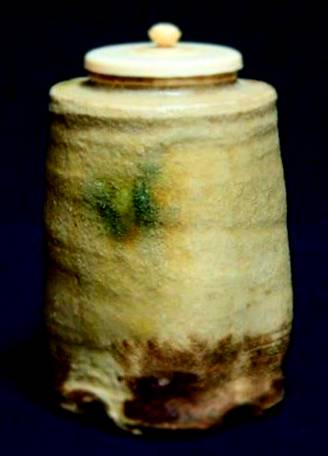
I have mentioned before, over the years I have come to think of Kimura Ichiro
and his work as quintessential Mashiko-yaki from it simple execution, design
and glazing to its folksy, utilitarian practicality even when it comes for
articles intended for tea ceremony. The posted illustration comes from an old
catalogue of Kimura's work and illustrates the honesty and range of his pottery
and even though this pot is intended as a mizusashi, it is easy to picture it
in an multiplicity of uses from rice storage to holding your cat (or dog)
treats. I am impressed by the simplicity of the form made all the more
interesting by the crackle glaze that reminds me of eggshell impressed lacquer
decoration that has been around for centuries. The surface on these pots is
enjoyably tactile with recesses creating fissures which in turn create the
wonderful visual landscape of the pot. After you study this pot for a while it
is easy to see the influences of his master, Hamada Shoji from the effortless practicality
and simplicity of the form to the easy to use classic style knob set a top the recessed
lid. The raised bands around the form and mouth of the pot look very much like
they are holding the pot together and keeping the volume of the interior from
expanding any further; with all of these visual and tactile cues I think there
is little else that could have been done to make such a simple mizusashi so
thoughtfully interesting.
Wednesday, November 18, 2015
THE RIGHT BLEND

Looking
a bit more like a medieval storage than a modern mizusashi this pot owes its
creation to a adherence to tradition and an eye to the future. Made by Osako
Mikio this Tokoname mizusashi finds its roots in Kamakura to Edo era storage
jars while uniquely blending the old with the modern approach that was first
espoused by Ezaki Issei and carried on by two of his students; Osako Mikio and
Takeuchi Kimiaki. This mizusashi has a rather feudal form and simple lid with a
surface of rich textured running ash which has created a pot that has an
exceptionally utilitarian feel balanced with the complexities of the Chanoyu
for which it was both intended and well suited. Synthesizing the formal and the
everyday, Osako Mikio created pots that are conversant in both their purpose
and the casual nature they reflect. Finding its origins in the old, this modern
pot is a classic addition to the Tokoname tradition and a unique vision that clearly
points to a dedicated potter.
"Every pot has its lid." Old Proverb
誰にでも適当な似合いの人がいる
Wednesday, November 27, 2013
CARVED CADDY

Over the years I have seen a
number of these carved, three piece tea caddies, both simply executed and
carved to varying degrees. They seem rather prevalent during the Meiji Period and
continue to be carved to this very day. Of all the ones I have seen, this one
strikes me as a bit unique being heavily carved over most of the form with deep
relief flowers with virtually no damage despite the fragile nature of some of
the carving. Carved out of a single piece of wood, the caddy is wrapped,
seductively, in flowers and leaves that bring the eye entirely around the form
and give a rather pleasant feel when held in the hand. I am not sure as to the
utility of these particular tea caddies in formal chanoyu, but as an experiment
a while back, I placed loose tea inside and put it up on a shelf for nearly two
months and the tea that emerged were still fresh and perfectly usable. The
combination of beauty and utility makes the piece that much more special and a
wonderful object to enjoy on a shelf or on the table ready for tea.
Wednesday, August 31, 2011
UTILITAS

Going all the way back to the beginning, I have always been captivated by various tea utensils and as such have made chawan, mizusashi, full tea sets and various other components. Though I have exceedingly little experience with chanoyu, I have done what I could to understand the function of each piece and have added my own nuances. Over time, I have had a lot of feedback from tea people (chajin) as to how pieces have preformed with subtle suggestions and input as to how to make varying objects. There are a number of my pieces that are being or have been used for chanoyu and kaiseki by the Urasenke and Omotesenke schools of tea ceremony. Seeing my pots in this setting being used, is about the greatest feeling I can imagine as a potter.
Illustrated is a close-up of the chaki of Urasenke tradition practioner, Todd Frey of York, PA. The mizusashi and matching shakutate are by me and are porcelain neriage with my Ao glaze. They are part of a set that includes a chawan, mizusashi, kensui, shakutate and futaoki. Todd has a wonderful authentic “tea house” in York and gives chanoyu demonstrations. You can learn more about him at;
http://www.gessha.com/
(Photo graciously provided by Todd Frey)
Monday, June 6, 2011
UNDERSTATEMENT
“The art of tea Way consists simply of boiling water, preparing tea and drinking it.” Sen (No) Rikyu (1522-1591)
It may sound rather niave, but I have long been fascinated with Rikyu’s assessment of the tea ceremony. Not since Julius Ceaser’s commentary, “Vini, Vidi, Vici” has a statement been so simple and to the point though in the case of Rikyu, the actual accomplishment of tea is anything but simplicity. With all of the formality, aesthetics and the grace and posture involved in chanoyu, the art is the absolute definition of the “complexity of simplicity”. In the end, like a great chawan, the art is to make it look simple and uncontrived. It is this simple “Way” as Rikyu puts it,that can take a lifetime.
It may sound rather niave, but I have long been fascinated with Rikyu’s assessment of the tea ceremony. Not since Julius Ceaser’s commentary, “Vini, Vidi, Vici” has a statement been so simple and to the point though in the case of Rikyu, the actual accomplishment of tea is anything but simplicity. With all of the formality, aesthetics and the grace and posture involved in chanoyu, the art is the absolute definition of the “complexity of simplicity”. In the end, like a great chawan, the art is to make it look simple and uncontrived. It is this simple “Way” as Rikyu puts it,that can take a lifetime.
Monday, December 27, 2010
NEW FORM FOR A NEW YEAR

A while back I was asked to make a mizusashi for a New Year’s Tea Ceremony. The tea practitioner that was commissioning the piece had several very specific parameters that I had to work within. Size, form, glazes were the strictest requirements, together with the fact that the piece was to have a formal attitude and needed to “go with” the rest of his tea pieces (chadogu).
I made a number of sketches of things I thought would work within his requirements, some based on older designs, some that were evolving newer ideas and some I had never worked with before. He chose a form based on works I am currently working with and with some modifications, he approved the idea. I moved on to the prototype next, seen in the photos. It is loosely based on my interpretation of a Kawai Kanjiro façade to one of his henko forms. The glazing on the prototype was to be simple to show the form off to its best. The gallery was glazed as the mizusashi was to have a ceramic lid and a lacquer lid. I made this prototype with two different ceramic lids.
After the piece was fired, I showed it to the collector and he really liked the piece. I threw another, it was later glazed as he requested and fired in my last glaze fire. It came out exactly as he wanted and we narrowly got a lacquer lid back from Japan in time. It will be used for his first tea ceremony of 2011 and I was very happy to assist in the project and look forward to some pictures.

Illustrated is the prototype mizusashi with recessed lid and glazed in my medieval green and temmoku glazes. The chawan is a severely paddled haiyu glazed piece similar to the one he will be using. The second picture shows how recessed the lid is.
Subscribe to:
Posts (Atom)
.JPG)