Friday, December 17, 2021

LOST IN THE LIGHTING

Illustrated is a rather vivid and compelling Shino henko that is just about lost in the lighting. When I had this in hand I took a number of pictures, including enough for a future slideshow video but I managed to take a good solid group of more creative pictures using sun and shadow and various other techniques. I think this one conveys some of the emotion, presence and topography of the henko that a full on, well lit photo may not capture showcasing the casually applied swipes of Shino glaze that Matsuzaki Ken applied around the form as well as the indiscriminate ash that has landed here and there bringing ones focus to the shoulder and neck that truly needs our attention. Despite a slight loss of the details of the piece it is clear that this henko has a strong form that has movement and a degree of verticality and is clearly the recipient of all of the best qualities of the bones of the pot, the quality and application of the glazes and the narration and process of the firing. The next photo I put up of this pot will be a more formal portrait but for the time being, I hope this static photograph has captured some of  the movement and dimension of the pot and I think that is about as much as I could hope to achieve with the limited photography skills that I have.

Wednesday, December 15, 2021

THEN & NOW (SHINO EDITION)

In some respects, the arrival of this rather nice Tamaoki Yasuo Shino chawan is a trip down memory lane. I doubt I had mentioned this previously but when preparing for our first trip to Japan, I had limited printed material to go by with the exception of a handful of catalogues so I was eager to see and/or visit  potters in Shigaraki, Mino and Bizen and at the top of the list was Tamaoki Yasuo. Though I had written Yamaoki prior to our trip we had never back and once there had the hotel call to try to make an appointment but he was away when we would have been able to visit. We were both a bit bummed by this setback but truthfully there was no shortage of pots to see and handle and after several days we said good-bye to Gifu Prefecture. Our last stop was to be Osaka-Nara-Kyoto while staying in Kyoto proper and on our first day there we ran in to a gallery that had four chawan by Tamaoki Yasuo including the rich Aka-Shino bowl that I posted about previously* as well as three Shino pieces so in the end, it really is all's well that ends well.     

Over the years I have handled quite a few pots by Tamaoki  who was, way back when considered one of the five great hopes of Mino whose work has moved the Mino tradition in a modern directions with his innovative forms, creative use of Shino glazes all the while blending modernism and tradition in to his tea ceremony pieces of which this chawan is a classic example. Relying on a good strong and practical form and a Shino that can be distinguished from that of many of his contemporaries, this chawan displays a rich and varied landscape ever so reminiscent of old Momoyama ink painting though quite a bit less monotone in its brushwork, so to speak. In many respects this is a classic bowl from the 1990s by Tamaoki, being carefully crafted, it is one of several chawan forms in his oeuvre relying on archetypes that came before him from the Momoyama era through the mid-Showa period that reflects his vision of modern Mino and modern chadogu. I have to admit what appeals most to me is the simplicity of the bowl and the fact that his chawan rarely appear like they have been forced, fussed with or overly manipulated, they have that freshness of form that looks like a potter threw a bowl and then casually lifted off the wheelhead and this is what you end up with and in my opinion that is truly one of the attributes of a really good chawan.

(* https://albedo3studio.blogspot.com/2015/03/iam-constantly-amazed-at-how.html )

Monday, December 13, 2021

CAN I GET A FOOT WITH THAT


For the most part I have been using four different hump molds to make this shape in three different sizes and it has become a staple in terra cotta, stoneware and occasionally porcelain. This square tray form and a mate to it are a bit different in that I was asked to put a raised foot rim around the usually square, flat base which took about two minutes to figure out the best way to do that. I rolled out and cut a square the size of the base, cut most the interior of the square out and then luted it to the bottom and well, there you have it, a raised foot on the piece. made of stoneware this is glazed in my temmoku and medieval green with decoration under the glaze in two of the quadrants. The process only added a few minutes to the whole thing but I will admit I was a bit surprised when the email asked; "can I get a foot with that?". 

(Sorry the rear photo is a bit over-exposed it was the only way I could light it up. )

Friday, December 10, 2021

NOT HAMADA

Quite a long while ago a collector friend of mine sent me this faceted bottle which he had concluded was by Hamada Shoji. It was sent to me with the intention that he wished to sell it but when it arrived I had to inform him that it was not Hamada, though it was a Mashiko pot and had a small impressed mark now well obscured by thick temmoku glaze. Once he heard the news he decided to just abandon the piece at my doorstep and that is how I came to own this pot which I have enjoyed all this time after all a nice pot is a nice pot whether it is fully identified, has a box or any associated provenance. As you can see it is very competently made and has excellent facets to complete the sturdy form covered over in temmoku and tessha glazes that flourish in Mashiko. In this case it is all the small details and special effects of the glaze that captivate the eye, the richness and depth of the surface makes me think of a number of potters but I have yet to identify exactly by whom. In the back of my mind I am keenly aware that there is an eventuality to uncovering the maker, it is always about time and the possibility the identity is only one random click of the mouse away. Anyone have any thoughts?    

"What one man can invent another can discover."  Sherlock Holmes (Sir Arthur Conan Doyle)

Wednesday, December 8, 2021

SUNLIT SUBTLETIES

Illustrated is a simple, subtle mizusashi made by Furutani Michio back in the late 80s to early 90s. The exterior of this classic Shigaraki pot is a puzzle like blend of hi-iro fire color and sandy, drift like patches of ash that made its way past other pots in front of this mizusashi to land haphazardly on the surface presenting a distant and solemn landscape that evokes emotion and a certain amount of pathos. Made using the coil and throw method, this form is a standard for Furutani Michio with casual lid to accompany the form and a functional and not overly thought out knob. As with most of his pots, there is a looseness, rhythm and honesty to this piece that is only decorated with sparingly applied marks of the potter and the eloquent serendipity of where the pot was placed during the firing making each piece even in series rather unique and as individual as possible. Now I realize that this sun and shadow portrait doesn't quite tell the full picture but what it does do is focus one's attention to the surface and truthfully to the atmosphere that this mizusashi presents with or without the lighting effects. I'll be sure to put another, differently lite overall shot of this Furutani Michio Shigaraki mizusashi up at some point in the future that coupled with this photo should give a fuller understanding of the piece or at least the best that a static secretive image can convey.  

"A picture is a secret about a secret, the more it tells you the less you know."  Diane Arbus

Monday, December 6, 2021

SILHOUETTE(S) III

It has been a while but every now and I again it is enjoyable to make some more playful pots and the silhouette pieces fit that bill. Illustrated is a pair of silhouette tebori covered jars made of terra cotta, covered in black slip and then hand carved to various effect. In this case the subject matter is of Woof the dog both of which are accompanied by large silhouette knobs of  Woof to stand in as knobs for the pieces. There is not much different between the normal lids with tooled knobs and these exaggerated handles that are also slip covered and carved to match thematically with the rest of the pot beyond the addition of a cut out slab and ten minutes additional working time. As is easily imaginable the possibilities are endless and also mired in corny aphorisms but they are meant to be playful so why not commit 110%.

Friday, December 3, 2021

F.R.T.

I think there are times when you look at a pot and just think, "classic" and this is one of those times, a pot that has that medieval presence but is modern in its creation. Perhaps it is the combination and balance of simplicity, honesty and the natural surface that makes this a classic pot where the distillation of vision, technique and surface speak volumes without the superfluous detail to interfere with the experience. This is one of those pot photos that came by way of a fellow Northern collector, large, elemental and positively medieval in appearance made by Nishiura Takeshi this pot is spotlighted by sunlight showing off many of the characteristics of modern Echizen. 

This full round tsubo has a powerful form that has a coating of somewhat carburized greyish ash together with rich areas of brown tamadare running down the surface adding movement and animation to the piece as it moves through varying other areas of the ashy surface while the ever so slightly meandering lip creates a tranquil and casual focal point. This landscape makes a rich contemplative environment and one can only envision the number of locations both real and imagined that arise as the viewer moves around the pot. It is clear from this photo that the sun certainly adds to the conversation with this Nishiura tsubo which clearly is classic in almost every sense of the word.

Wednesday, December 1, 2021

AKI-HENKO II

I put up a blog post back on 10/22/2021 regarding this fall themed Rimpa influenced Aka-Shino henko by Hori Ichiro and finally got around to putting together a quick video slideshow of the pot. I had taken quite a few pictures of this piece along with a number of detail shots and distilled them down to this 3:14 video that I show off the piece well enough to give a clearer sense of the presence and volume of the henko without having the opportunity to sending it around to everyone that would like to handle it after all the postage costs would accumulate rather quickly. As I mentioned in my previous post this pot as with most by Hori Ichiro is a combination of the element of fire, air, earth and water but I may have forgotten one of the most essential and overlooked, that of curiosity and creativity of which this potter has in abundance. Enjoy the video.


Monday, November 29, 2021

"OF TWO COLORS"
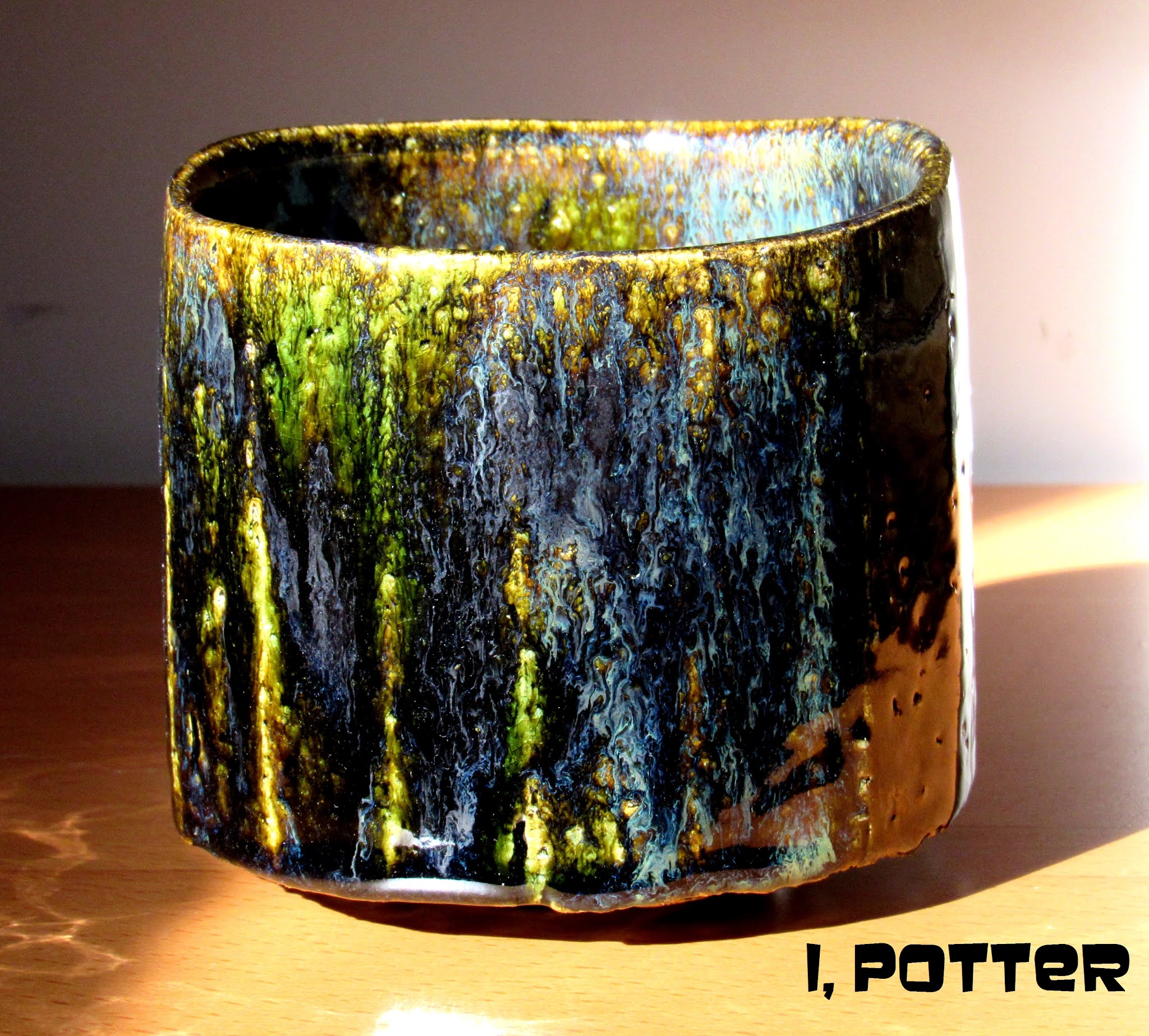

I am not sure that the term dichroic applies to this faceted Kuro-Oribe style surface but it definitely has two rather distinct appearances and a few others depending on the light source creating a different vision of the work. In this first picture utilizing only natural sunlight the green is quite easy to see showing off the wonderful clay texture underneath with areas of flowing blue, black and white all cascading down the surface complete with dramatic built up areas of glaze at high points further accentuating the varying effects. In the second photo this bowl takes on an entirely different demeanor and presence where the tungsten light source has turned the green into a rich deep amber with areas of almost black with swirled blue-white residing within.    

I should also mention that there is actually a third appearance which is quite interesting, if the bowl is resting on a particular shelf just before sundown, the surface starts out as a visible green but as the sun sets and the incandescent lighting takes over the bowl slowly shifts from green to the amber tone. With my limited skills I have tried photographing this effect to zero success, the camera either reads it as all green and shadow or amber and shadow but to the eye it is both. So my conclusion is this is a dichroic effect where the different light wave lengths are interfered with by the surface of the glaze and/or dispersed differently causing  two distinct yet related appearances, one showing off the copper and the other making full use of the iron. I am reasonably sure this is what is happening but if somebody that has an indepth knowledge of this principle feels otherwise, please let me know.

 "Vision is the art of seeing what is invisible to others." Jonathan Swift

Friday, November 26, 2021

CHISELED

Over the years it has been fascinating to watch the works of Matsuzaki Ken change, even mature from how he sees form, decoration and especially the firing process. This wood fired, chiseled surface henko falls in to the end of his second phase of pottery making where form and firing are married for maximum effect. Dating to 2004, this henko was coil built creating a slightly thick form that was then "decorated" by using a chisel to create the visual texture of the piece that once wood fired was  both softened a bit yet further accentuated by ash for a dramatic effect. There is a wide array of surface effects on this henko and I choose this side to showcase as it is the side illustrated in Andrew Maske's book, KEN MATSUZAKI; Burning Tradition, I should also note that this is illustrated in an exhibition catalogue from the same year (2004) in Japan. As for the form, it has a primal appearance, elemental and rather stoic that makes the mind work for all the various associations possible; simple form, excellent execution and perfect surface, the pottery trifecta.