Monday, July 8, 2024

SURVIVOR

There is something to be said about a pot that immediately speaks of the herculean battle waged with fire and ash and certainly among this group who glaze their pots, Tsukigata Nahiko and Kumano Kuroemon always stand out among the crowd. This Kuma-Shino mizusashi is a perfect example where though locked in a battle for survival and facing the distinct possiblity of melting and succumbing to the heat of the kiln, this pot is a survivor and lives to tell the tale. The thick Kuma-Shino surface coating in a thin coating of luscious green-blue ash is interupted by areas of intense and crusty ash painting a narrative that potter and collector alike can understand and appreciate for the complex and beautiful landscape now frozen into the surface.

This particular mizusashi was thrown as a bowl form and altered a bit prior to the firing and once it had come out of the kiln intact a simple cypress lid was carved and fitted to the pot completed with a thin wood strap acting as a handle. I love the contrast between the simplicity of the lid and complexity of the surface all the while being unified by a simple form that waits for the viewer to remove the lid to expose the wonderful Kumano treasure exposed within.

Friday, July 5, 2024

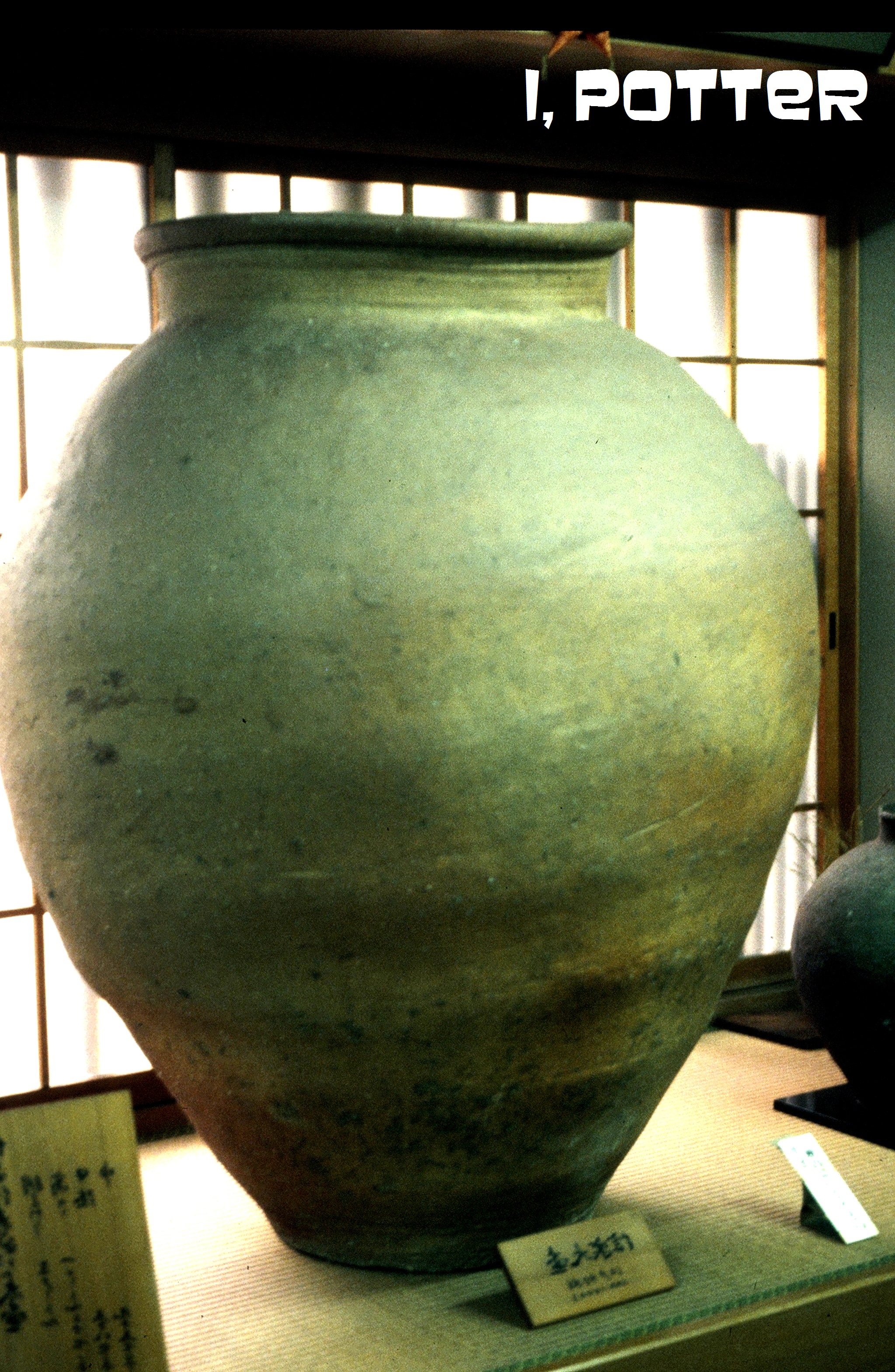
O-TSUBO

I am reasonably sure that many visitors to Shigaraki have seen this somewhat large (!) Ko-Shigaraki O-Tsubo on display at the small museum of mostly historic pottery located downtown (I am sorry the name escapes me at the moment). When people talk about large Japanese pots, this is always the piece that springs to my mind as I stand 6'2" and it was rather impressive and almost my size, in height, luckily not width or circumference. I realize this is not the best photo, it was originally a poorly lit picture with a negative now decades old but it still gives a sense of the scale and granduer of this large early tsubo. perhaps my favorite features of this behemoth are the indented furrows, three of them surrounding the based and the strong, defined mouth and lip with just enough movement and undulation to really call attention to its features. As I mentioned, to me this is a big pot and moving forward I guess in any description using the word or term large, there should likely be a number of caveats which include a link back to this pot for reference.

Wednesday, July 3, 2024

30 MINUTES OR LESS ÷ 2

Realizing that it is unlikely I will work tomorrow and I had a few minutes to play with, I decided to to make a teabowl from start to finish in 15 minutes or less. Starting with a little over 1.5lbs of clay, I threw a standard nondescript bowl and then decided how to procide. I will admit this was a bit of a cop-out as there is nothing that pushes any parameters at all in this hexagonal piece but it came to mind and I went with it. I dried the clay just a bit and proceeded to beat on it with my large wooden spoon until it had its overall shape and then defined the lines with a metal rib and a rasp. I then dried it a bit more and tooled the foot and finalized all the angles before covering it in thick white slip and worked it impasto style in opposing directions around the teabowl. So in just under 15 minutes, this is what I ended up with, a rather large bowl covered in thick, impasto slip on to its next stage, drying which I can assure you takes a wee bit longer than 15 minutes but the heavy lifting is now complete.   

Here is to hoping everyone has a wonderful (an safe) Fourth of July!

Monday, July 1, 2024

OBJECT IN B&W

I am sure to anyone following my blog, it is clear I am not a photographer with my premise now in the digital age being, take lots and lots of pictures and hopefully one or two may be worth something. For a number of my pictures it would seem to be a confluence of luck, placement, sun, shadow and timing all together to get a shot that is interesting. I think I got lucky with this shot where the pot, in this case a Shigaraki bird object by Kohyama Yasuhisawas in just the right place and seemingly at the right time for this old school black and white study of light and shadow.    

I must admit, the texture and incised decoration circling the object are heightened in the image and present a nice study of a tactile invitation where the mood highlights the provocative form. In truth, Kohyama has a definite mastery of creating forms that are part geometry, organic and animated whether they are small like this little bird object or the large, objects of movememnt and even flight in his Kaze, wind series. As for this throw back photo of an object in B&W, all I can do is hope it captures even a hint of the attributes that make Kohyama Yasuhisa's work so packed full of emotion and life. 

"Black and whte is abstract; color is not. Looking at a black and white photograpgh, you are already looking at a strange world." Joel Sternfeld

Friday, June 28, 2024

CARRYING ON

Over the years I have seen quite a few pots by Kawai Takeichi including at Merlyn Dailey's EAST WEST SHOP in Victor, New York. My wife and I would stop there every chance we got on on treks between upstate NY and Cleveland. Merlyn always had quite a few Kawai Takeichi and other modern pots on hand as well as numerous prints including those by Kosaka Gajin who's minimalist black and white images we greatly admired. At one point he had two mizusashi at the gallery, both molded and square in form, one rich gosu and the other in this exact pale green ash glaze over slip trailing, both were sold the night before we showed up during an exhibition of Japanese prints.    

Flash forward a couple of decades and this mizusashi came our way in a slightly different form than the previous two we had handled as it is truly square and the lid fits in any position you decide to set it, the others were almost a bit lozenge in shape and only fit in two positions. Made in a mold with an applied inner lip, the body was quickly sliptrailed in a gritty, almost sandy slip. The texture in the sliptrailing gives the decoration a wonderful visual and actual texture with each plane of the square decorated in a similar manner pulling the form together and presenting bold almost calligraphic designs at the center of each side. The lid has a simpler decoration in which straight lines define the geometry and borders the edges, finished with a perfect handle that reminds me of earlier English pottery. To complete the form, the mizusashi and lid were glazed in an ash glaze that makes for a pale green surface that builds up slightly on the northern side of the slip trailing creating areas of glassy and wet accents carrying on a tradition inspired by Yanagi, Hamada and the Mingei Movement. Now to be clear, I am in no way comparing this pot to the work of Kawai Kanjiro but to my eye Kawai Takeichi has captured the essence and presence of the master's work and certainly is an exceptional addition to the school founded by a quiet and humble artisan decades before this pot was even conceived of.

Wednesday, June 26, 2024

ELEVENTH HOUR

Today was one of those days that doesn't have throwing/ making in the cards but rather a couple of errands and several hours of packing pots from the firing that was unloaded yesterday morning. In the firing were several orders as well as three teabowls that had to be quickly photographed and then packed up. I started with the serving pieces which need far more attention than the smaller pieces and worked my way to the teabowls which sold to a customer as soon as I sent him the photos. In the eleventh hour I received an order through my Trocadero marketplace and packed the last package that I am going to pack today (then off to the Post Office and one last errand.)

Illustrated is one of the three Kuro-Oribe style teabowls from this firing thrown out of a small batch, sandy white stoneware and faceted. As per usual, it is hard to know exactly what the surfaces will look like given the glazing process and usually each one is a welcome surprise with highlights here and there, especially around the interior walls and floor of the bowl. The one feature that I am pleased with for the longest is the shelf that is created from the faceting process which fills up and creates these deep, dark pools of almost black though more amber and rich green in the right lighting. This bowl and its compatriats are all now packed up and going halfway cross the country, it is always pleasing to see my pots collect dust somewhere other than my studio, so hasta manana


Monday, June 24, 2024

IN CONCERT

I saw my first show of Tamaoki Yasuo's work back in 1991 at a gallery in Kyoto and honestly was immediately hooked on his pottery. First and foremost, I really enjoy the way he handles clay and creates his forms out of a rather fine and textural clay. Secondly the simple yet elemental manner in which he decorates his pots, especially his Shino work just speaks to me from the use of layering of iron under the glazes to the use of varying layers, thicknesses of the Shino glaze itself creating pots, chawan of real textural wonder.   In the illustrated Shino tsubo, Tamaoki has combined a rich, crackle iron engobe or slip together with a simple, even primal rhythmic design composed of both Muji-Shino and Aka-Shino adding to the sense of undulating motion that surrounds the ovalled pot without any breaks in the action. The tall, ovoid form holds the surface and decoration together in harmony which could have easily gotten out of hand and created an incoherent aethetic but instead all the players acting in concert, present a rather  unified vessel. Tamaoki used this technique for two decades creating a body of work where form as canvas and glaze as palette have contributed to a rather busy modern Mino tradition.

Friday, June 21, 2024

THIN CRUST

Illustrated is a detail shot of a Oni-Shino mizusashi I was able to visit back in 2020 if memory serves me. This picture is from a take-gata mizusashi with mostly white Shino and some areas of a thin crust of golden brown ash and some traces of running green ash around the piece with what amounts to a kaleidoscope of color and texture that is just A+ in my book. It is nothing short of amazing how well this process of glazing and firing works for Tsukigata to produce a never ending narrative of visual abundance, the interplay of the varying texture and color of the surface makes for an unending conversation between potter, pot and viewer which quite frankly is the best outcome for a lump of clay, a handful of materials (chemicals), a bit of heat and a determined and adventurous potter can ever hope for. The next big mystery is trying to figure out how to get the owner who mostly collects guinomi and tokkuri to part with such a luxurious pot! 

(I apologize for the singular detail shot, as the mizusashi is not mine to share, this was the best I could offer.)

Wednesday, June 19, 2024

BITS & PIECES

Realizing the heat dome was making its way into our neck of the woods, I decided to try to get a handful of pots made before it got a bit to warm. The first smal group of pots were a group of medium size serving plates and bowls in terra cotta which dries unevenly in the heat and humidity so I switched over to making a three pieces in stoneware, two high footed covered jars, lids, knobs and a single teabowl with the clay left over from throwing the bits and pieces off the hump. The next morning I set about first tooling and decorating the six terra cotta pots followed by tooling, assembling, slipping and raking the three stoneware pots.    

As you can tell the two covered jars aren't that big, perhaps 10" tall at the moment, thrown out of a bit less than three pounds of clay. I decided to go with the large generous knobs to accentuate the jar forms and make for an easy to use lid. I first learned to make various styles of hollow knobs way back at Kent State where Kirk Mangus was demonstrating a variety of lids and knobs that he used in his work and that was a very long time ago. Two of the hollow knobs were made by throwing them off the hump and later attaching them to the lid and the other he left extra clay in the lid and then later used that clay to throw up the knob and close it at the top. At any rate, no throwing today but at least I got the terra cotta and stoneware pots finished as the temperature hovers in at 91 degrees and may get even hotter.     

The current weather sort of reminds me of the famous Harry Truman quote; "If you can't stand the heat get out of the kitchen" but in this case, maybe it's the studio.


Monday, June 17, 2024

TIDAL POOL

As I look at this rather large piece I am reminded of lapping waves swirling around in a tidal pool where the dark recesses speak a bit ominously of what is hidden under their depths. The wonderful texture and surface of this large Iga platter was conceived and executed by Kojima Kenji bringing a good idea into outstanding results. The Iga green of the surface coalasces into deep, dark pools at the depths of the swirled texture creating sheets of gem-like bidoro across the breathe of this modern osara inspired by the longevity of the Iga and Ko-Iga traditions. 

Attached  to the overall photo is an exhibition card which once again clearly shows a vastly different surface from the here and there photos. For whatever reason, my photo was taken using normal lighting and the surface is predominantly green in appearance while the card photo shows a rather distinctly brown pot is if in contrary universes of illuminating wavelengths. At the end of the day if you asked me which best represents the actual presentation of this large Iga osara I would have to say that I guess it depends on the light source you are viewing the piece in and whether or not you are wearing sunglasses.