I am not sure if you are familiar
with the Japanese publication, magazine called "THE MINGEI" but it is
an informative and educational view into the folk art of Japan all packed in to
around 80 or so pages. I have a number of issues of the publication and from
time to time I am able to get a few more and recently this copy showed up. I
was immediately struck by this wonderful Kawai Kanjiro press molded covered
box. Glazed in stark white and iron brown the rich design flows about the
surface demanding your full attention while sparking the sub-conscious into a
series of association, some you are probably unaware that you possess. The
beauty of this design is how it is many things to many people but likely to
Kawai, it was a simple design to fill space and articulate the form, to my eye
it is just like Rorschach evolved into three dimension. This pot is a fitting
cover shot for a magazine the remains true to the ideals of the people's art.
I recently received a pot
from Japan that I was a bit apprehensive to receive both as the pictures didn't
necessarily tell the whole story and I was considering how it would arrive
packed. From the moment the package arrived I could tell there was
something different about the packing, the box was reinforced with bent pieces
of cardboard effectively creating another box just inside the box and the wood
box was packed with bubble wrap and crushed newspaper securing it within. Once the
interior package was taken out and the bubble wrap removed I opened the wood box
to the sight illustrated. As snug as a bug in a rug, a well packed piece is a
thing of beauty and this pot was thoroughly secure inside without any movement
and truthfully, the pot was as thoughtfully protected as I have ever seen. Now
I realize this is not a picture of some wonderful or engaging piece but great
packing is almost as much a thing of beauty and an art as is a truly great pot
bringing to mind, "anything worth doing is worth doing well". "Anything worth doing,
is worth doing right." Hunter S. Thompson
I just started a new cycle on
Monday dedicated to terra cotta after having cleaned up the studio and prepared
a group of slips over the weekend. I will be making carved tebori, falling
leaves, abstrakt resist and black and white slip pieces for several galleries
and two (?) shows which will be made up of primarily thrown pieces with a
handfull of molded forms to fill out the groupings. I don't tend to make too
many pieces using molds but honestly slump and hump molds do come in handy for
some forms that are just to labor intensive to throw and alter and I have added
oval, square and rectangular tray/plate pieces to my repertoire which fits
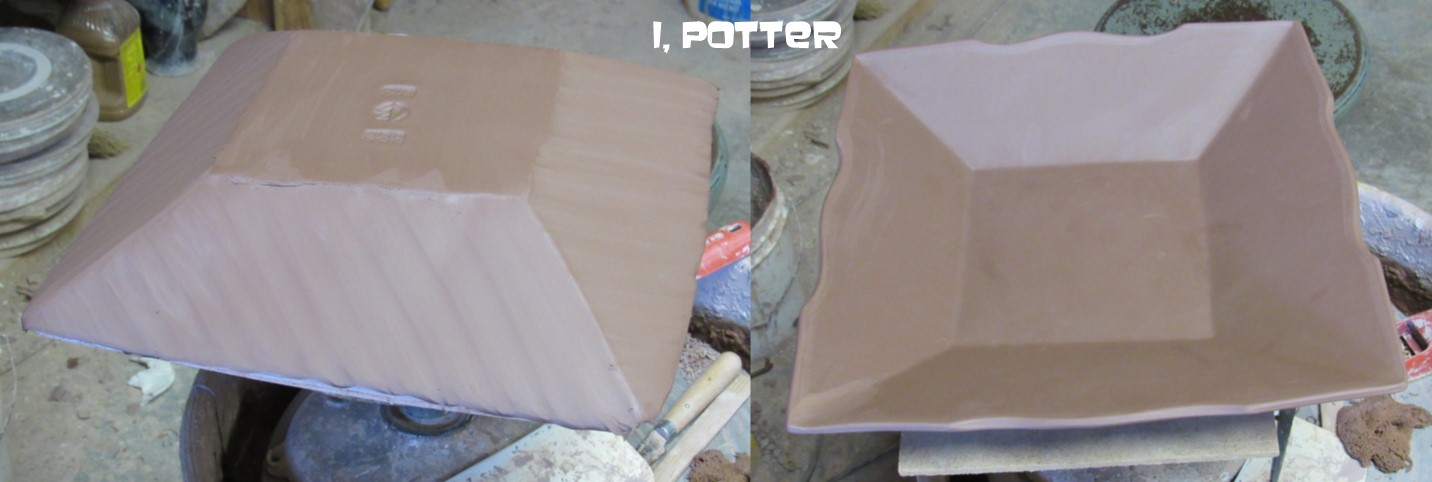
quite nicely with the thrown pots. Illustrated is a square plate on and off a
hump mold, after the form has been fine tuned, I covered the piece in black
slip and will wait again until it is firm enough to carve. If I start early
enough in the day and have the right music on the cd-player I can usually get
four square plates made during the course of the day with the intervals of
dealing with them filled with throwing, tooling and decorating (carving or slip
work) making the whole process flow rather smoothly even if it is another hump
day. Postscript; Terra Cotta and
humidity just don't mix and at the very least are certainly odd bedfellows.
There is something
unmistakable about the conspicuous color of runny ash used by the Tokoname trio
of Ezaki Issei, Osako Mikio and the maker of this pot, Takeuchi Kimiaki. The
tones of greys, sandy tans and browns that wood fired Tokoname clay turns is
partially covered in the green ash glaze of the Ezaki-mon added prior to
firing. The glaze runs down the pot to liven up the surface and form adding its
unique signature appearance to the mizusashi and with Takeuchi, he was quite
adept at marrying these textures for maximum effect. In most of his works,
there is a classical and graceful presence to the pots drawing heavily on
documented archetypes, his master's pottery and his own sense of visual
vocabulary adding his own voice to the Tokoname tradition. It is easy to look
at this profound mizusashi and imagine it in use during tea ceremony with the
glassy drips and runs painting a vivid scene of the ancient and the modern. "Grace is savage and
must be savage in order to be perfect." Charles A. Stoddard
I was searching through a
photo file yesterday and stumbled on a group of shots of this Kon Chiharu
Shigaraki tsubo and figured little harm could be done by another short visit in
the form of a slideshow video. It isn't too small or too large and has a
definitely intriguing surface, instant visual appeal and the motion of the ash
highlighted by a multitude of bidoro
droplets act just like a series of jewels in a crown. Enjoy. Here are two additional links
to blog post featuring this tsubo if you are interested; http://albedo3studio.blogspot.com/2013/12/out-of-touch.html http://albedo3studio.blogspot.com/2013/12/phases.html
I put up a post recently
showing a teabowl form that was influenced by a Paleo-Indian axe head and
mentioned that I also make serving bowls with lug handles spanning the
indentation. Illustrated is an iron glazed bowl with a rain pattern added above
and below the indent with small, serviceable lug handles added to give the pot a
bit more dimension. At about 11" across this was made as a do all sort of
serving bowl and the lugs add a bit of grip if oven mitts are used so the bowl
makes it safely to the table. I am sure I have mentioned this a time or two
previously but I am always interested in seeing the array of forms and pieces
that can come of a simple idea. To date this ancient device has made its way
across a large number of my bowls, covered serving pieces, mugs, cups, covered
jars and vases so it may be safe to say it has proven to be adaptable across
various clays, glazes and temperatures. I can only muse that it would have been
wonderful to come up with this particular design in the first place but as I
good friend was quick to remind me, had I come up with this idea originally, I
would have been dead for a very long time.
Hope everyone is enjoying
another wonderful Forth Of July including our friends the Brits, after all breaking
up is always hard to do. In the spirit of the Forth with fireworks, family,
picinics and BBQs what could be more essential then hotdogs and mustard?
With the perfect pigment and
brush and a well practiced hand, the decoration on this Egaratsu chawan seems
tailor made for this pot, creating motion and both accentuating the horizontal
natural of the form and adding wispy hints to allude to the vertical. Made by
Maruta Munehiko (b.1961) this chawan sums up what Egaratsu is about with this
pot easily identifiable as that style. Maruta grew up around clay as his father,
Maruta Masami was a famous folk potter before going on to study with Hamada Atsuya,
third son of Hamada Shoji before returning home to Karatsu to set up his own
studio. Using a number of local clays and in various Karatsu styles, Maruta
create a rich and diverse array of pottery of which the Egaratsu is among my favorite.
Even in a field, crowded by a number of potters and pots it would be hard to
just walk by this bowl without having the feeling that it needs to be picked up
and brought home with all due haste. "In the brush doing what
its doing, it will stumbles on what one couldn't do by oneself."Robert Motherwell
Illustrated is a rather
simple form with a lurid, almost lyrical incised decoration running around the
piece creating a sense of perpetual motion. The pot was glazed in a rich
Mashiko ash glaze (haiyu) and then was wood fired by the potter, Matsuzaki Ken
with the results being framed in ash over ash making for a rather rustic
chawan. The incised decoration has filled with the glaze and natural ash
from the firing to fill the channels and present a rich and dark decoration
which moves freely about the pot. This combination makes for a wonderful blend of the formal and
the common while adding to the tactile experience the piece has to offer. It
never ceases to amaze me that the confluence of a lump of clay, a simple wood
tool and a few materials mixed with water can combine to create such a pleasant
vessel with just the slight help of a good potter.
Years ago I saw this
Paleo-Indian stone axe at the Natural History Museum and I was struck by the
form and it almost sculptural elements. The form was conical and about 2/3 of
the way down the form was this highly polished channel that ran around the axe
where the handle was secured and though I didn't know it at the time, the form
and particularly the indented area was to have a large influence on my making
pots. Starting some time in the early 90's I began making this serving bowls
and bowls of all type with a rounded profile interrupted by a concave channel
running around the bowl and for the serving pieces I applied small handles that
went over the indents to echoes the overall roundness of the forms. The teabowl
pictured is one of those typical forms where the fullness of the form is broken
with the recessed channel which serves to visually break up the surface as well
as to play in to various glaze activities, with runny glazes benefiting the
most. The ash glaze over the temmoku is made from ash that I got from my
sister-in-law and once screened but not washed, this is the end result. As
anyone who works with ash can tell you, each and every batch yields varying
properties and results depending on the source and combination of woods not to
mention contaminants that went into the general mixture. I tend to test each
batch of ash that I receive for any unsatisfactory anomalies but quite frankly
it is the constant diversity that I find quite pleasing and it allows a single
glaze combination to morph from time to time and create a new look with each
new batch.




.JPG)
