Today is one of those, no
throw, no tool, no decorate and no glaze days, rather, I have some pots to pack
and some errands to run. On a day like this what could be better than donuts
which at one time were known solely as "circular perfection", but
times have surely changed. My wife was away for work in the Oregon and Washington
area two weeks ago and she sent me this photo from the well known Portland
hotspot, Voodoo Donuts. Considering she was quite a distance away, I was not
able to share in the donut festivities but let's face it, isn'tit just wonderful seeing these active, yummy
looking and fun edibles? So while I am drudging about doing those tasks that I
am not particularly fond of I will just keep in mind that in one of her trips
to Portland, either I will tag along or at the very least, she will secret away
a donut or two that can make the journey from Portland, Oregon all the way to
Little Falls, New York and not even be considered day olds! "Donuts.
Is there anything they can't do?"Matt Groening
I was in a hurry to
photograph this particular Oribe style vase and rather than use my actual
digital camera which was not at hand, I relied on my "emergency use"
cell phone, basic technology from 2007 if I remember correctly. There is
nothing smart about my cell phone, it has five emergency numbers programmed in
to it and it takes very rudimentary photos at best, a lesson I learned the hard
way and as I look at the phone know and look for a focus app I ask myself, what
focus? Of course I didn't learn how poor quality the photos were until after
the pot was gone and out the door, yet a new lesson learned. This 11" tall
vase was thrown out of stoneware, incised with a thin, sharpened piece of
bamboo and later glazed using my lepidolite Oribe glaze, a glaze which I use
exceedingly sparingly but that is what was asked for. Though I use a number of Oribe
style glazes, this particular one using lepidolite has a quality that I can
just not seem to 100% reproduce without the rare material, especially the
unique iridescence that it produces. Where slightly thicker around the mouth,
the glaze is this intense, deep green pool that is just one of my favorite
effects on pottery and mostly isolated to various Oribe, Iga and Shigaraki
pottery. I apologize for the poor quality of the photo but since I am making
very few pots in this glaze, I thought it may be worth sharing and the lesson
that goes along with it. I wouldn't bother enlarging the photo, it
only gets worse the larger it gets!
I find it quite a unique
experience to be welcomed in to a collectors home to see and experience their
collection. There are a myriad of advantages of peeking into one's collecting strategy
and style from handling more pots, seeing pieces by potters you have not handled
before, being introduced to new potters as well as seeing how ones collection
is displayed and conceived. In this particular instance Mindy and I were
invited to see a collection of a couple who like us, collect as a team with
each piece discussed and vetted as a democratic process and with our
collecting, Khan sometimes casts the deciding vote (in my favor of course). Of
particular note was the way in which a large number of chawan and gunomi/ tokkuri
were on display, well-lit and lined up on shelves that just seemed to float
against the wall creating row after row of pots that just were asking to be
viewed and handled, with permission, of course. I think you can tell a lot
about a collector seeing such a large number of pots, carefully arranged and
displayed from style and firing preference to a taste for particular potters.
it was exceedingly enjoyable seeing this collection with just as many larger
pieces as there were small treasures, a well thought out and balanced
collection that left us eager to visit again at some future date.
Illustrated is a wonderful
little kogo by seiji and seihakuji specialist; Kakutani Hideaki. I posted up a
thrown and altered slip vase glazed over in a seiji glaze a while back and
though just a diminutive piece, there are similarities. This kogo was thickly
thrown out of porcelain and then had a foot tooled in the piece before Kakutani
faceted the sides and top making for an almost polar landscape
covered over in this soft, bluish celadon. I have to say it is a joy to see
this piece in person, small, intimate and animated by the varying cuts making
for a small treasure that fits in the palm of your hand and is easily tucked
away on a shelf near far larger pots, residing in the land of the giants.
Illustrated is a second
generation ash test that I have been working on quite recently. This is a basic
1:2:3 glaze composed of, you guessed it, just three materials of which one is
wood ash. The first tests were very stiff and had a series of issues but I
altered the formula, a basic batch recipe and started off using the glaze much
thinner than in the original tests and went from pots, to rings to this bowl
with the next test waiting on the bisque and another bowl test before moving on
to bigger pieces. Over the years I have become much more careful and judicious
in the testing process trying to keep the cost of materials, energy, clay and
time down to a minimum and yet the biggest problem still remains, when do you
give up on a particular test formula? I can still see the promise in this
surface, especially on all the cuts, facets and angles of this bowl and think
it is worth just a few more tests considering there is still test glaze
available and some bowls just begging to be glazed.
At this point I am not sure
that I would say that I am amazed by the styles and diversity of a number of Japanese
potters but I think it a safe bet to say there are some things that you just
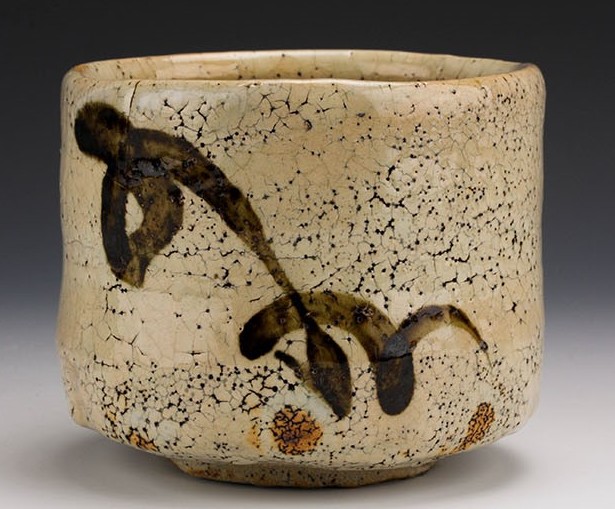
don't associate with specific individuals. In the case of this illustrated chawan
it would seem to be something of a rarity to see actual "decoration"
on the piece with a few fluid and spontaneous brush strokes of iron over this
kohiki style bowl of rather stoic and formal form.It is easy to see the potter, Tsukigata Nahiko
in the form and surface of this pot being a thick, heavily crackled kohiki surface
with an ash based glaze over the piece but what does stand out is the use of
brushed iron decoration on the front of the chawan. Though I have literally
thousands of images of various works by Tsukigata this is the first decorated
pot that I can remember seeing though as a talented calligrapher and painter,
there are a large number of calligraphic tiles done in Shino. Aside from the
tiles, there are a number of pottery pieces that have one form or another of
some calligraphic or abstract decoration in the slip prior to being glazed in
Shino or other glazes (https://albedo3studio.blogspot.com/2014/01/gone-forever.html )
but as I mentioned, this is the first example of actual brushwork that I can
think of. I'll go on record by saying that I am not exactly amazed to see this
piece in Tsukigata's body or work but I will admit to being just a tiny bit
surprised. "Expect nothing. Live frugally on surprise."
Alice Walker
I have an internet friend
that knowing my interest in wood fired pottery send me jpegs now and again that
he thinks may be of interest. The other day he sent a group and among them was
a handful of images of a rather animated Shigaraki haikaburi chawan by Kowari
Tetsuya. At first glance the form looks pretty straight forward defined by its
brief and concise nature but as you study it you see the naturalistic twist to
the form that set the piece in motion and is echoed in the lip and lower lines
of the pot, not quite as simple as first thought. The chawan is covered over in
a mostly drier natural ash surface with the face being punctuated not only by
areas of wad scars and a rich hi-iro but also by several ash drips and a series
of punctuated areas where the feldspar has melted out of the surface. I find
the bowl eminently practical with its straight sides and solid kodai but there
is a sense of wit and playfulness that makes the chawan just that much more
interesting. Admittedly, Kowari Tetsuya is one of those potters that I enjoy
how he handles the clay, molds it to fit his mind's eye and chooses a firing
style that best compliments the pot be they Kohiki, Shino, Oribe or Shigaraki,
each is chosen to bring out the most of the form and purpose of the pot. "Brevity is the soul of wit." William Shakespeare
This teabowl was part of a
recently fired group of similar pots where I was trying to figure out how each
glaze and glaze combination worked on this idea. This teabowl is glazed in my
saffron, iron yellow glaze, dipped once and where the glaze ran and pooled
around the horizontal projections it built up creating a darker area as well as
running over the edges with a neat effect reminding me of some glaze attributes
of Agano-Takatori wares. The translucent nature of the surface allows the way
the clay was dealt with while wet to show through which is a nice feature of this glaze making the
piece static, almost like it came directly off the wheelhead. I suspect the
next steps will be to see what slips look like over this faceting and under the
effects of the saffron surface hopefully creating another, distinct look.
The box is inscribed IGA STYLE CHAWAN but I think it is
quite easy to look at this piece and see that it has Iga written across the
entire surface. Made in Gifu Prefecture by Mizuno Takuzo, despite being a
traditional Mino potter, he created a wide array of distinct wood fired pots
that center around Mino-Iga and Iga style pottery. This Iga style chawan is a
typical example of Mizuno's unglazed, haikaburi style wood fired pieces that
despite being made miles away from Iga have many of the tell tale signs of that
distinct pottery excepting the clay body which is much more Mino in origin. The
face of this chawan has that medieval presence that I am very fond of that at
first glance defies its age with running ash giving way to the rough surface
underneath with areas of spatula work and other slight manipulation giving an
overall depth and sense of movement to the piece. The green ash highlights the
undulating lip and stoic form which balances very well with the exposed clay
color of the kodai. I can't help but think that this purposeful pot is an
honest combination of both style and substance all in the guise of a rather
forthright "Iga style" chawan.
I recently spent a little
time with this rather nice chaire by arguably, the father of modern Iga,
Tanimoto Kosei. The chaire is of a rather sturdy and classic medieval form with
a great surface which, like the Moon has a light side and a dark side. The area
facing away from the fire has a wonderful, green ash surface with areas of deep
pooled effects that add a sense of animation to the pot while the area that
faced the fire has a dark, almost ominous surface of dark greys and a shiny
black that masks much of the surface in shadows and mystery. I have seen quite
a few chaire by Tanimoto Kosei over the years and for me, it is a safe bet this
is among the finest I have seen showcasing a great form and even greater
surface to create an excellent Iga example. I took quite a few photos of this
chaire and put together a short video slideshow to give a sense of what this
Tanimoto Kosei Iga chaire offered in person, I hope this gives you the sense of the
pot.




.JPG)