Today
is one of those days, a day to get odds and ends done including acting as a
taxi service and dropping my wife off at the airport. As soon as I got home, I
started firing the kiln which has two large test bowls, 4 slip test small tiles
and a group of test pots included among the mix. As a last actual pottery
related chore, I glazed up a porcelain test bowl in a commercial glaze that
someone sent me as a gift and admittedly, I am curious what the results will
actually look like. Before glazing up the bowl, I contacted the manufacturer's
technical person and got a few suggestions as to how to use it as quite
frankly, I rarely use any commercial glazes and I guess this particular one is
a bit tricky. With actual clay related tasks out of the way, I
collected up and packed two small orders which includes a pair of cup and
saucers and a group of four matching temmoku and ash 8" bowls using
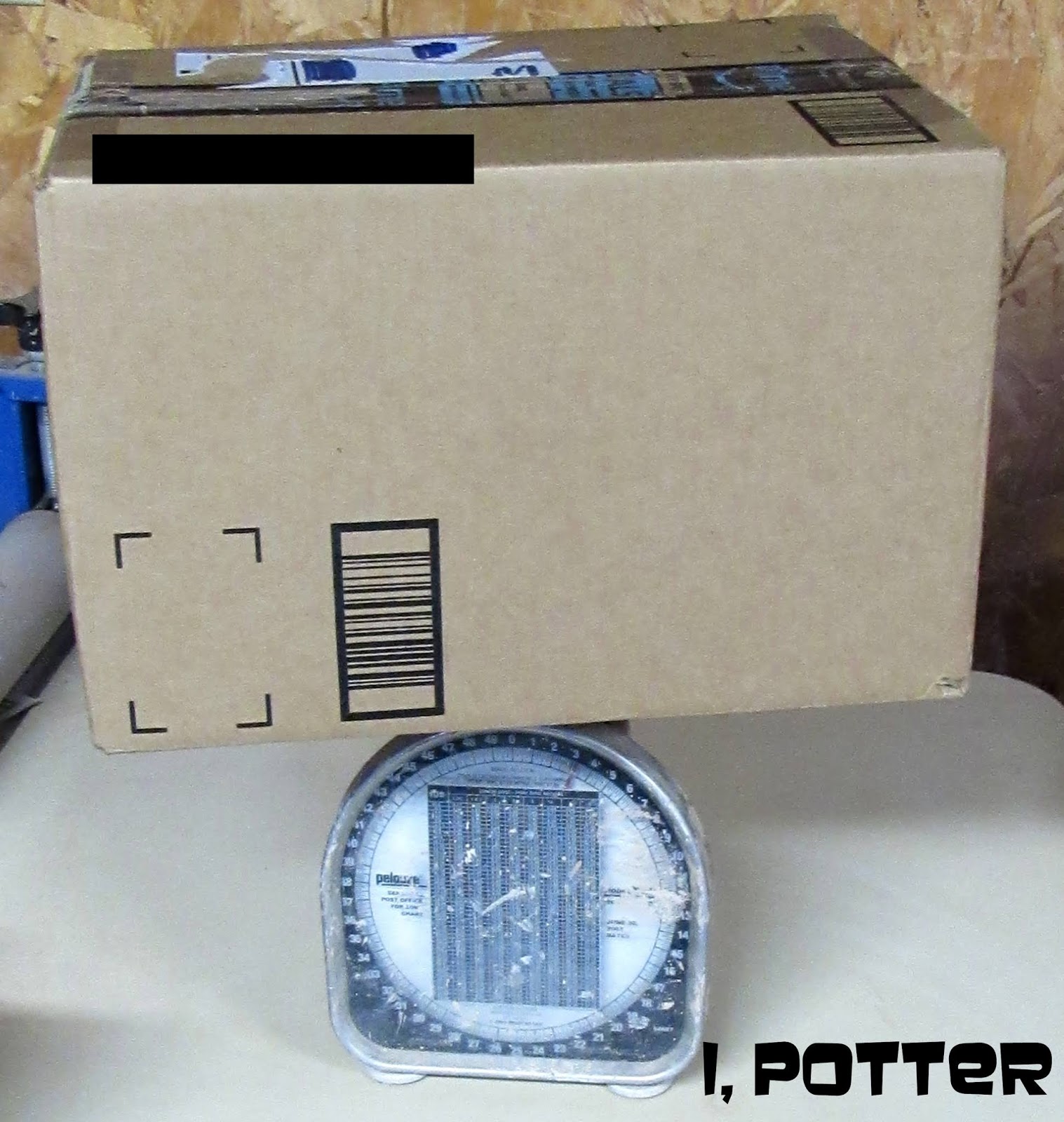
recycled or perhaps repurposed packing materials and boxes. As you can see the
slab roller and clay scale are pulling double duty to get the close to actual
shipping weight correct as the USPS is a bit touchy when it comes to any gross
miscalculations. Once all packed up, I set up and printed two labels and
scheduled a postal pick-up which makes tomorrow just a bit less busy. As you
can tell, today was one of those days of multi-tasking and completing some odds
and ends, all necessary and just part of my pottery week and what beats being
busy to make Monday just a bit easier to manage. Did I mention my wife is out of town? That means a week
of really bad, great cult movies!
Last
week I received an email asking me about the Kaneshige Kosuke piece known as
"Floating Object or Portrait" that I had put up on my blog that in
the photo somewhat resembles something out of an old horror or science fiction
movie. The emailer asked if I had taken any more "conservative" pictures
of the piece and of course I had, well over a hundred in fact. Illustrated is a
face on, overall photo of the sculptural piece that I think gives a rather
clear picture of the Bizen object for which Kaneshige is well known. The
surface has just the right firing to bring out the details and crisp cuts and
edges of the piece allowing all of the clay and texture to come front and
center which adds a bit of tension and even drama to the work. I hope this
portrait of the Portrait is what was asked for and maybe in the future I will
collect up the photos and put together a short video slideshow of what is
arguably a rather fine and thoughtful work by a modern mainstay of Bizen who is
known to have strayed outside the box now and again. You can see the
original post and photo by following the attached link; https://albedo3studio.blogspot.com/2019/04/plumbing-depths.html
A
while back I posted up a rather unorthodox Ki-Seto kabin by Tsukigata Nahiko
that was made around 1972 or so. As I mentioned in the blog, the surface
doesn't necessarily conjure up a text book definition of the style so I took a
picture out of the ONI-SHINO book, also circa 1972 to give a more classical
example of Ki-Seto which Tsukigata has termed, Oni-Ki-Seto. Despite the
creative moniker, this chawan certainly subscribes a bit more to the tradition
and it is clear in form and surface that this is clearly influenced by
historical archetypes and the works of his master, Arakawa Toyozo while there
is no denying that this bowl is distinctly the product of Tsukigata's creative
and fertile aesthetic. I love the power of the form and undulating lip and the
richness of the surface with areas of thicker, built up ash deposits and the
emphasis on the verticality of the chawan written in the streaking, running
glaze. I really like this chawan for the blend of simple and complex and should
we ever meet, I hope it is neither bashful nor offended by PDA*. (*
Pottery Displays of Affection)
Having
a few minutes the other day, I went ahead and made another kotsuzumi influenced
koro and admittedly it doesn't pay to just make one piece when trying out a new
idea. The construction of the piece was just like the previous one but I
altered the proportions a little to get a slightly different form which
includes four pierced squares in the knob to mimic the pierced and impressed
devices around the piece. Destined for my Oribe glaze with a wash over the surface
I am looking forward to seeing what this looks like finished and how the
glaze/wash combo responds to the sloping surfaces. As before, I will certainly
not count my chickens before the eggs are hatched but if this makes it and no clumsy
kiln loaders or unloaders get handsy than I will post a picture of the finished
pot when it (fingers crossed) makes it across the finish
line. "The place where optimism most flourishes is in the lunatic
asylum*." Havelock Ellis (* Sometimes known as a pottery studio.)
A
while back I posted a sunlit photo of a Shino mallet vase by Nakajima Ichiyo
and I finally got around to building a slideshow video of the vase. As you can
see the extremely simple form but good, classic proportions are a perfect foil
for the iron slip, Shino glaze and all natural ash effects created during the wood
firing that the piece stood up to. Admittedly this surface and indeed this pot
stand out among Nakajima's works from those others that I have encountered and
seen, the pot was subjected to a wonderful array of effects during the firing
process that make this pot stand out among the potter's body of work. The
degree of complication to what is honestly a simple addition of ash to the
glazed pot is presumably the best one can hope for where serendipity and
experience collide. I hope this short video slideshow gives the fuller
story of what this pot looks like in person and you can see the original post
where this Nakajima mallet vase is basking in the Sun by following this link;https://albedo3studio.blogspot.com/2019/10/sunshine-on-my-shoulder.html
The
end of the year always seems a chaotic time in the studio, rushed drying, decorating
and firing and in the aftermath is usually a total wreck. I went down in
the studio this weekend, my first time in almost a week to get a bisque kiln
loaded and get things straightened up and put away to find my 20+ year old
clock had met its demise and a single, solitary glazed teabowl on slab roller,
a staging point for finished pieces to get loaded in to the kiln. Sitting there
alone, I had tried every trick in the book to get it in to the last kiln but no
amount of rearranging or space sorcery was going to get the job done. Sitting
idle, waiting to be fired, this teabowl is next to the bowl I use to collect
excess glaze cleaned off the foot ring and despite appearances, there are
actually three glazes on this bowl, two very, very thin layers and a thicker
Oribe base glaze. Every now and again, I collect up all the contents of the
bowl and mix it thoroughly in to a wet glaze and test it out of which several
have worked out to make very cool accent glazes though never repeatable and
only in batches of 1000 to 2000grams one of which I used on an earlier version
of my Oribe until it was fully depleted. Now that the bisque kiln is loaded, a tiny
bit loose I should add, this glazed teabowl should fit in the next glaze firing and
not find itself alone again, naturally or otherwise.
Illustrated
is a vivid gosu tabi-chawan with a classic floral motif decorated on the front
and back of the bowl by Kawai Takeichi. Besides being a rather nice piece and
certainly a quintessential Takeichi pot, this particular piece has an
interesting, at least to my wife and I, back story. This piece is the first
Japanese pot we bought off the internet in 1998, a piece we spotted on a
Japanese website and decided to try emailing the dealer with what seemed like
no success at the time. The email I sent to this dealer was in English with a
few cobbled together Japanese written phrases but hours turned to days which in
turn grew into months. Then one day, out of the blue and almost three months
after our email inquiry we received an invoice email from the dealer for under
$90 shipped at the time we were instructed to pay using an International Postal
Money Order (IPMO) which we had to track down and order at our local Post
Office. After a week we received the IPMO, mailed it off to the dealer in Japan and about six
days later we received an email from the dealer letting us know the pot was
shipped by EMS and here was the tracking info. It was obvious that the dealer
had used some sort of translation program as the English was not great though
far better than my Japanese and here is what really stuck out from the email,
it ended with this cryptic phrase and I quote; "never push an
alligator" as did nearly all of his emails for the next several years. You
always tend to remember those firsts but I will admit, I doubt I will ever forget
that phrase and will forever wonder, what exactly does it mean, I am hoping it
was intended as some sage advice or practical wisdom as I can image the outcome
involving said alligator being somewhat less than positive.
We
wanted to take a moment to wish all a very Happy Holiday and Season's Greetings
from this end of the computer keyboard, including Khan who has dictated this
message this year as his lack of opposable thumbs makes typing something of a chore.
I found this photo on the web a number of years ago, it
may have been taken by Tsukigata Akihiko, son of Nahiko though I am not exactly
sure. Despite being a bit blurry and it does not exactly enlarge very well it
is clear exactly what you are looking at, quality control at a very human
level. The photo clearly shows Tsukigata Nahiko breaking up a serving bowl
while seated in front of a growing pile of shards with several larger pots
behind an iron kettle hanging from a jizai-kagi. Like every potter who goes
through this process of deciding what pots should be broken, it is clear by
Tsukigata's expression that this is a painful process seeing pots that came
from nothing but a lump of clay and then were nursed through the throwing,
bisque, glazing and firing process meeting the hammer. What I can say about
this process from my own personal experience is that though there is nothing
positive about this other than making sure the wrong pots don't get out, this is an absolutely necessary part of the process and I have broken
more pots then I care to remember. I suspect the exact same sentiment, that of
anguish and acceptance is most likely the case of what was going through the
mind of Tsukigata Nahiko as the sound of the hammer on ceramic shattered the
otherwise peaceful tranquility of the studio.