Monday, March 5, 2018
B&A II
A couple of firings ago, I made a series of small slipped
and combed covered jars in amber, Oribe and Ao+ glazes and when seaching for
some photos I noticed I had a before and after photo of the same jar showing it
from a nearly identical perspective so I decided to post it up. The before
photo shows the jar having been slipped, combed and only recently carved on the
shoulder and lid and the after photo is rather self-explanitory. These jars
were quickly slipped and combed and the carving was also done rather quickly
trying to give the piece a rather casual and natural feel and then once glazed,
the Ao+ filled in all the nooks and crannies creating a nice contrasting depth
of color to the overall appearance. I like making covered pots, it allows me to
fit together two seperate pieces as well as wondering what will this jar or the
others from the series will be used for?
Friday, March 2, 2018
TANPAN
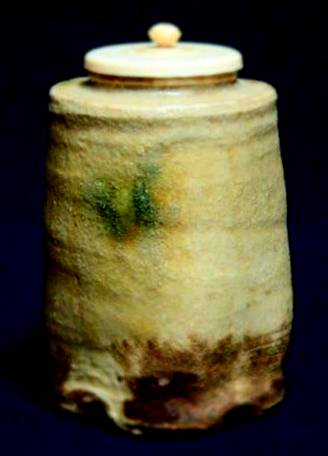
Arguably one of the finest Ki-Seto potters of the
20th century, Kagami Shukai (1941-2009) created this little gem of a chaire in
his thoughful and classical style. This simple form with natural throwing marks
and taunt shoulder is covered in Kagami's unique Ki-Seto glaze with tanpan
(tanban, tampan), copper splashes on the on the face and back and a slight amount of koge, scorching around
the bottom third of the piece making this an ideal and crucial part of the tea
ceremony. Though seemingly simple in its creation, this chaire is the pinnacle of
the art and the result of years of practice and in depth research not only
honing his craft but also understanding the historical glaze and forms he
pursued; in fact his research into Mino pottery extended to archeological digs
and kiln and shard excavations to further his knowledge of the history, clay,
glazes and manufacture of Shino, Oribe, Seto-Guro and Ki-Seto in the region.
There is little else I can actually say about this wonderful little pot other
than stating the obvious, big things do come in small packages and in this
case it also packs a tremendous punch on nearly every level.
Labels:
chaire,
chanoyu,
kagami shukai,
ki-seto,
momoyama
Wednesday, February 28, 2018
THE OLD STYLE
This jpeg is another image I have had on my computer
for quite some time and every time I look at it, it feels as if I am looking
back in time. Made by Nakagawa Jinenbo (1953-2011), this Karatsu style kohiki
mizusashi looks like it was made much earlier then in actuallity being a
product of the Heisei era. The casual faceted form has a timeless, weathered,
cracked surface that appears much more feudal than modern and shows a great dedication
to Ko-Karatsu which Nakagawa specialized in making pots in a wide variety of
the old styles using traditional methods, clays, glazes and kiln firing. I have
seen a wide array of pottery by Nakagawa in Japan and over the years and I am
particularly draw to his kohiki style which shows such inspired subtlties and
are the epitome of casual in their creation. It is a great tragedy that such a
gifted potter left at such an early age, one can only wonder what great pots he
would have left behind beyond those already made and fired in his unique and
old style way.
Monday, February 26, 2018
STRETCHED OUT
For a while now I have been making up my own higher
iron clay body which throws rather well and looks nice when fired but I began to
discover that it has its limitations in regards to man-handling it. The more I
push, shove, fold and alter, the more it was just not happy with the process so
I set about altering the formula a bit and here is the latest incarnation. I
will start off by saying that there is not a lot of large particles in the mix
and I don't use grog, but this test seems to respond well to be folded,
altered, pushed, pulled and stretched out. The illustrated bowl was thrown
round with a slight waist and then it was folded up to an oval form and then I carefully
stretched out the clay above and below the waist to create a bowl almost twice
as wide as it was when it was thrown. As you can see, once tooled I applied a
thick slip that I combed above and below the waist and am now keeping my
fingers crossed that it doesn't collapse before it dries enough to be stable.
Provided it makes it through the bisque and glaze firing, I will post up the
finished piece and conclude the newest clay body will allow me more latitude
when working with it, after all, a potter has to know his clay's limitations.
Friday, February 23, 2018
A BEAUTIFUL FRIENDSHIP
I recently received an email asking if I could show
an overall photo of the large Matsuzaki Ken Shino tsubo that I posted in a post
entittled; PERSPECTIVE. When possible, I try to be accomidating and since I
took a large number of photos of this piece and have not built a slideshow
video of the pot, this photo will have to suffice for the time being. As I
pointed out in the original post, I was just not prepared for the actual scale
and volume of the piece as it is quite large and certainly commands the space
it is in and that is around it as well, a pot like this is a lot like a
beautiful friendship. Along with the sheer presence of it being a large pot,
the form is sturdy and solid with a surface that has just about everything you
can imagine from the thick whipped cream like Shino, subtle iridescence here and
there, rich yohen and ash coating the pot forming areas of beautiful glass
across the piece. I have to admit, it was an impressive piece and spent way to
short a time here but none the less it has left an indelible mark on my mind's
eye and will be hard to forget as time goes by*.
(*Sorry, I couldn't resist, not one but two
CASABLANCA references. How often do you see that in a pottery blog post?)
Wednesday, February 21, 2018
BOTAMOCHI
On my first trip to Japan, I was fortunate to
encounter a wonderful exhibition showcasing primarily chadogu made by Kaneshige Michiaki, eldest son of Kaneshige Toyo. There was a wide variety of
pieces and surfaces each complimenting his forms and I distinctly remember a
very fine chaire that had been fired on its side, botamochi style very much
like this illustrated piece. The chaire was placed on a pad which then acts as
a "resist", keeping ash from building up on the surface and thus
creating this rather vivid area ringed by various attempts of the ferocity of
the kiln to paint the masked area, the results can be quite wonderful as seen
on this diminutive little giant. Back in the early 1990s there was a wonderful
series of videos which high lighted 90 of Japan's finest teaware makers, GENDAI
(no) Chato. Of the twelve vidoes, all but three featured 10 to 12 potters
however Kaneshige Michiaki was in one of only three videos which feaured just
three potters attesting to his standing in regards to making chadogu. This
chaire has everything you would want from rich surface to engaging and enticing
form obviously crafted by a master potter at the height of his skill; a
classic pot by a classic potter, Kaneshige Michiaki.
Monday, February 19, 2018
T&A V
I have mentioned previously that after my first trip to Japan, I became interested in bells as a form more than as the functional object. If you look at bells from ancient China and medieval Japan, the forms, decoration and construction of these objects is wonderful with such a wide variety all created for the nearly exactly the same purpose. Using the dotaku bell form as a starting point, I like making these thrown and altered pieces and in this case, a simple piece with an incised grasses pattern under my rich lepidolite Oribe. In making this piece, I tried to keep the lines crisp, forming graduated angles and then added lugs to either side of the pot and a thrown neck/mouth to complete the pot. Due to my shortage of materials, the glaze was sparingly and carefully brushed on to the piece once bisque with areas receiving a secondary coat around the shoulder, neck and mouth. I thought this pot came out rather well and that was the sole reason that I found the pot lepidolite worthy, as the matrial runs out I will have to be more and more selective as to where it should be used and in the mean time, the testing to get a closer version of this glaze moves ever forward.
Labels:
dotaku,
henko,
lepidolite,
t&a,
the bells of st. Mary's
Friday, February 16, 2018
AN INVITATION TO TEA
A long while back I wrote about an early 17th
century Shigaraki chawan that belongs to the Cleveland Museum of Art and
recently I found a photo of a chawan that though rather modern, has many of the
same attributes of the original from form, posture and overall presence. This
chawan is by Furutani Michio, made in the 1990s and has the very same attitude
as if extending an invitation to tea. This is a simple bowl, high sided with
casual but not overly emphasized throwing marks with a slight flair as the bowl
progresses to the lip. I imagine it is a rather tactile bowl with the areas of
peppered ash creating a familiar and active sensation. Though these two bowls
were created centuries apart, it is obvious the Furutani Michio considered the
exact same functional and aesthetic sensibilities as the 17th potter; how does
the chawan feel in the hand, considering the weight, circumference, the lip,
the tea pool and the appearance; basically, how do you make a chawan that
appeals to all of the senses. Though if you were to put the CMA chawan and this
one by Furutani Michio side by side, there are obvious differences but it is
the similarities that ties the old to the new and after all, that is the best
that a potter steeped in tradition can ever hope to do.
Labels:
chawan,
cleveland museum of art,
Furutani Michio,
shigaraki
Wednesday, February 14, 2018
GAMA-YOHEN
This
chawan showed up the other day and I took a group of photos and made this
slideshow video to show off the surface which is a bit unusual. Made by a
classic Showa potter, Ichikawa Kodo, this gama-yohen chawan shows a wide
variety of textures and colors with wonderful iridescence and copper flashes
across the bowl. I don't know a lot about the potter other than he specialized
in this gama-yohen as well as Shino and Oribe pottery. I think what makes this
bowl appealing is the unique surface, pratical size and form and its dedication
to function, I hope the video gives off that sense as well.
You can see more of this chawan over on my Trocadero marketplace;
https://www.trocadero.com/stores/albedo3studio/items/1374753/GAMA-YOHEN-CHAWAN-BY-ICHIKAWA-KODO
You can see more of this chawan over on my Trocadero marketplace;
https://www.trocadero.com/stores/albedo3studio/items/1374753/GAMA-YOHEN-CHAWAN-BY-ICHIKAWA-KODO
Monday, February 12, 2018
GOLDEN BROWN
I was throwing a couple weeks back and had some
extra clay left over from throwing off the hump so I threw a couple of high
sided teabowls. Once thrown, the question was what to do with them and since I
had some black and white slips looking me in the face, I decided to make two
quick mishima style inlay pieces. This one was carved with a real uneven
herringbone style texture and then had white and black slip inlaid before it
was carved off, the other one was done in just white slip inlay. I used my
saffron style glaze over this piece and then added a wash of iron to deepen the
color to a rich,golden brown. The other bowl was glazed in Oribe and though the
inlay is a bit harder to see, it makes still makes for an interesting texture.
Subscribe to:
Posts (Atom)